
It’s typical for roguelikes to be informationally dense video games. Discovering how their many mechanics interlock for yourself can be part of the fun, but sometimes players need a nudge in the right direction. Here’s a handful of different things I’ve learned across my playtime with Against the Storm, which I hope will aid newer players as they embark on their journey through the wilderness around the Smoldering City.
1. Anchor Everything Around Your Warehouses
There’s something you need to understand about Against the Storm: every one of your settlers moves around in real-time. This means that one of the game’s primary challenges is designing your settlement in such a way where everything flows efficiently. This becomes especially apparent as players rise through Against the Storm’s many difficulty levels, which decrease the room for error.
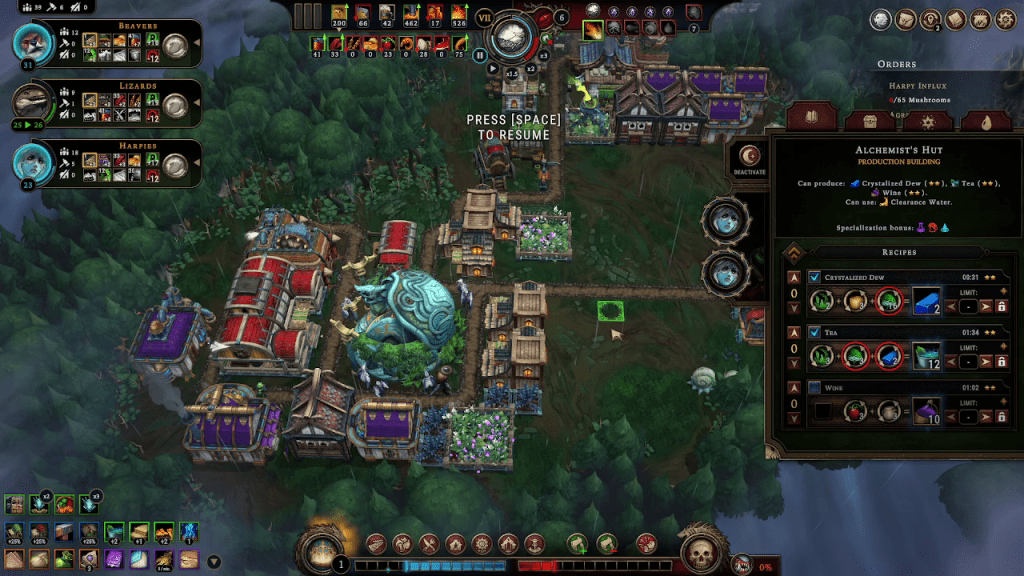
To that end, I’d recommend making liberal use of Small Warehouses, and building the bulk of your settlement’s industry around them, or the Main Warehouse. This is especially true for remote resource nodes that are located exceedingly far away from your Main Warehouse. You’ll lose so much time if a settler has to leg it halfway across the map every time they need to drop off a resource bundle. By building around either your Small Warehouses, or your Main Warehouse, your settlers will spend more time on the tasks you’ve assigned them to, instead of running a marathon around your settlement.
Speaking of running across the map…
2. Build Multiple Hearths
Did you know that every settler takes their break at the closest Hearth?
As with Warehouses, it’s important to have multiple Hearths because it can help to eliminate bottlenecks in your production cycle. Every settler needs to take a break every 2-ish minutes. When this happens, they’ll walk to the nearest Hearth to enjoy some food. As you can imagine, the further they have to walk to get to a Hearth, the longer they’ll be on their break for. As such, giving them a nearby place to rest can prove effective for increasing the output of goods across your settlement.
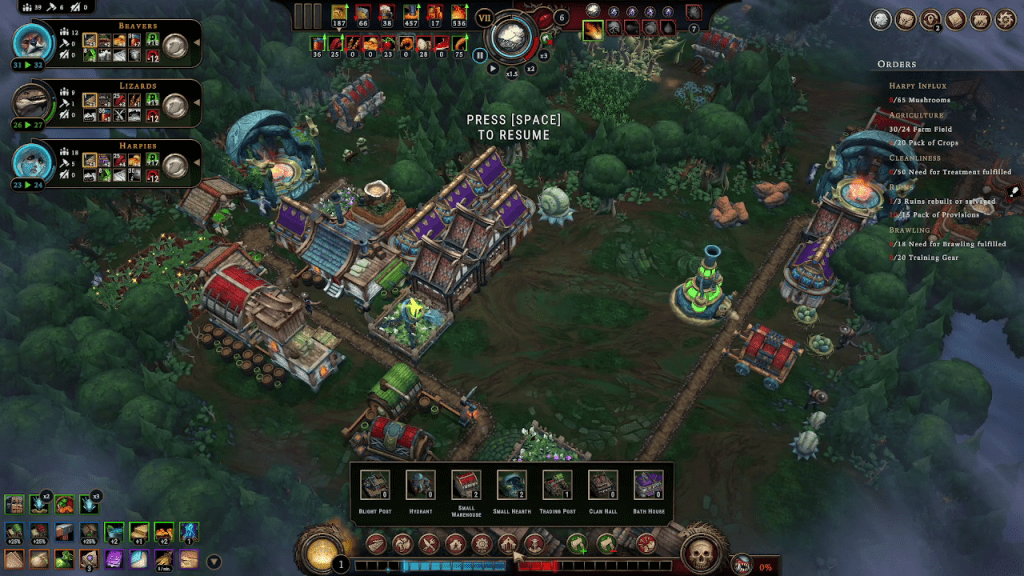
It’s also worth noting that Hearth bonuses stack, which provides an extra incentive for creating several of them. It isn’t much, but having a handful of upgraded Hearths throughout your settlement will boost global resolve, and production speed.
3. Use Crafting Limits to Reduce Micromanaging
Question: have you ever tabbed through your resources mid-game and found you have 150 pieces of lumber? I have. I forgot I left 2 Beavers working on plank production in a Lumber Mill, and suddenly found myself with more lumber than I knew what to do with. This sucked as I really needed that wood for crafting other goods.
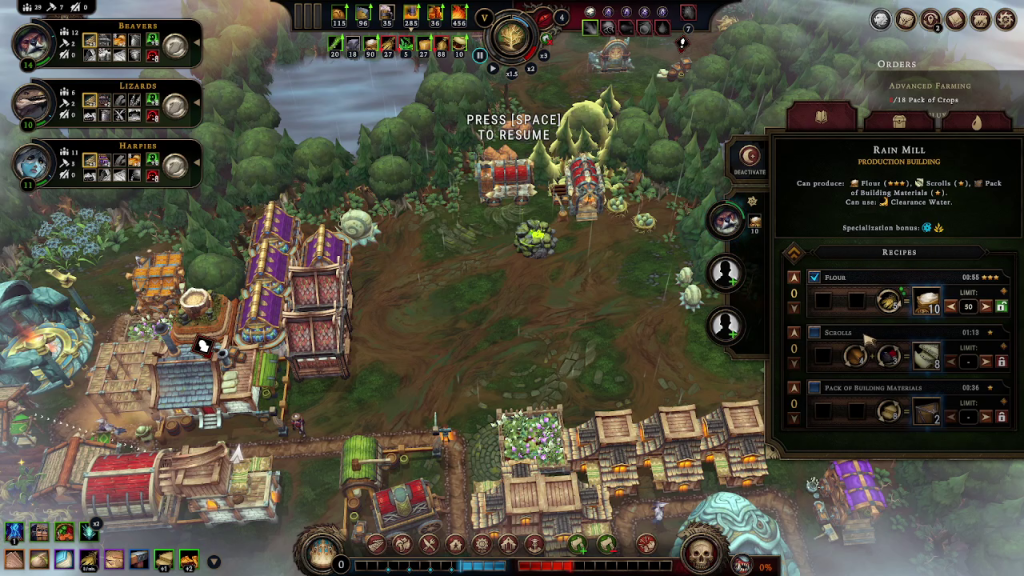
I could have avoided this entire predicament if I’d simply set limits on production, which I’d wholeheartedly recommend every player adopt. It can be fairly trivial to micromanage a smaller settlement, but once you’re looking at 30-40 villagers, it can become quite difficult to keep track of everything. Limits simply allow players to set a cap on how many goods can be created, so raw resources aren’t needlessly wasted.
4. Having More Settlers Isn’t Always a Good Thing
It can be tempting to expand rapidly in the early stages of your settlement, but having additional settlers isn’t always a positive in Against the Storm. Additional settlers will put increased strain on your food, and service consumption which makes maintaining High Resolve bonuses a lot more challenging.
Additionally, the more settlers you have, the higher your Hostility rating. This can make surviving the Storm season incredibly difficult if you have a disproportionate number of villagers compared to what you’re currently able to provide for. As such, taking on additional villagers should be a decision that players consider carefully, instead of something they opt into without thought.
5. Recycle Unused Buildings
This one is fairly straightforward: if you’re not using something, then you should destroy it. Doing so will reimburse the player for the material cost of said building. This is also true for any decorative items that you may find on the map. This will prove to be hugely beneficial as getting additional Parts (the resource with a gear icon) can be somewhat challenging, so it’s important to stretch your limited supply as far as you can.

However, it is worth noting that if you’re playing on a map with the Corrosive Torrent modifier then you will not be refunded for building materials. This is the one, and only time that players shouldn’t recycle unused buildings to shuffle their resources around.
6. Assign the Correct Number of Farmers to Work Your Fields
Food production is one of the most important facets of running a successful settlement in Against the Storm. However, keen eyed players will notice that villagers assigned to farming won’t always have enough time to harvest the crops they’re tending. There are passive buffs that can increase harvesting speed, but in lieu of those it’s generally best to assign 1 farmer for every 5 tiles of fertile soil that is being tended. As long as you’ve got a Small Warehouse nearby, this ratio of farmers to fertile ground should yield the maximum possible output every season.
7. Attack the Trader if You’re Struggling to Manage Hostility
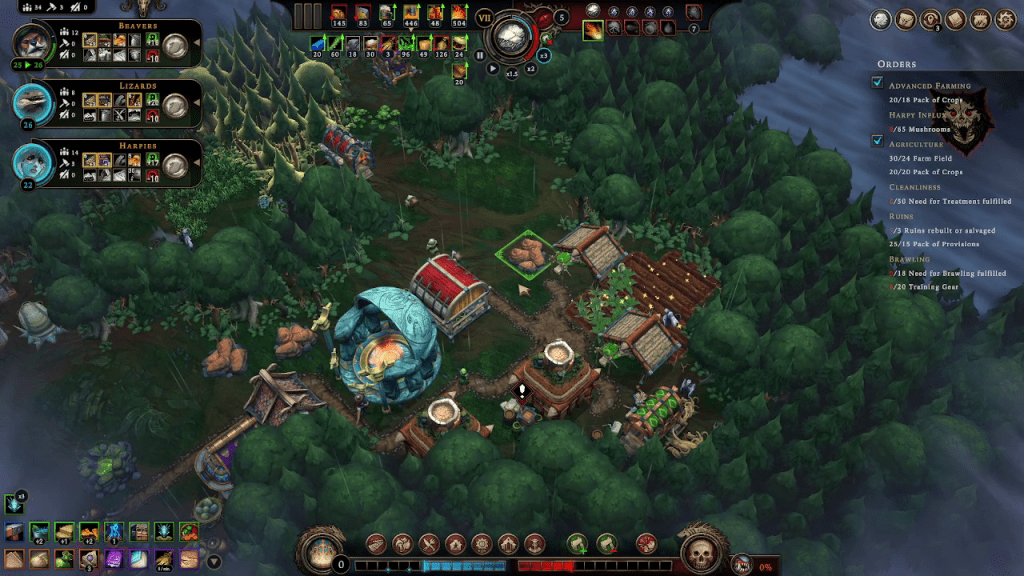
Attacking the Trader might seem like an unintuitive solution to dealing with a high Hostility level, but stick with me. Every level of the Queen’s Impatience that has been accumulated lowers Hostility. If you use the command to immediately call a Trader to your village, that’ll hit you with a 0.5 Impatience penalty, which doubles every subsequent time you call the Trader. Then you can attack the Trader for free supplies, and several additional points of Impatience. Obviously this is risky if you’ve already got a high Impatience level, but if you’re sitting on 5 or less Impatience then attacking the Trader can prove to be a really efficient way to lower your Hostility level before the Storm season.

8. Perform Ancient Seal Missions on the Lowest Mandatory Difficulty
I’m personally not a huge fan of the Ancient Seal missions, but they are how players progress the limited story in Against the Storm. To that end, don’t make the same mistake I did by playing Seal missions above the lowest required difficulty. The difficulty of the mission is scaled to the difficulty you select before embarking. This means that you can unintentionally make the Bronze Seal, which is supposed to be the easiest, harder than the subsequent Lead Seal, and Silver Seal if you attempt it on Viceroy difficulty. Don’t do that – there’s no special rewards for accidentally throwing yourself into the deep end.
I think that wraps up all of the gameplay tips I wanted to share for Against the Storm. There’s so many small things that end up making a world of difference, but they aren’t always super obvious. Regardless, I hope some, or all, of this advice was useful for new players that are struggling to break through the initial wall of challenge that Against the Storm throws at you.
Did you enjoy what you read? Consider supporting my work by buying me a coffee over on Ko-fi.
 Frostilyte Writes