I’m aware that this isn’t a particularly topical game to be writing about in 2025, but I’ve been playing Mini Motorways over the past several weeks. As such, I wanted to record my notes on the game so that they may exist in a place that is far easier for me to search. Plus, if this helps some other folks out in their pursuit of various Steam achievements (for example, obtaining all of the 2000 trips achievements) that’ll be even better.
Restart Early
There’s no getting around it: Mini Motorways is a luck based game. The only difference between easily soaring past 3000 trips, and struggling to break through 1500 can quite literally be decided by your first 10 minutes on a map. A very clean start will set you up for success, and give you fewer problems to work around in the early game. Ergo, if you think that your starting spawns are a little too messy then it’s probably better to restart the map, instead of wasting up to an hour only to fail just short of 2000 trips.
What actually constitutes a bad start though? That kind of depends, but here are some things to look for:
- You’re forced to use a bridge/tunnel with fewer than 4 destinations on the map
- There’s no way to easily keep different colours completely segregated during the first 2-4 weeks of in-game time
- You’re reactively responding to every problem within the first 2-4 weeks
As you play more, you’ll get a better feel for when you’ve got a bunk start, but hopefully that helps to get you started. I typically try to think about how quickly I can respond to problems as my litmus test for if I should stick with a map, or reroll it. If I’m constantly waiting for Sunday to finish, so I can get the perfect piece to fix a problem then I’ll usually reroll. Ideally, you want to feel like you’re a step ahead of the game, instead of constantly responding to problems several days after they occur. When you find that you’re fighting on the backfoot too often, that’s when it’s time to call it quits.
Regardless, it’s better to throw in the towel after you’ve only wasted 10 minutes, instead of an hour.
Keep Colours Segregated
I have to imagine that the folks at Dinosaur Polo Club were hoping that people would design proper roadway systems in Mini Motorways. Unfortunately, if you’re chasing higher scores then you need to throw proper roadway design to the birds. It’s way easier to reduce traffic congestion, and score points more quickly by keeping each colour completely segregated from every other colour.
This is easier to describe with a picture so here’s what I mean:
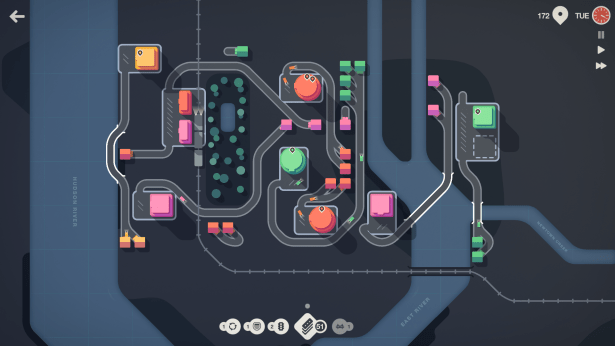
If at all possible, you should also keep each destination separated even if they’re the same colour. This will give you more control over the flow of traffic that arrives at each destination. It also helps to reduce the number of intersections that appear within your road system.
Speaking of intersections…
Avoid Creating Intersections
Cars will always slow down at intersections in Mini Motorways. This will increase the time it takes for a car to finish a trip. While this won’t typically matter when there are only 2 cars on a road, the slowing effect of intersections increases exponentially as more cars travel on a particular road. This can quickly snowball, and causes trips to accumulate faster than your cars can clear them out because your main road has too many intersections that are holding up the flow of traffic.
Now, you may be thinking: that’s impossible. I need to have intersections so that I can get all of the necessary traffic to a destination.
Fair enough. But there are a few tricks that you can exploit to reduce the slowing effect of intersections in Mini Motorways:
Driveways Don’t Count as Roads
Yes – the little stretch of road that connects a house to another road doesn’t actually count as a road tile. What this means in practice is that the game won’t recognize any intersection between a road tile and a driveway as an actual intersection, which bypasses the speed penalty that cars normally experience at intersections. This makes it possible to connect several houses to a single road that the game will think of as being straight which keeps cars moving efficiently throughout your city.
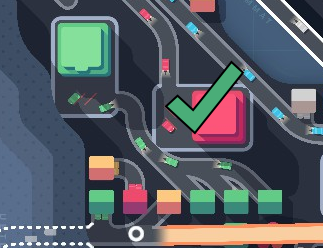
This is also true for the driveways that lead into destinations, though you should have your different destinations act as the end of a given road, so that information isn’t as immediately useful to us.
Don’t Connect Every Single House
I find that the biggest contributor to new intersections is trying to link together several houses into a single subdivision. However, consider that you don’t actually need to connect every building up to an existing road. Fact is, the demand for most destinations can be handled by a very small number of houses, which means that there isn’t always a reason to connect new houses to your existing roadways. This can prevent you from adding unneeded intersections into your roadways, and helps to keep travel time down for the existing cars that are already using those roads.
If you’re curious, the magic numbers for each destination type is as follows:
Train Station: 1 house
Square Destinations: 2 houses
Circle Destinations: 3-4 houses
It’s important to keep in mind that demand does increase for every destination type the further into a level you get. Once Mini Motorways can’t place a new destination, it’ll instead increase the demand for one of your existing destinations. When this happens, you’ll need to start adding additional houses beyond what I’ve recommended to keep things running smoothly.
In addition, if a car has to travel more than 12-15 road tiles then you might want to add an additional house to my recommendations. Longer travel times require more cars to cycle through the trips otherwise they’ll accumulate too quickly for the limited number of cars that you have serving a particular building. By that same logic, you can reduce the number of houses for shorter (less than 5 road tiles) trips.
Use Diagonal Roads
I feel like this is probably the first trick that most players are going to teach themselves, but it bears mentioning here: use diagonal roads whenever possible. The way that Mini Motorways is coded appears to cause cars to slow down whenever they have to take sharp turns (90 degree angles). If you can turn the cars without sharp angles then they’ll complete trips faster even if they have to travel on a few more road tiles. Ergo, using diagonal roads can help to keep traffic moving more efficiently.
Also, using diagonal roads can save you road tiles in the early game when you won’t always have enough tiles lying around to build completely segregated road networks. However, this becomes less of a problem in the mid to late game since you’ll likely have more road tiles than you know what to do with by that point.
Don’t Connect Motorways Directly to Houses or Destinations
I know that it may be tempting to hook motorways directly into the driveway for a destination, but I’ve found that this typically leads to high traffic congestion. Instead, you’ll want to place a few road tiles that lead directly into the destination’s entrance. This gives cars a few tiles of road to alleviate any congestion problems instead of turning the destination’s parking lot into a swamp of cars.
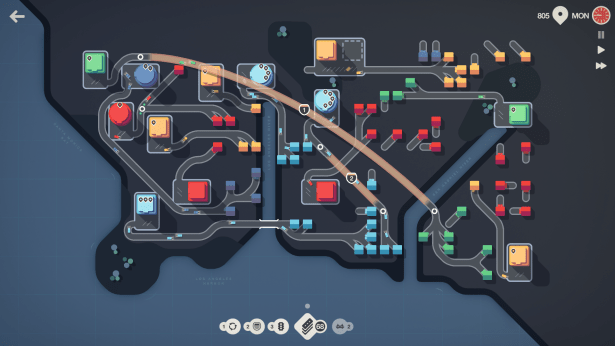
The same logic is also true in reverse – you want a few tiles for your cars to leave houses otherwise you might find that your housing area is overly congested with traffic.
I couldn’t tell you exactly why this behaviour happens, but it does. Having a few road tiles helps to keep everything nice, and evenly distributed.
Have Separate Feeder Roads for Duo Destinations
I’m going to be perfectly honest here: I don’t know why this works so well, but it does. Having 2 separate flows of traffic, 1 for each destination colour, seems to work a lot better than having mixed housing groups that file into a duo destination from a shared road. Perhaps it has something to do with how Mini Motorways handles road congestion? I dunno.
What I do know, is that having 2 separate feeder roads for a duo destination seems to keep them from becoming overwhelmed with trips.
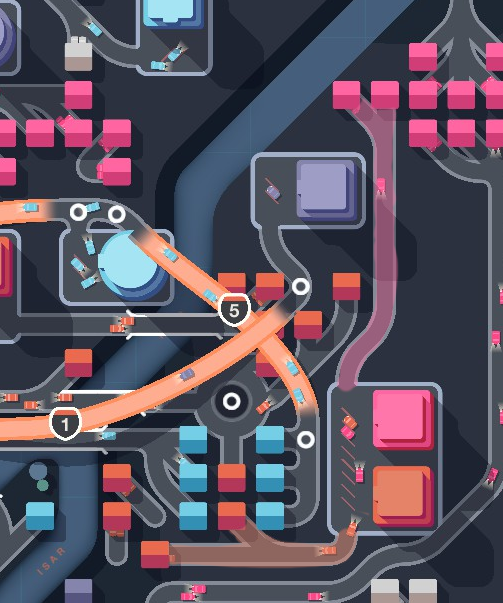
Also, it doesn’t seem to matter which side of the lot you connect the road to. Cars will park on either side of the parking lot regardless of where the destination is located to collect a trip. As such, you should aim to connect in a colour in whatever way uses the fewest road tiles. This will ensure that more trips can happen in a shorter period of time, so the destination won’t become backed up (until the endgame when demand starts to increase across the board).
How Do I Use Roundabouts and Traffic Lights?
I didn’t have a clever way to re-frame this as a tip. Instead, here’s a brief breakdown on how Roundabouts, and Traffic Lights work in Mini Motorways.
Roundabouts: keeps traffic moving at a steady pace. Ideally used when you need 2 colours to intersect so that both colours are able to continue moving quickly to, and from their respective destinations. This will always be slower than having a direct road without an intersection, but Roundabouts have a minimal slowing effect when compared to vanilla intersections. Ergo, use them whenever you’re going to be stuck with an unavoidable intersection.
Traffic Lights: completely removes the speed penalty at intersections when the lights are green. Stops traffic completely when lights are red. Will alternate based on demand.
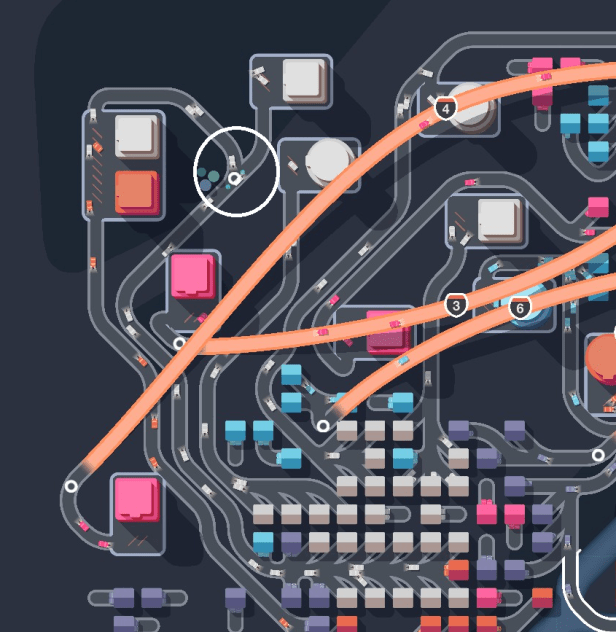
Ideally, you want to use traffic lights when you’ve created a 3 way intersection by merging 2 subdivisions of houses together for a single destination. This will minimize the speed penalty of intersections, especially once you have higher volumes of traffic moving along the road to a given destination.
Roundabouts Aren’t Terribly Efficient in the Late-Game
Contrary to how they work in the real world, Roundabouts don’t actually keep traffic moving that efficiently in Mini Motorways. They’re excellent additions in the early game when you need to intersect 2 different colours of traffic. However, Roundabouts can’t handle high volumes of car traffic, and will slow your traffic to a crawl once demand starts to ramp up for every destination in the mid to late game. As such, you’ll want to remove them if you can.
This is genuinely baffling since this is exactly the problem that Roundabouts were created to solve in real world traffic, but Mini Motorways is coded in such a way where Roundabouts become much less efficient when too much traffic travels through them.
It’s also worth mentioning that Roundabouts are a lot harder to place once you hit the late-game as you’ll have less space for them. You don’t have much control over where, and when houses will spawn, so this also causes Roundabouts to drop off in usefulness the further into a level that you get.
Be Proactive, Not Reactive
How many times have we heard advice like this before? Well it holds true in Mini Motorways as well. If you’re constantly responding to problems reactively then you’ll quickly fall behind, and be overwhelmed. Speaking from experience, it’s very easy for setbacks to cascade into one another, and completely demolish a run of Mini Motorways.
As such, you’ll want to get ahead of any potential problems. Remember to regularly pause to assess what your traffic levels look like, and try to work out if you need additional houses, or a more efficient path to a particular destination. A lot of trips accumulating at a particular destination could be a sign that you need to intervene.
I’d caution you against completely redesigning your entire city though. Certain updates to your roadways can be worthwhile long term investments, but you won’t get any of your building materials back until every single car has returned (unless there is an alternative route that they can take home. This can cause a backlog of trips at a particular destination, and completely ruin an otherwise well played run.
I guess what I’m saying is that if you’re at or over 1500 total trips, you’re probably stuck with everything you’ve already got in place. Radical changes at this point can, and will kill your run. It’s better to just ride it out, and pray you hit the 2k threshold for those Steam Achievements.
Don’t Be Afraid to Break the Rules
I know I just spent the last 2000 words telling you all sorts of ways that I’ve found success playing Mini Motorways, but don’t be afraid to throw that out the window when it isn’t working. While I try to follow all of the advice I’ve outlined above whenever I’m playing, there are times when you simply can’t do everything perfectly. Ideally, I’d be doing everything I’ve outlined above, but there are so many tiny complications that sprout up throughout a level of Mini Motorways that I’m constantly having to make concessions.
That’s all to say: don’t feel bad if/when you need to break away from my advice. Some times it is better to do something that is sub-optimal, but which continues to allow you to keep moving forward instead of restarting as soon as the game throws a curve ball at you.
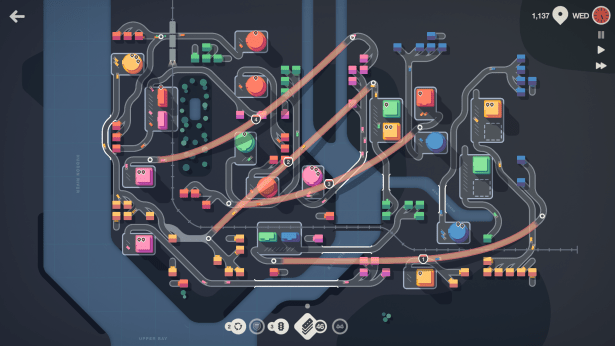
Heck, here are a few examples of the absolute messes I’ve come up with on some of my 2000 trip runs:
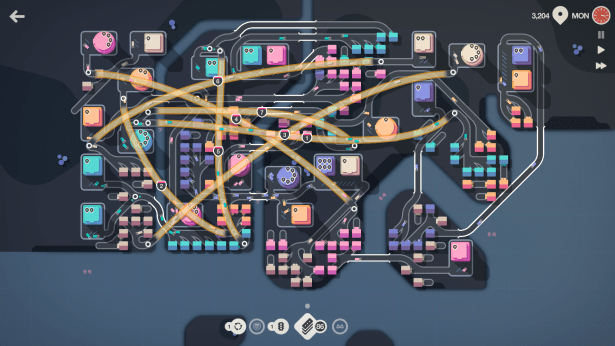
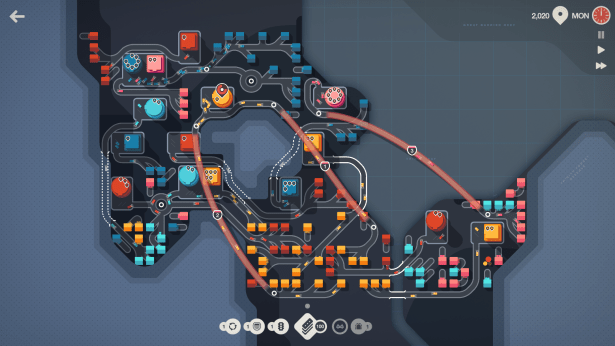
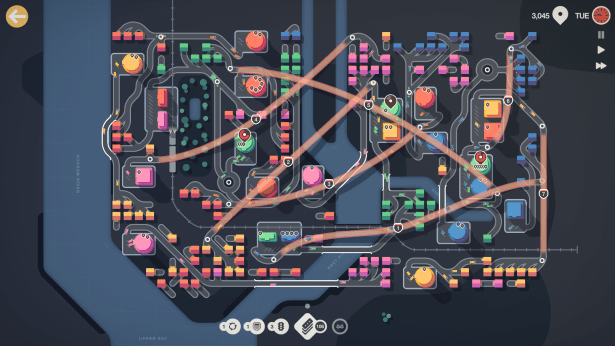
Okay – that’ll do it for Mini Motorways. I’ve been using all of those tricks to consistently score over 2000 trips (3000-3500 in most cases) on each level as I’ve been playing through the game. I hope those tips also help anyone else who’s still out there playing Mini Motorways, doubly so if you’re an achievement hunter, and you’ve been struggling to earn those 2000 trips achievements for each level.
Did you enjoy what you read? Consider supporting my work by buying me a coffee over on Ko-fi.


this was awesome
LikeLike
Discovered this game about a month ago and was struggling to hit 1,000. Finally decided to look up some tips, only read your article here and the very next game I played I broke 2,000! Great tips, they work!!
LikeLiked by 1 person
I’m glad it helped. 🙂
Huge W on breaking 2k for the first time. Hopefully it’ll be the first of many 2k finishes.
LikeLike