It was around 2am while staring at my wife like Charlie Day from that 1 meme that I thought to myself, “yeah, this game is pretty good.” I’d just spent the past 3 minutes laboriously detailing a conspiracy between 2 members of the Roottree family to cover up (nope, spoilers) after spending 45 minutes going down a rabbit hole of several seemingly unrelated articles. She stared back blankly, and said, “Steve, I think we need to go to bed.” Sadly, she was right. I was talking complete nonsense at that point.
However, the thing that I was correct about was that The Roottrees are Dead is pretty good. It’s great even. Honestly, I don’t think I’ve had that much fun playing a detective game with Mir since Return of the Obra Dinn. And I mean for that to be the highest of compliments.
Developer(s): Robin Ward
Publisher(s): Evil Trout
Release Date: Jan 15th, 2025
Released on: Windows, Linux, macOS
Reviewed on: PC (Win)
Copy Purchased
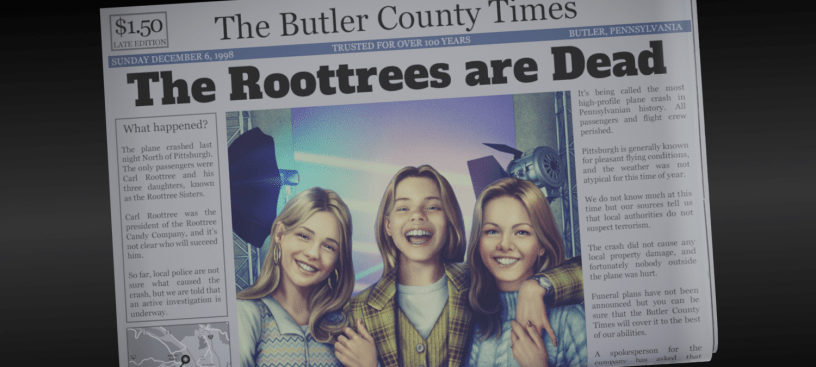
Having made that Obra Dinn comparison, I’m sure many of you have already made several (correct) assumptions about what kind of game The Roottrees are Dead actually is. It’s a Detective game where you’re tasked with filling in 5 generations of the Roottree’s family tree. This includes figuring out each member’s maiden name, latest profession, and the name of their spouse. Along the way, you’ll uncover the history of the Roottree Candy Corporation, and also reveal a secret that their oldest members had been hiding for the better part of the past century.
Falling Down the Rabbit Hole
I feel like that description of Roottrees is enough to sell anyone who is predisposed to a good mystery. Uncovering a family secret, and 5 generations of a family is a monumental task that is rife with rabbit holes to explore.
And I can confirm that Roottrees is indeed filled with rabbit holes. In fact, slowly descending down each hole until you end up going off into outer space like I did during the story I shared earlier.
To explain exactly how I got there though, we first need to look at how the gameplay loop works within The Roottrees are Dead.
Basic investigation in Roottrees is broken down into 2 distinct parts: using in-game web searches, and evidence examination. The former sees you trolling the web looking for possible references to members of the Roottree family. These are served up in short text summaries, which describe all of the key information that you’ve found in your search.
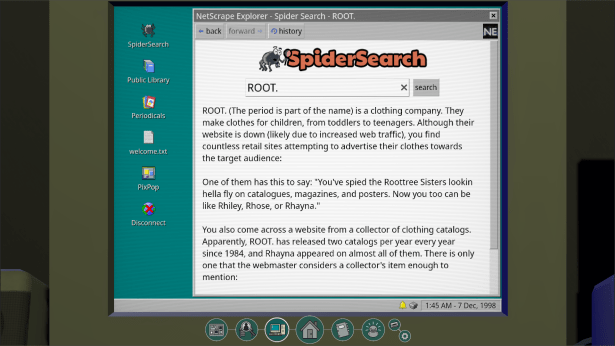
From there, you can try to find additional information by keying in on specific keywords, or phrases. For example, perhaps you were searching for Jimbob Roottree, and found a reference to the Jubilee Sanctuary Foundation. What’s that I wonder? Well, let’s type it into our search, and see if we can find out more about it. Then while reading about the foundation, you learn about one Kelly Peel, and that leads you down a completely different line of articles.
Even the evidence examination feeds into this process of finding new leads, and looking into them with a quick web search. While looking over a piece of evidence, like an old news article, you might happen upon a particular name, or see a detail in the background of a picture that prompts your next line of inquiry.
This sort of compulsive digging where you find a keyword, and use it to continue your search sits at the heart of what makes Roottrees so damn compelling to play. Every single phrase you discover feels like a step in the right direction even if the bulk of the information that you glean doesn’t immediately feel useful. You just need to keep digging until you finally get that last piece of the puzzle, and can see the full picture.
By the way, none of those names that I included above are actually in Roottrees. There is no Jimbob Roottree, or Kelly Peel. I do actually want you to enjoy The Roottrees are Dead completely unmolested provided I’m able to convince you that it’s worth your time. Which, to be clear, it is.
Palpable Sense of Place
Digging through rabbit holes is great and all, but your investigation has the unfortunate impediment of taking place in 1998. That’s correct – less than a decade after the internet was made available for public use. As you might’ve surmised, that means that most members of the Roottree family weren’t actually alive during the modern era.
This whole lack of being alive during the age of the internet would prove to be a major impediment to your investigation were it not for some additional resources that are made available. Namely, you have access to an online library, and periodical archive. This will allow players to search through several older written documents while they pursue relevant lines during their investigation.
What I like so much about this is the twofold way that it increases the palpability of Roottree’s world.
The first, I feel is obvious: it’s 1998, and we’re looking into a family tree that starts around World War 1. This might come as a surprise to anyone who wasn’t born before the 2000s, but it used to be a massive pain in ass to look up information about older topics. I remember researching projects for grade school where I actually had to check out books from the library, instead of spending 4 hours reading about the subject in online articles. That changed dramatically by the time I was in High School, but Roottrees rather faithfully captures that pre-2000s internet feeling where you simply couldn’t find everything you wanted to online.
The periodicals also do a ton of heavy lifting as it relates to adding texture to the game’s world. Each of the different sources that you can search through (yes – there are several archived magazines) has their own history. I really like how some publications even change names over time as they merge with other publications. That’s a thing that actually happens (even now), and seeing it reflected in Roottrees helped to immerse me even further into the experience.
Helpful Hints
Now, I can guess what some of you are thinking: that all sounds really involved. Overwhelming even. And yeah it can feel that way. I revelled in the complexity of Roottrees’ investigations, doubly so since Miranda was right there to pull me back down to Earth anytime I decided to visit another planet.
However, I would caution you against writing Roottrees off out of fear that it sounds too complex. There’s a hint system in the game, which we did use a couple of times, and I found it to be very useful. It offers leading questions to help players that are stuck in a specific line of thought to hopefully send them down the correct line of thinking.
And just like all good puzzle games, Roottrees also offers graduated hints. The first thing you’ll see will be a question like: wow those Wimbly Cousins sure seem interested in Karla Roottree. That’ll be followed by a series of increasingly specific hints that eventually tell you to look up the relationship between the Wimbly Cousins, and Karla. In this way, no player should be left behind, even when the threads of your investigation become particularly murky.
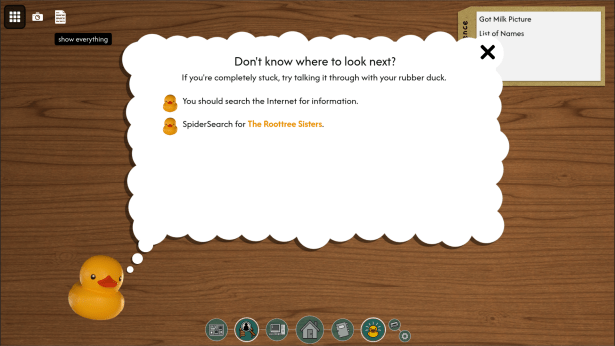
Obviously, I can only speak from my own experience, but I thought this hint system was great. It helped to get us pointed in the right direction a few times when we became completely stuck on an erroneous line of thinking. I also believe that it should help to lower the barrier of the game’s more difficult moments so that players of all levels of deductive aptitude can enjoy solving The Roottrees are Dead.
Also, again, none of those names are actually from the game. There is no Karla, or Wimbly Cousins. I really don’t want to spoil anything here if I can avoid it.
Addressing the AI Elephant in the Room
Finally, there’s one stray thought that I wanted to cover before I wrapped things up in this review. It’s something that I only found while looking into the game some more while I was writing: does Roottrees use AI artwork?
Short answer: no.
I think there’s a bit of a misconception because the Steam release (which is what I’m reviewing) is an enhanced version of The Roottrees are Dead. It was originally made as a game jam entry, and that version of The Roottrees are Dead is playable for free in a web browser. The browser version from 2023, as I’ve understood it, uses AI artwork. However, the Steam release features completely new artwork, and newly added voice acting. Both of these elements were paid for, and do not use AI.
As someone who has worked in multiple fields that are currently under threat of being replaced by AI, I really appreciated these improvements in the Steam release.
What are you still doing here? That’s it. That’s the whole review. I feel like I don’t need to tell you, again, that I really enjoyed The Roottrees are Dead. Why are you still here? Go play the game for yourself. It’s an all-timer, and I’d be really surprised if we’re not still talking about it the same way we do Return of the Obra Dinn in a few years time.
Did you enjoy what you read? Consider supporting my work by buying me a coffee over on Ko-fi.
 Frostilyte Writes