
Progression is weird.
I feel like most people want to feel as though their time is spent on something of worth, even while playing a video game. For example, no one wants to spend 4 hours cutting down trees, and have nothing to show for it. Instead, they want to be all, “I’ve got this big impressive house in the middle of the woods! Well…they were woods. Now it’s more of a clearing because of the whole 4 hours of cutting trees down thing.”
A direct result of this sentiment has been the creation of the term Roguelite. This refers to Roguelikes, a genre notorious for stripping players of everything when they lose, that have permanent progression. This is commonly referred to as meta-progression, and allows players to build up their character(s) instead of having to start from square 1 every single time they play.
The single best example of a Roguelite is Rogue Legacy, and its sequel (Rogue Legacy 2) which are interchangeable as far as this example is concerned. In each run of Rogue Legacy, players collect coins as they explore the ever shifting hallways of Castle Hamson. When they perish, all of the player’s accumulated riches will be returned to base, and can be spent on a variety of upgrades that directly improve the attributes, and abilities of future characters. Then they can do it all over again on a future run of the game.
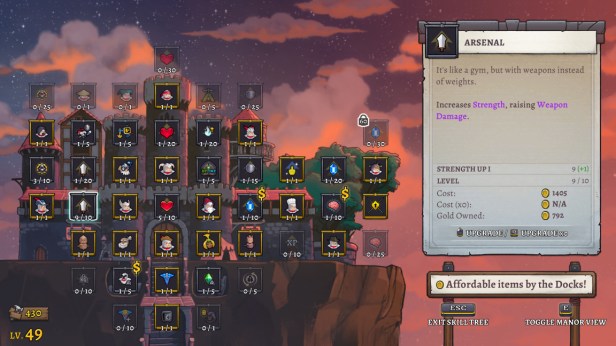
As loath as I am to use the term, Roguelite does provide a shorthand that easily conveys the 2 different types of progression that you’ll stumble upon within Roguelikes.
Regardless, I bring all of this up because I wanted to talk about changes that were made between Hades and Hades 2 as it relates to meta-progression. Both are Roguelites that allow players to upgrade their character, but they go about it in slightly different ways.
While I’m of the opinion that Hades 2 does a much better job, we first need to cover how Hades handled meta-progression so we have a baseline for comparison. Here’s a quick primer:
In Hades you play as Zagreus, the son of Hades. He’s trying to escape from the underworld, and does so by journeying out into the depths of Tartarus every night. Along the way, Zagreus can collect materials that serve no immediate purpose for his journey. However, once he returns back to the Hall of Hades, he’s able to spend these formerly useless materials on permanent upgrades. This includes things like increasing Zagreus’ Health, or upgrading the strength of your weapons.
There are a couple of benefits to this style of upgrade system, but the one that’s most relevant for what I want to discuss is how it affects the feeling of progress. In either Hades, losses can feel really demoralizing because you’re sent right back to the start of the game. This can make it feel as though you haven’t moved forward, and your time was wasted.
However, small upgrades which increase Zagreus’ strength over the course of several runs can help to alleviate this feeling of stagnation. Each upgrade is a tangible reminder that you’ve moved forward, and increased your odds of success. It also gives players several smaller goals to work on as they build themselves up for their first big win. In essence, Hades’ upgrade system helps to provide players with a constant sense of forward momentum, which should help to carry them through the game’s steep initial difficulty curve.

Unfortunately, this system wasn’t perfect. In my own experience, I ran out of things to upgrade before I beat the final boss in Hades. I wasn’t too bothered by this, but it does reveal a gap in Hades’ meta-progression system. It appears as though it was designed to help motivate players with smaller goals, while they chip away at the larger goal of beating the game. Obviously, that’s not happening for every player if it’s possible to completely run out of these smaller goals.
In an attempt to rectify this shortcoming of its predecessor, Hades 2 has made a handful of iterations on its own meta-progression systems.
Firstly, there’s a wider range of upgrade materials, and far more things to spend them on. This isn’t always a good thing, but it did mean that I was grabbing upgrades a lot more often than I did while playing Hades. In fact, I think I unlocked something new, or purchased an upgrade for Melinoë every single time I arrived back at Hades 2’s central hub. This meant that no run felt completely without purpose, even while I was getting tossed around like a ragdoll during my first few hours of Hades 2.

Weapon upgrades are also a lot easier to access in Hades 2. Much like the first game, you still need to unlock all 6 weapon types before you gain access to upgrades. You then use basic materials like Silver or Spirit Ashes, which you can find in the very first area of the game, as the primary ingredients for many of the starting upgrades. This should ensure that all players, regardless of aptitude, are able to find the necessary materials to give themselves an additional edge in combat.
Compare that to Hades wherein you needed Titan Blood to upgrade any of your weapons. This was (relatively) easy to obtain as you got it from defeating the first boss. However, you wouldn’t receive another Titan Blood unless you beat her again with a different weapon, or on a higher difficulty. Increasing the difficulty wasn’t possible until after you defeated the final boss, so this meant that players (like myself) would very quickly become locked out of upgrading their weapons after purchasing only a handful of upgrades.
It’s also worth mentioning that Hades 2 has completely removed this (somewhat) arbitrary limiter on boss rewards. You’re always rewarded for beating a boss regardless of your selected difficulty level, or weapon choice. This freed SuperGiant up to make boss materials usable in far more of the game’s different unlocks and upgrades. As such, boss materials feel a lot more valuable in Hades 2 even though they’re way more common than they were in the original Hades.
The final area of meta-progression that I wanted to mention is my favourite change in Hades 2: Arcana Cards. Fundamentally, Arcana Cards fulfill the same basic purpose that the Mirror of Night did in the first game. You exchange a handful of common materials, and receive a variety of passive bonuses that increase the strength of the player character, Melinoë.
However, there’s 2 major differences that change how Arcana Cards feel as it relates to progression.
The first is that many of the early Arcana Cards are a lot more impactful when compared against early game buffs from the Mirror of Night. For example, 1 of the cards lets Melinoë slow time whenever she uses a charged attack, and another adds a window of invulnerability to Mel’s Cast ability. Those are really strong boosts that are immediately apparent during the player’s next run as they repeatedly slow down time, and block attacks that otherwise would have damaged them.

By comparison, Zagreus’ most noticeable buff from the Mirror of Night was gaining an additional dash, which let him maneuver more effectively in combat. Many of the other bonuses related to increasing damage output, which isn’t as easy to perceive in the heat of the moment. Thus, Zag’s boosts don’t feel as impactful as some of Mel’s do.
The other major difference is how you unlock each of the bonuses. In the original Hades, you unlocked new skills from the Mirror of Night by spending 1 resource type, and then you upgraded them with another. This meant that every player was unlocking every skill in the same order. That meant that SuperGiant could balance Hades a lot more tightly, but it also means that players have less say over how they upgraded Zagreus.
By comparison, Hades 2 gives players a lot more freedom in how they upgrade Melinoë. You start off with only a handful of Arcana Cards, but you’re quickly given the ability to choose which cards you’d like to unlock, and activate from a pool of several. This naturally gives players a lot more agency, and makes each new activated card feel like a personal decision, which is something that the original game lacked.
This is a little off-topic, but there are also changes to how you equip these bonuses. The Mirror of Night provided a bunch of either-or buffs where players had to select 1 of 2 available options. I don’t think that’s a bad system, but it doesn’t result in the most interesting decision making, nor a lot of build customization. Personally, I ended up using the same set of skills for the overwhelming majority of my playtime. I took what seemed best, and never bothered to switch it up, aside from achievement hunting.
By comparison, Mel can equip any configuration of Arcana Cards, but she’s limited by what’s referred to as Grasp. This is yet another thing that players can upgrade between runs, and it gives a clear indicator for what value of cards you’re able to equip at any given point. You can then mix, and match several Arcana Cards to get your desired pool of effects based on your current amount of Grasp.
I just really like this new Arcana Card system. Freeing up the player to have a more active role in terms of which abilities they unlock, and when they unlock them gave me a much greater degree of investment than I felt playing the first game. That doesn’t make Hades 2 better, but I found I was getting sucked into its meta-progression treadmill in the same way I do with a good Role-Playing Game. That’s not normally how I feel while playing this style of game, so Hades 2 has gotta be doing something right.
Did you enjoy what you read? Consider supporting my work by buying me a coffee over on Ko-fi.
 Frostilyte Writes