
People are going to accuse me of shitposting for saying this, but my favourite video game town is Blighttown from Dark Souls. Yes, really. I get that it’s a collection of dilapidated huts, and every single one of them appears to have been painted with poo water from the swamp that sits at the base of the village. That’s not exactly the kind of place you’d expect someone to declare as their favourite.
However, it isn’t the fact that Blighttown looks as though someone balled it up, and wiped their ass with it that makes it so endearing to me. Rather, it’s the architecture. The whole village is built into the side of a cliff upon ancient ruins. It’s highly impractical, but extremely cool. I mean, just look at it:
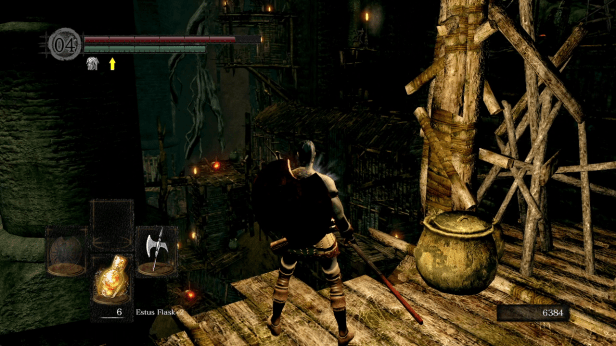
See?
Even despite the shoddy nature of the construction, you’ve gotta admit that there’s a certain charm to Blighttown. Maybe it’s just because I grew up in the concrete infested confines of urban North America, but the combination of verticality, wood, and stone just works for me.
Either way, it isn’t just Blighttown that I’ve been drawn to thanks to this fascination with rustic, vertical villages as some City Builders also riff off the same principles. For example, last month I poured some time into the Early Access build of Whiskerwood where I ended up building Endstone, my settlement featured below, into the side of a mountain. It wasn’t exactly an intentional decision. I simply started mining ore out of the mountain, and built an entire town around the central shaft to support my mining efforts. Fast forward a couple of hours, and boom – you’ve got yourself a mountain village.
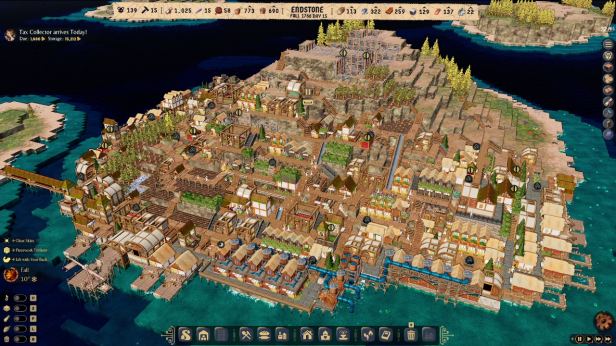
Doesn’t it look super cool too? I will fully admit that saying that has the same energy as the Obama meme, but I love how my settlement looks visually. It has so much character thanks to its unconventional, vertical design. And it only continues to get more, and more interesting to look at as I’ve been forced to expand, and implement utilities like running water. That’s what all of those blue pipes, and bathhouses are for at the base of the mountain if you were curious.
There’s also this really neat detail in the centre of the town. In the early game, the area in the dead centre of the above screenshot was a giant crater. This was the aftermath of my mining efforts throughout the early game, which were foundational in establishing Endstone with a proper economic foothold.
Unfortunately, I tapped the area, and moved my mining operations towards the top of the mountain. This left a massive gaping hole in the middle of my settlement though, which I eventually repurposed. Now, the whole crater has turned into the well-to-do neighbourhood where all of the best apartments are located.
While it doesn’t make the game more mechanically compelling, I do find this tidbit of history makes the process of city building more enjoyable. There’s a palpable depth to my settlement in Whiskerwood. It started as a rinky dink mining village with wooden huts, and now the bourgeois have settled in with walled gardens and brick apartments. I find that stories born out of gameplay – even though this one is about how I accidentally gentrified Endstone – add a ton of additional personality to the games that bore them.
And yes, in case you were curious, those grey things are slides. They provide a movement speed buff when moving down the mountain, so there’s a benefit to using them aside from it looking adorable whenever they’re in use.
Whiskerwood may have been my primary source of inspiration for this post, but it wasn’t my only example of vertical villages. Hence Timberborn, which those of you with especially good memories will recall that I covered early last year.
Now, Timberborn does provide players with a lot of space to invest in typical urban sprawl, but that starts to fall apart once you begin building dams to manage water flow. If you don’t create a reservoir to store the water, then you’ll be hard pressed to actually make use of it without flooding your village.
Ergo, you’ll likely end up arriving at a similar solution, at least conceptually, to what I always end up doing: building a multi-tiered city. This allows the water to pool in certain areas before trickling down to lower levels. It doesn’t always capture the appearance of our previous 2 examples, but it is plenty rustic to make up for it.
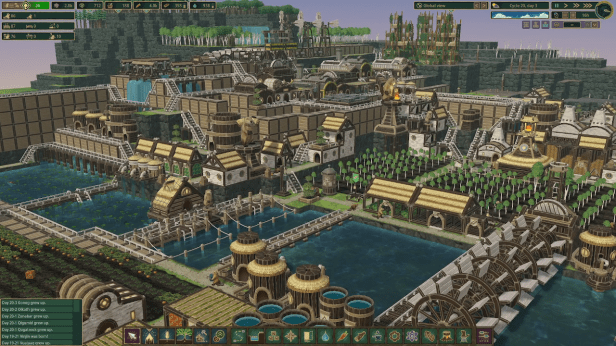
Though, I’m fairly certain that some of the available maps in Timberborn have much steeper inclines, and cliffs that you can build alongside. Here, I simply ended up building a dam on the central waterfall before redirecting the flow to various reservoirs. It isn’t quite the same vibe as Blighttown or Endstone, but I think I gave it a pretty good effort considering that I built this settlement specifically so that I’d have a screenshot for this article.
For my final example, there’s last year’s Cataclismo which I loved the aesthetics of even if I didn’t end up enjoying the full campaign all too well. In most missions, campaign or otherwise, you’re better off concentrating the bulk of your resources into a small, extremely well fortified position. This naturally forces players into situations wherein they need to build skyward in order to maximize their limited space. Ergo, you end up with settlements that look like this:
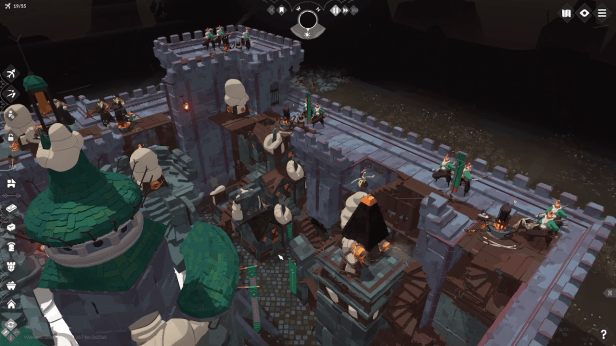
You can see that I’ve got houses stacked upon one another, right up against the outer wall of my settlement. The alternative would’ve been to spend more stone to make a wider wall, but that wouldn’t necessarily be an efficient solution, nor the best spend of a somewhat limited resource.
It’s also worth noting that Cataclismo provides players with wooden scaffolding, and requires it to be used when building upwards. You can actually see some of that scaffolding in the attached screenshot since I seldom build my walls with the scaffolding hidden. It’s also the best way to build paths, and support stairways, which are integral for keeping everything and everyone in your village properly connected.
For lack of a clean transition, I have to ask: was this a weird thing to get fixated on for an entire post? The answer is probably yes. Do I care? No, I can’t say I do. These vertical villages are always a joy to look at, and I’m glad more games seem to be adopting a build-up mentality. It sure beats the ravenous urban expansion that’s turned the majority of North America into the world’s largest parking lot.
Did you enjoy what you read? Consider supporting my work by buying me a coffee over on Ko-fi.
 Frostilyte Writes
Blighttown is such a divisive area in Dark Souls but you are right that there is something undeniably compelling about its layered, ramshackle vertcality. There is a kind of organic logic to the way those structures climb on top of each other that feels almost believable as a settlement. The combination of wood and stone against a swamp backdrop creates a memorable atmosphere. Really curious to see where this exploration of vertical villages takes you next.
LikeLiked by 1 person
You should take a trip to France if you haven’t already. There’s so much cool medieval vertical architecture there it’s amazing to see in person. Mont St. Michel might be the most famous example, mind-bogglingly cool
LikeLike