
Earlier this year, I played a demo for a game called Wildfrost. It’s a card game of the roguelike persuasion, so it immediately jumped out at me from the many other offerings during that particular Steam Next Fest. I enjoyed what I played enough to put it on my wishlist, but missed picking Wildfrost up during its initial launch window.
Fast forward to a few weeks ago, and I saw Wildfrost on sale. I remembered that my regular sparring partner Totsugeky mentioned he’d been playing it, so I decided to ask him for his thoughts. This triggered a 25 minute discussion where we ended up chatting about some of our favourite mechanics from different card games, which ultimately convinced me to finally pull the trigger on Wildfrost.
Let me tell you, I’m so glad Totsugeky recommended Wildfrost. I can’t stop playing it. There’s a laundry list of articles I wanted to write this week, and I made no progress on any of them. I can’t seem to pull myself away from Wildfrost during the early morning, and evening hours where I typically do the bulk of my writing. This game is just too fun, and I needed to let you all know about it.
A lot of Wildfrost’s DNA is shared with other games of its ilk. However, there are a few key mechanical differences that make Wildfrost feel fresh after the hundreds of hours I’ve spent on Slay the Spire, and Monster Train.
The first of these differences relates to how the player is able to orient their minions. The battlefield in Wildfrost is made up of 2 lanes. Both you, and your opponent are able to place up to 3 units in each of these lanes. Whenever combat is initiated, a unit will attack the front of the opposing team’s lane. In this way, Wildfrost’s unit orientation is somewhat reminiscent of classic RPGs where your tanky units hold the front line, and squishy damage dealers sit in the rear.
What’s interesting about these battle formations is how flexible they are. Wildfrost allows players to freely move units during their turn without penalty. This might seem inconsequential, but it leads to a boatload of decision making, and is a key aspect to playing the game successfully. For example, if you have a card that boosts an entire lane’s health by 1 then you can move both of your frontline tanks into the same row for a turn to apply this buff on both of them. Alternatively, if you need to soak up a weak hit, you could opt to have one of your backliners pop forward for a turn, helping to save your tank’s health for those heavier hits. There are fairly rudimentary examples, but I hope they illustrate at least some of the potential of this mechanic as it regularly determines how well the player will succeed.

The second major difference is another departure from convention: recalling units. With the exception of your powerful faction leader, every one of your units can lifted from the field, and shuffled back into your deck. This might seem impractical, but it carries a couple benefits. Firstly, the recalled minion will receive a partial heal. In most cases this will restore them back to full health. Secondly, any negative status aliments that were accrued will be wiped away. It’s also worth mentioning that recalling doesn’t use the player’s action, nor does it wipe away any of the attack buffs that a unit has accumulated. In this way, recalling a minion is similarly beneficial to changing their orientation on the battlefield, and choosing the right moment to pull something back can make or break a fight in Wildfrost.
There’s also a secondary mechanic in support of recalling: injuries. Any time a unit is defeated in battle, it sustains an injury that reduces its health, and attack. This can be incredibly debilitating to play around in harder fights, which provides an additional incentive for players to keep everyone alive, and healthy. It’s often better to pull your minions back to heal then let them take the fall as going into the next confrontation on the backfoot is a huge disadvantage.
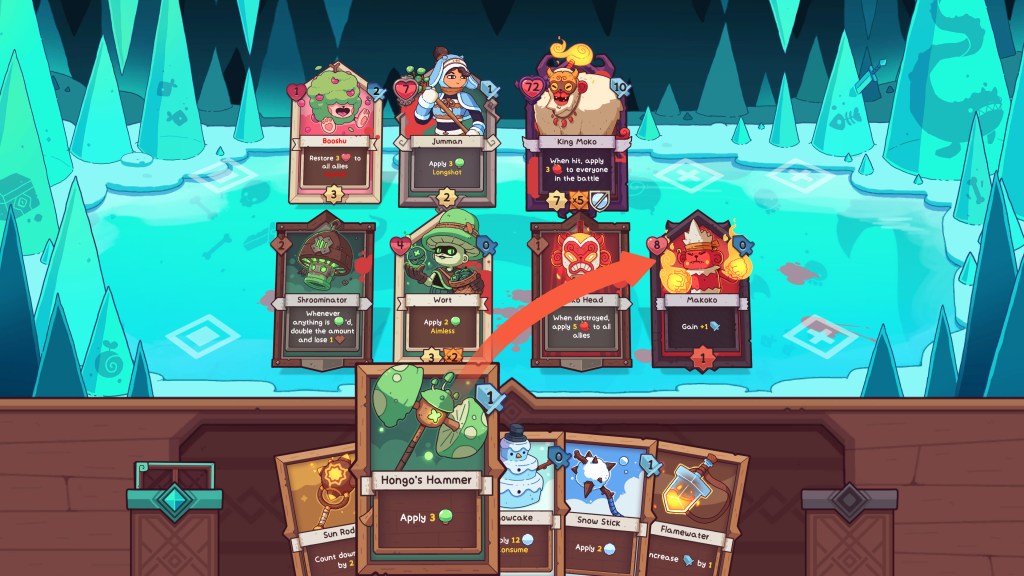
I know these two mechanics probably sound fairly straight forward, but it’s mind-boggling how different Wildfrost feels because of them. And there’s no way it would feel this fresh without either of these systems. Many of the actual card abilities are things you’ll have seen in every other card game: poison, multi-hit, armor, rage – all of the usual suspects are here. It’s thanks entirely to Wildfrost’s unorthodox minion positioning, and card recalling systems that a uniquely refreshing experience with a compelling gameplay loop is born.
If you’re a fellow roguelike card game enjoyer, do yourself a favour, and play Wildfrost. Don’t be like me, and sleep on it for 3 months. Wildfrost is one of the real ones, and I regret not playing it sooner.
 Frostilyte Writes
“I know these two mechanics probably sound fairly straight forward, but it’s mind-boggling how different Wildfrost feels because of them. And there’s no way it would feel this fresh without either of these systems.”
I am glad you put that in. I was reading through waiting for this exact point. Having played a few card games like this over last 2 years, everytime I see a new one its hard to tell if it is something fresh or just a rehash of all the other similar style of card games coming out.
LikeLiked by 1 person