
Well, I finally got around to playing The Rise of the Golden Idol. That…uh…makes it sound like I took a lot longer to play it than I did. I played it a week or 2 after its release. By my standards, that’s actually quite quick.
Either way, Golden Idol 2 is good. That probably feels like a really muted opinion given how I was gushing about the demo during my preview back in October. In fairness, I think the demo showcases one of the more exciting chapters, and it was also one of the better demos that I played. Ergo, there was some bias going on there that maybe caused me to talk it up a bit more than was strictly necessary.
Don’t get it twisted though: The Rise of the Golden Idol is a fun time, and something I’d easily recommend to others. Though, I feel like I’d qualify that recommendation a little. That is, if you played the original Golden Idol game and enjoyed it then you will definitely enjoy the sequel. The Rise of the Golden Idol is a lot more of what already made the first game so darn good, which makes determining how much someone will, or won’t enjoy it fairly easy to gauge.
But, I’m getting ahead of myself. Again. Actually, maybe I should always start off these reviews with my concluding thoughts so people who just want the “score” can find it more easily.
Anyway, here’s all of the reasons why I think The Rise of the Golden Idol works so well, and why you should give it a look if you’re at all interested.
Not Giving the Game Away
I already mentioned how The Rise of the Golden Idol does a much better job of not giving the game away than its predecessor during my original preview of the game’s demo. However, I wanted to elaborate on what I meant by that without a somewhat strict word count. I do try to limit myself during those previews since I’m covering multiple games in a single article, and don’t want to overload readers with too much information.
Anyway, what exactly does Golden Idol 2 change from the original which helps to prevent it from spoiling itself?
Before we can answer that question, I think it’s important to provide a primer on the general gameplay formula of the Golden Idol games. Mostly because it’d be significantly harder for me to explain the minor, albeit impactful, differences between the first and second game without first establishing what you do, and how you do it.
So, for those that aren’t already familiar with how the Golden Idol games work here’s a brief summary:
- Players open up a scene and click on highlighted objects throughout the scene
- This fills up their lexicon with all of the relevant words that are needed to solve the scene
- Players are then asked to identify the various actors from the scene (ex. Who are all these people?)
- You’re also usually quizzed on some other relevant detail about the scene like what motivation someone had for doing what they did, or how a particular device works
- Finally, you’re asked to describe the sequence of events that transpired in the scene (ex. Explain how this man got lit on fire)
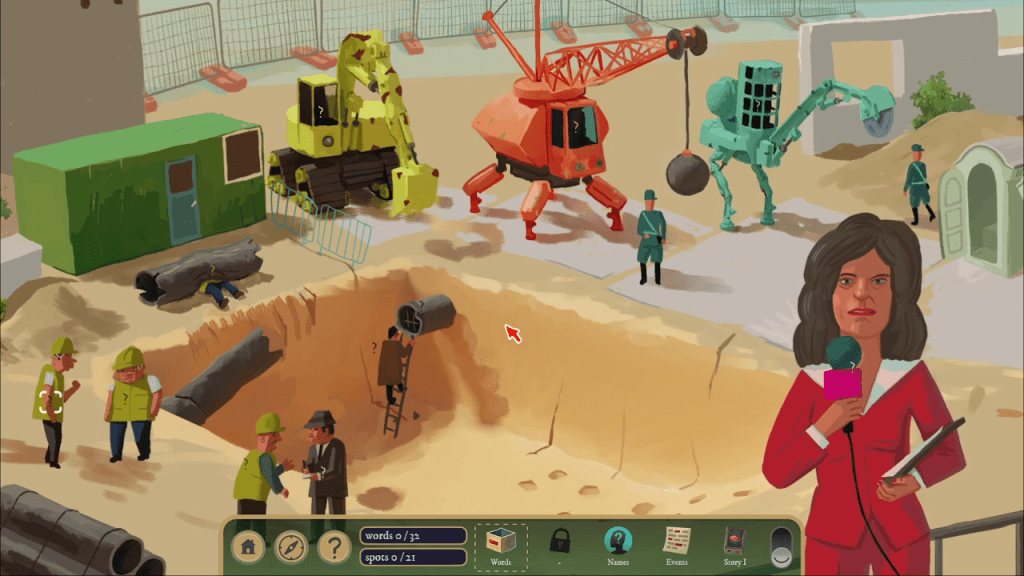
Hopefully that makes some degree of sense. What you do as a player in these games is fairly straight-forward. The complex bit is actually pulling out the details that help with explaining what transpired. This, like so many other deduction style games, requires players to pay attention to a variety of different context sensitive clues. For example, one of the scenes in chapter 1 shows an accident that happened in a construction lot, and the key to solving that comes from outside of the words that you’ve collected in your lexicon.
Now, a key problem of the first game was that the events tab would sometimes give away what actually happened in a given scene. Here’s an example of what the events tab even looks like so you’ve got a frame of reference:

As you can see there are a number of colour-coded spaces here that the player is expected to fill in. Unfortunately, how you’re asked for information here can sometimes lead your line of thinking. For example, if you were asked how someone was murdered then you now know they were murdered. That’s no longer a piece of information that you need to figure out on your own through investigating the associated scene.
I’m of the opinion that Golden Idol 2 goes a long way to improving upon its predecessor in this regard. The wording in the events tab seems a lot more deliberately chosen this time around to obfuscate what actually happened. This gives players an opportunity to figure it out for themselves. That’s kind of the point of this game, so I was quite pleased to see that the folks at Color Gray made an effort to meaningfully improve things with the sequel.
The other improvement in this regard is that some scenes contain multiple event tabs. This allows the developer to split information up in a way where the player has to prove they already understand some key piece of information about a scene before they’re asked to solve for the remainder of what happened. So, to reuse my earlier example, in Golden Idol 2 you’d be asked to prove that you know someone was murdered, and then you’ll be asked the question about how they were murdered instead of just being asked how they were murdered outright. This provides yet another control to help prevent situations where Golden Idol 2 could potentially lead the player’s thought process, and inadvertently spoil the game’s puzzles.
The Structure of the Story
Obviously I can’t get around talking about the structure of the story in The Rise of the Golden Idol without including a couple spoilers. In my opinion, the spoilers are minor, but if you want to go into the game completely unmolested then skip this section of the review.
As for the rest of you, let’s get into the story.

I suppose the best place to begin is at the beginning. The full release of Golden Idol 2 features the same opening as the demo, which I think was an excellent choice. This is because players are hit with a handful of unanswered threads to start pulling at. Many of the victims have mysterious red markings in their eyes, which the police are referring to as the Red Curse. A drug cartel, and demon worshipping cult are also referenced. However, we’re never actually given enough information to make heads or tails of any of this.
After completing the opening act, we’re then whipped back in time to 3 years earlier. It’s not really clear how this new scene is related to what was just witnessed, which should get the gears turning for anyone playing. Why are we here? What does this have to do with the Red Curse? Yet more unanswered questions.
In an effort to keep spoilers light, I don’t want to elaborate any further on the specifics of the plot in Golden Idol 2. However, I did want to point out that I think starting the game in this way, by throwing a bunch of unanswered questions at the player, does a great job of reeling in the player’s interest from the get-go. This is important because there is a lot of setup that follows those opening bits. Without something to anchor down my interest, I’m fairly certain I would have bounced off Golden Idol 2 before it started to pick up any momentum. However, that wasn’t the case as I was left with far too many unanswered questions that I needed to find answers for. As such, I was able to push through those seemingly unrelated story beats until everything started to fall in place, and I was finally able to see the bigger picture.
So, we’ve already established that the overarching plot of Golden Idol 2 is told out of order (chapter 1 happens in present day, and chapter 2 is 3 years earlier), and discussed the potential merits of that. However, individual scenes within a chapter are also told out of order some of the time too. And, just like with the overarching story, I think this lack of order was a clever way to structure the story.
Obviously, playing individual scenes from a chapter out of order repeats the same pattern of providing players with unanswered questions that we’ve already discussed. I think it works just as well here, for the same reasons: it hooks the player, and gives them threads to pull at as they unravel all of the details in a chapter.
However, I think there is another benefit to structuring the story in this way: it provides an additional axis for deduction gameplay. A big part of what makes Golden Idol 2 tick is that players are constantly being asked to put on their detective hats and figure out what happened. Who are these people? What motivations were at play? When did this even happen?
That last one is crucial because you wouldn’t even have to ask it if all the scenes occurred in order. Instead, the player has to look for context clues, or explicitly stated dates to determine the exact sequence of events throughout a chapter. This is one more opportunity for Golden Idol 2 to give players those wonderful “ah ha!” moments that make this style of game so fun to play. Plus, I always felt like a smartypants whenever I finally figured out how all of the pieces fit together.
I think that’ll do it for The Rise of the Golden Idol. As I already stated at the top, it comes with a recommendation from me. I think it does what it does better than the original Golden Idol game, and that’s nice to see from a sequel. Plus, it’s similar enough that if you enjoyed the original then you’re probably going to enjoy what’s on offer here.
If you were curious about the original game, but never got around to it then The Rise of the Golden Idol is a great place to start. The story takes place well after the original game, and there’s no meaningful continuity between the 2. Though, there are a few nods for players of the original game, which is always nice.
Alrighty, that’ll be it from me. Thanks for reading, and I’ll see you in the next one.
Did you enjoy what you read? Consider supporting my work by buying me a coffee over on Ko-fi.
 Frostilyte Writes