
I don’t know if other folks do this, but I occasionally scroll through Opencritic to see which games reviewed well in a given year. I’m not omnipotent (yet), and so I tend to miss quite a few game releases throughout the year. Checking Opencritic isn’t a perfect way to remedy this problem, but it does provide me with a concise list of games that some other folks found interesting.
To be clear, I’m not checking Opencritic for the stuff that received 90 or higher. It’s kind of impossible to not know about those games. No – I’m looking for stuff between 72 and 87. That’s where the neat stuff that I haven’t yet heard of is hiding.
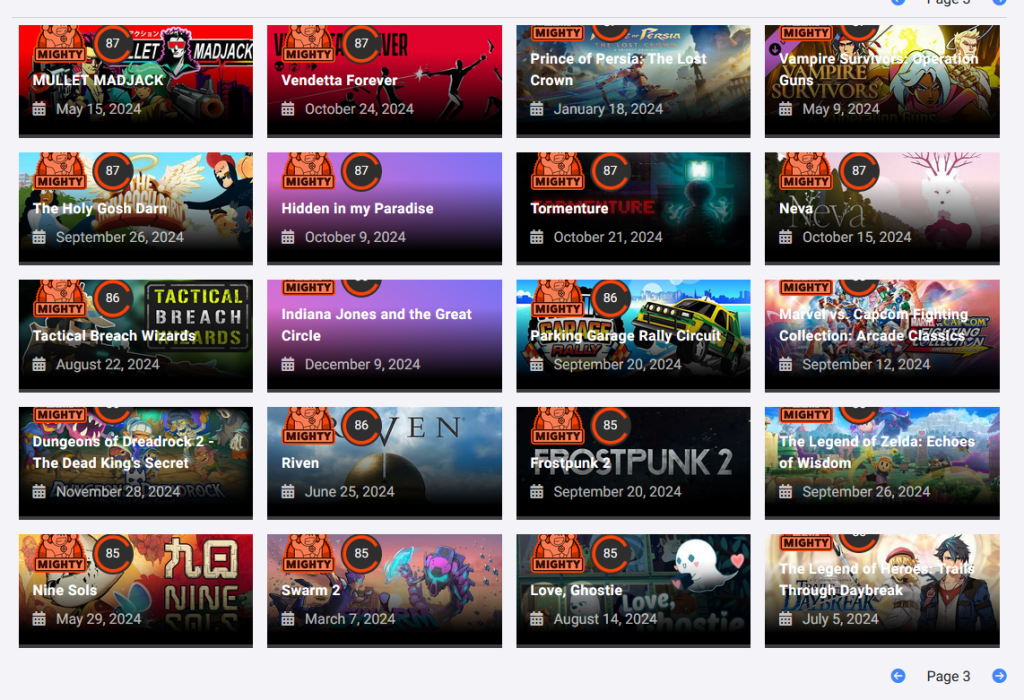
I bring all of this Opencritic stuff up because it’s how I learned about Shogun Showdown, which will be the focus of today’s Demo Dive. It was released back in September around the time that I was playing Peglin, and still working my way up to Masters in Street Fighter. That is to say, my attention was so wrapped that I couldn’t even tell you what games were even coming out.
Regardless, Shogun Showdown looked neat, and, thankfully, it still had a demo available on its store page.
Real quick before we continue: lots of respect to the developers of Shogun Showdown. And anyone else who leaves their demo live after releasing their game. I think it demonstrates a lot of confidence in what the developers have created. It’s almost as if they’re saying, “we know you’ll want more after you try this free sample.” Plus, it lets folks who missed your original release window try the game out, and make a more informed purchase. Firm handshakes all around.
Having said that, what did I actually think of Shogun Showdown’s demo?
Well, I liked it enough to buy Shogun Showdown during the Steam Autumn sale. That’s gotta count for something right?
But what actually is Shogun Showdown? Good question. From a vibes standpoint, it’s a video game that attempts to capture the cinematic feel of being a lone Samurai akin to what you’d see in a film from the 70s. You stand as the lone warrior against a horde of nameless mooks that are all trying to stop your righteous quest to overthrow the wicked Shogun.
However, from a gameplay perspective, that question is not so easily answered. It’s kind of an amalgamation of a bunch of different mechanics that you’ve probably already seen in several other games. However, Shogun Showdown combines those different pieces into an experience that feels wholly unique.
For starters, you play as the little lady in the centre there:

You’re able to move left, right, turnaround, and attack. Your goal is to defeat several waves of enemies, which are all hell-bent on trying to kill you. To do that, you’ll need to weave around their attacks, while launching your own counter offensive. Simple, right?
The thing that makes Shogun Showdown interesting is how exactly you go about attacking. There are a few different attacking tiles at the bottom of the screen. To attack, the player has to load the tiles into the attacking queue. They can load up to 3 tiles into the queue, and begin attacking at any point. This will use all of the tiles in the queue sequentially. What’s cool about this is that it opens the door for combo attacks that see players killing several foes simultaneously as they chain multiple abilities together into a single deadly sequence.
However, things aren’t simply as straightforward as dodging enemy attacks, and unloading wombo combos because your abilities have cooldowns. Thanks to this additional wrinkle, players won’t always be able to attack, nor will they have their best combo components at all times. This creates a push, and pull wherein players need to figure out what sequence of attacks makes the most sense for their current situation. You can’t do everything, so managing cooldowns, enemy positions, and the space you have available to retreat are all variables to keep in mind while fighting.
Shogun Showdown is also a roguelike, so, aside from your starting 2 attack tiles, everything else you find is randomized from run to run. This has the obvious benefit of meaning that players can’t repeatedly rely on a single winning strategy for success. Instead, they’ll need to work with whatever the game gives them, and try to formulate a winning strategy much like what happens in deck-building games. Albeit, Shogun Showdown provides far fewer opportunities to draft new abilities, and instead focuses on how players choose to upgrade those abilities. Regardless, the vibes are similar enough that if you enjoy roguelike deck-builders then you’ll likely enjoy that aspect of Shogun Showdown too.
The result of all of these different pieces is a game that feels, to me at least, a lot like a deck-builder, but with far more tactical elements. Trying to choose abilities that work with one another, and upgrading them into a winning strategy is what gets the deck-building part of my brain turning. However, the actual moment-to-moment combat is far more tactical than playing a hand of cards thanks to all the different variables that players need to manage. It’s a really neat gameplay fusion, and works surprisingly well.
The final bit of Shogun Showdown that I wanted to touch on from my time with the demo are the visuals. I already mentioned how the game is going for the feel of a 1 versus 100 style Samurai film, and I think the crunchy pixel art does a great job of selling that. There’s a whole swath of different abilities, and the attacking animations, while limited, really sell the impact of your character darting across the battlefield cutting down all who oppose them with laser precision.
Plus the music is just chef’s kiss. I’m not well versed enough in how to articulate why I enjoy music, but it feels authentic to the kind of experience that Shogun Showdown is going for. It’s exactly the sort of thing you’d expect to hear in a Samurai film, albeit with a little bit of chip-tune to help tie the game’s entire aesthetic together. This ensures that the music perfectly mirrors the onscreen duels, and really sells the vibes that Shogun Showdown is aiming for.
All in all, Shogun Showdown managed to make a great first impression with its demo. I already stated it, but I have purchased the game, and my opinion of it has only continued to improve as I’ve unlocked the remaining character classes, and a whole bevy of additional weapons. I’m firmly of the opinion that there’s a lot to like here, and more folks need to give Shogun Showdown a look.
If you’re interested in trying Shogun Showdown for yourself, the demo is still available to play on both Steam and the Nintendo eShop. Progress carries over to the full game, so anything you unlock will be permanent. Achievements earned (on Steam) are also retroactively applied when you first boot up the full game.
Thanks for reading, and stay safe out there.
Did you enjoy what you read? Consider supporting my work by buying me a coffee over on Ko-fi.
 Frostilyte Writes