
I can’t remember the last time that I was as engrossed with a game as I’ve been with Monster Train 2. It’s just about the only thing that I’ve been playing for the past 2 months. I don’t typically stick with anything that long unless it’s a Fighting game, which I view a little differently since I actively play, and compete at in-person events for those.
No such anchors exist for Monster Train 2 though, and that got me thinking. What about Monster Train 2 has allowed it to continue being fun well beyond the point where I’d normally get bored of other, similar games?
In doing some reflection, I think I’ve identified exactly why Monster Train 2 has stuck so hard: every card feels like a puzzle. What I mean by that is that every card has the potential to be a key component of your deck within a given run. The trick is figuring out what combination of upgrades, Artifacts, and supporting cards you need to properly facilitate said card. And it’s that process – unravelling how best to utilize a card – that I’ve found so damn compelling.
Let me walk you through an example to showcase what I mean:
In the original game, I strongly disliked playing the Umbra clan. I thought they had very mediocre Units, and most of their Spells felt borderline unusable.
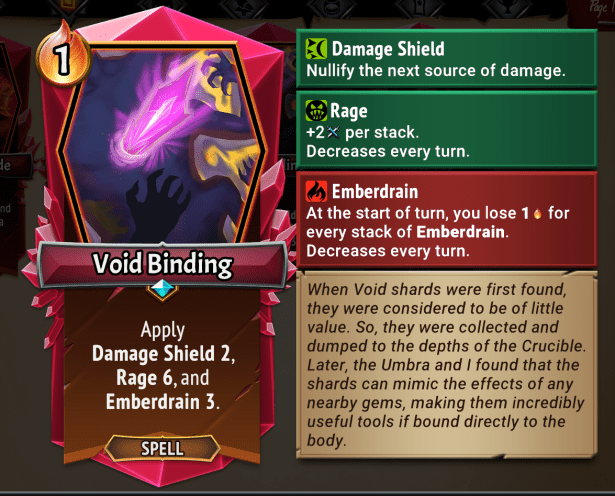
As a quick example, here’s a card called Void Binding. It’s a 1 cost card which applies 2 Damage Shield, 6 Rage, and 3 Emberdrain.
Because I know that not everyone reading this article will know what any of those keywords do, here is a quick primer:
Damage Shield: negates the next time a Unit takes damage.
Rage: increases a Unit’s Attack by 2 for each stack of Rage. Rage decreases by 1 stack per turn.
Void Binding specifically increases Attack by 12 since it applies 6 stacks of Rage. That’s a fairly strong damage buff.
Emberdrain: reduce your Ember by 1 for each stack of Emberdrain at the start of your turn. It decreases by 1 stack per turn.
Ember is how you play cards. By default, you have 3 Ember per turn. That means that Void Binding completely negates your ability to play cards on the following turn unless you’ve found a way to increase your Ember.
In essence, Void Binding provides a fairly substantial offensive, and defensive buff when played, but it limits your ability to play cards on the following turns. It’s certainly possible to survive turns where you’re not able to play cards, but, generally, you’re going to want to play additional cards every turn.
It’s not just Void Binding that applies Emberdrain either. Several of the Umbra clan’s best buffing Spells also apply Emberdrain to compensate for the strength of the card in question.
This all had the effect of completely turning me off drafting any of these cards. They all seemed like more trouble than they were worth because of how they’d affect my ability to continue playing cards during future turns.
However, I had to reexamine that line of thinking when I decided that I wanted to win a Covenant 10 (the highest difficulty in Monster Train 2) run with every single clan.
I’d saved the Umbra for last because I knew it was going to be a complete slog to try, and force a win with them. They had so many terrible cards afterall. Using them would be akin to playing with one hand tied behind my back as repeatedly dodged any, and all Umbra cards while building my deck.
At least, that’s what I thought initially.
I was actually forced to learn how the Umbra cards worked in order to score my first Covenant 10 win while playing with them. That required me to take another look at all of their cards, especially those that I’d originally written off as useless.
That brings us to the card Perils of Production. It’s a 0 cost common that applies 3 Rage, 2 Emberdrain, and gives you 3 Ember.
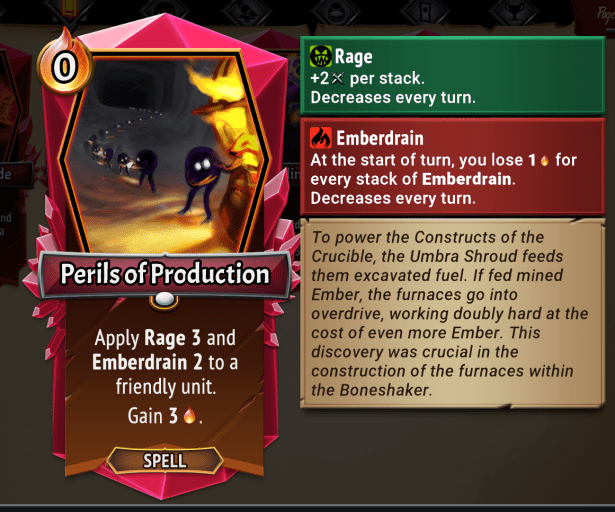
At first, I thought Perils was another useless Emberdrain card. However, something caught my eye: Perils of Production gives 3 Ember when played. That’s an extremely rare attribute for a card to have. How rare? There are 436 cards in Monster Train 2, and a mere 10 of them create additional Ember when played. Or 12 if you count cards that provide additional Ember on the following turn. Either way, it’s a rare attribute.
This got me thinking though: with a Holdover upgrade, I could play Perils of Production every turn. This would allow me to slowly accumulate Rage on one of my Units, while negating the effects of Emberdrain. It wouldn’t matter how much Emberdrain I accumulated if I was using Perils to resupply my Ember every turn after Emberdrain triggered for the turn.
Huh.
And…if that’s the case then I could also use Void Binding to get an even better buff. Or make use of Furnace Tap, which allows a Unit to attack twice for the remainder of combat. In fact, I could also make better use of all the different X cost cards that the Umbra have too by duplicating Perils, or applying a Spell Chain upgrade.
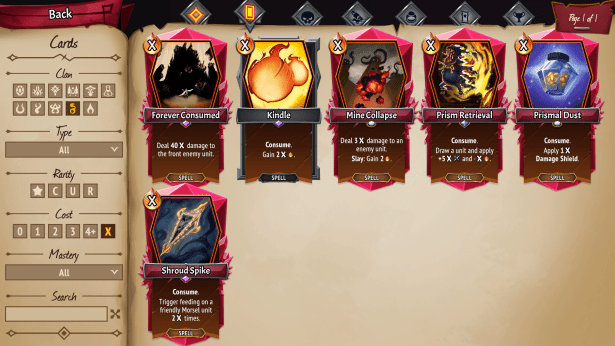
Very suddenly, I had a whole host of new options available to me by simply understanding, and leveraging Perils of Production. While this isn’t my first run using it, here’s an example of what exactly that looks like in practice if you’re curious:
As you can no doubt see, Perils allows the player to very aggressively stack a boatload of Emberdrain with reckless abandon. This lets the player leverage all of the Umbra’s different powerful Spell cards with ease, while not incurring a negative penalty that completely outweighs the strength of the buff in question.
That got me thinking though: are there other cards I’ve erroneously written off? I completely misjudged all of the Umbra Spell cards. With a few simple upgrades, Perils of Production opened up a whole host of new strategic depth to the faction, and allowed me to leverage several new possibilities. Perhaps there were other cards that I was ignoring that’d do the same thing if I gave them a second look.
And you already know where that shift in perspective got me. I’ve continued playing because I’m curious to find the solutions for how best to use all of Monster Train 2’s 436 different cards. They may not all seem useful at first glance, but I now have over 2 dozen different examples of situations I outlined above with Perils of Production. Times where I’ve examined a card under a new set of circumstances, and cracked how to apply it properly. And that’s been a surprisingly thrilling process.
Though, credit where it’s due, I do think I need to highlight developer Shiny Shoe’s involvement here. They’ve attempted to balance Monster Train 2 in such a way where every card is capable of shining. That makes the act of actually solving the “puzzle” around each card so compelling. I know there’s a solution – some way that I can spin a card to get the most value out of it – it’s just a matter of finding it.
Did you enjoy what you read? Consider supporting my work by buying me a coffee over on Ko-fi.
 Frostilyte Writes