
We both know why you’re here: the October 2025 Steam Next Fest. Specifically, you’re looking for a shortlist of interesting games to check out while the event is live. I may be (a little) late, but I’ve got you covered. Here are my favourite games from the October ‘25 Next Fest.
Quick reminder: don’t forget to wishlist any games you’re interested in on Steam. This’ll send you a notification when the game launches, help the developers to gauge interest in their title, and it’ll increase the visibility of said game on Steam after it releases. It’s an easy, and free way to support any upcoming release that you’re keen on.
Skip to:
- The Séance of Blake Manor
- Moonsigil Atlas
- A Heavy Morning
- Monsters are Coming! Rock & Road
- Tearscape
- Dead Weight
- Whiskerwood
- Barrel Roll
- Xanthiom 2
- Cairn
- Crashout Crew
The Séance of Blake Manor
Elevator Pitch: A supernatural Detective game where you unravel both the disappearance of a missing person, and the otherworldly occurrences at the titular Blake Manor.
Thoughts: You know me: I gotta check out any promising new Detective games. The Séance of Blake Manor was being crowed about by a few different folks, so I decided to give it a looksie myself.
For what it’s worth: I think it’s fire, and I’m keen to play through more of it.
As far as what’s on offer, it’s your standard Detective game fair. Most of your playtime will be spent looking for clues, or interviewing the various guests of the titular manor. Once enough information is uncovered, the game will prompt the player to make a deduction, which involves filling in the blanks of a sentence with colour-coded words, and phrases. It should all look very familiar to anyone who has played either of The Golden Idol games, and is just as satisfying here.
Though, for my money, the reason to put The Séance of Blake Manor on your radar is the spooky flourishes. There’s some grade A sound design on display in the demo, and there were a couple of moments where the occasional flash of an otherworldly creature caused me to lurch in my chair. I don’t know that any of these were jump scares per se, and they tied in nicely with the supernatural themes and spooky atmosphere of the game, so I’d call it all fairplay.
The other notable difference for Blake Manor from its contemporaries is the inclusion of a timer. Every interaction costs 1 minute, which limits the number of items that a player can reasonably interact with while solving particular quandaries throughout their journey. As such, players need to think carefully about what they do, and don’t interact with, which I thought was a refreshing twist over indiscriminately interacting with everything. Though, I actually enjoy the added tension of a good timer, so take my opinion with a grain of salt.
Regardless, The Séance of Blake Manor is definitely 1 to keep your eyes on if you’re into Detective games.
Moonsigil Atlas
Elevator Pitch: A Deckbuilder where your cards cost physical space on the game board to play instead of energy/mana.
Thoughts: Moonsigil Atlas was 1 of 3 different demos that I had to pull myself away from early, so that I could continue playing the other demos that I had downloaded. If that doesn’t speak volumes about how fun it is, then I don’t know what does.
That said, the basic idea here is that every card has a sigil inscribed onto it. You’re then able to play said card as long as you can find room for it on your game board. At the end of each turn, your board is cleared, and you draw a new hand. In this way, Moonsigil Atlas replaces a typical energy system with the ability for players to continue playing cards as long as they can find, or make space for them.
What’s really neat about this system is how it influences the rest of the game’s design, which is why Moonsigil Atlas felt so fresh to play. For example, effects that create new cards require players to plan ahead so that they actually have the available space to play said cards. Likewise, any card with the Persist keyword will remain on the board, which also requires a bit of foresight so that you don’t end up inadvertently screwing yourself on a future turn.
The upgrade system is also affected by this design, and allows players to alter the shape of a card’s sigil in addition to augmenting its effects when played. Heck, there’s even an upgrade that allows you to swap the sigils of 2 cards, which can be useful for giving a powerful card a much smaller shape that’s easier to play.
Plus, you’ll also have to consider a card’s shape in addition to its effect before drafting it. Consideration for a card’s energy cost is also present in traditional Deckbuilders, but the higher degree of shape customization means that Moonsigil Atlas has more granularity for what will, and won’t work well within a given deck.
There’s just so many interesting things that cascade throughout Moonsigil Atlas because of this single foundation change. It feels like something I haven’t played before, and that’s always a welcome sight with Deckbuilders.
A Heavy Morning
Elevator Pitch: An interactive story about coping with depression.
Thoughts: I think it’s a really powerful feeling when you see yourself represented in a piece of media. It’s almost like you’re being acknowledged – like someone out there has seen you.
Alternatively, it can be a reminder that others have gone through similar experiences as you. That can be a really comforting sensation, especially while you’re actively working through those same experiences.
I say all of this as someone who has been attending therapy for depressive symptoms for over a year now. And it was really comforting to see some of my experiences represented so earnestly within A Heavy Morning’s demo. It was a reminder that I’m not alone because of the authenticity, and sincerity with which the subject matter was presented.
I also liked how cognitive reframing, and box breathing were represented. Obviously, a video game isn’t going to fully capture the experience of using different cognitive behavioural therapy techniques to deal with depression, but I thought that A Heavy Morning did a faithful job of recreating both as interactive mini-games.
It probably won’t be for everyone, but I’m glad that A Heavy Morning exists.
Monsters are Coming! Rock & Road
Elevator Pitch: A genre mash-up of Bullet Heaven, and Tower Defence gameplay where you build and arm a moving city, while defending it on foot.
Thoughts: Well, this was an unexpected surprise, but a welcome one to be sure.
I originally picked up Monsters are Coming because it looked like a fun twist on typical Tower Defence gameplay. Instead of plopping your towers down from on high, you’d be right in the thick of it collecting resources, and defending your mobile fortress-city while fortifying its defences.
What I didn’t expect was that all of the actions performed by the player character would happen automatically. This puts Monsters are Coming inline with the deluge of other would-be successors to Vampire Survivor’s crown over the Bullet Heaven subgenre.
For what it’s worth, I thought Monsters are Coming was really damn compelling, and I had to tear myself away from it. There’s so much going on between collecting resources for your town, to actually building up your fortress’ economy, and defences. This meant that I was constantly bouncing around the screen trying to do something in service of the overarching goal of surviving the oncoming hordes. The result was a game that I found really compelling to play on a moment-to-moment basis, and the screen wasn’t a complete stimulus overload either.
If you, like myself, have found that Bullet Heaven games aren’t quite your cup of tea, then give Monsters are Coming a looksie. You might be pleasantly surprised like I was after finishing a few runs.
Tearscape
Elevator Pitch: What if Bloodborne was 2D, and available on the Gameboy Color?
Thoughts: I’m not sure what Bloodborne did to everyone who played it, but I’m more than happy to keep trying games that are inspired by it. Doubly so if those games abandon the third dimension, and slap on a pleasantly nostalgic Gameboy Color aesthetic.
Despite that earlier comparison, the focus in Tearscape isn’t exclusively on combat: it’s also a little puzzley. Though I wouldn’t say it’s puzzley in a traditional sense. Rather, Tearscape is puzzley in the same way that older games tended to be.
Here’s a quick example of what I mean:
While roaming around the graveyard at the start of the demo, I saw a locked chest off in the distance. I couldn’t get to said chest because it was behind a locked gate. I did however notice that there were some stairs next to the chest, so my assumption was that there must be an underground path that I’d missed. This was proven true a few screens over when I discovered the entrance to said tunnel hidden among a couple tombstones.
I realized that this sort of thing won’t be to everyone’s taste, but I felt really smart for identifying, and actually finding my way over to that chest. The contents of the chest weren’t even that substantive – the real reward was the dopamine hit from solving the puzzle.
That aside, Tearscape’s combat was simple, but satisfying. It almost felt like 2D Zelda (which I believe is intentional), though the addition of a dodge roll, and parry do add a bit of necessary spice to the mix.
If you’re at all like me – easily won over by a game with a nostalgic artstyle, and some modern QoL tweaks – then Tearscape is something you should put on your radar.
Dead Weight
Elevator Pitch: Grid-based Tactics with sky pirates, defenestration, and a Roguelike twist.
Thoughts: You know what’s great? Defenestration.
Repeatedly knocking people out of windows was part of what made last year’s Tactical Breach Wizards such a joy to play. It almost feels like you’re cheating because you’ve effectively 1-shot an enemy, but done it in a way that doesn’t seem like it should be allowed.
I mention all of this because that same principle was adopted by Dead Weight. It’s a grid-based Tactics game where every character has a push action, and you can leverage that to send enemies to their untimely demise instead of doing things the old fashioned way. And I’m very much in the market for another game all about shoving people to death given that TBW was my favourite game from last year.
Though, it should be said that you can still do things the old fashioned way. In fact, leveraging a mix of both standard combat abilities, and defenestration proved vital in completing the tutorial run that was showcased by Dead Weight’s demo.
While I still have some questions about how much run-to-run variance there will actually be in Dead Weight, I enjoyed what I played enough to throw it on my wishlist. The cadence of combat, and focus on positioning (for both offence, and defence) made for a strong impression, as did the excellent pixel art.
Whiskerwood
Elevator Pitch: A City Builder with Redwall vibes where you manage a village of anthropomorphic mice, and pay taxes to your cat overlords.
Thoughts: Gosh. Where do I even start with Whiskerwood?
I suppose I can start with the game’s visual appeal. I feel like I don’t need to explain that one too much. The folks at Minakata Dynamics could have used any muridae, but Mice do make for a particularly cute group of settlers. Plus, the different building designs are chock full of rustic appeal. I see enough glass, steel, and concrete in my day-to-day to where that’s a huge plus.
It’s not all aesthetics that Whiskerwood has going for it though – the management side of things isn’t too shabby either. Right from the get go, you’re given taxes from the royal kingdom of cats that you’ll need to figure out how to pay. They send someone around to collect payments once every 3 days, so keeping on top of your economic exports is imperative to success.
While this isn’t too different from the kinds of drains that you’d find in other City Builders, I appreciate how it can be filled by whatever resources a player has on hand. Ore like copper, and gold go for the highest price, but if you’d like to save some of your reserves for later payments then you can opt to fill the remainder of your tax quota with excess lumber, fish, or thatch. It’s a nice addition that makes managing your economy in Whiskerwood feel a little less singularly focused on prospecting.
The other thing that I really liked about the Whiskerwood demo was how your mining activities terraform the playspace. I don’t know exactly how to articulate it, but it gives the world a sense of physicality, and place that other City Builders lack. I’d also hazard a guess that in longer playthroughs than my (limited) time with the demo, the constant erasure of space (thanks to continued mining) will lead to some interesting logistical problems.
Barrel Roll
Elevator Pitch: A Western themed Deckbuilder where your deck consists of the bullets in your revolver. Also, there are robots.
Thoughts: I don’t think it’s a secret that I enjoy Roguelike Deckbuilders. I’ve been writing this blog for almost a decade now, and a new card game has made it onto my “best of” year-end list just about every single year. Heck, last year there were 2, and I have it on good authority that there’ll be another 2 Deckbuilders claiming top 10 spots for 2025 as well.
That’s all a really long way of saying that I’m keen to find, and play new takes on the genre. So you can imagine my excitement when I watched the Steam trailer for Barrel Roll.
While it might not be a Deckbuilder in a wholly traditional sense, Barrel Roll has all the typical trappings that I look for from the genre. You’re drafting abilities, you have limited access to said abilities, and it takes careful planning and forethought to properly execute your strategy. It just so happens that you’re shooting your cards out of a revolver because they’re bullet-shaped.
The thing that really set Barrel Roll apart for me though was how players are expected to manage their resources. You can only shoot each of your bullets once before you need to reload, and you’re limited to the next 3 bullets in the revolver when choosing your next shot. This makes the process of actually navigating your shots, and choosing when to reload a big part of your overarching strategy, which I really enjoyed.
The visuals, and music were also killer. I mean…just look at it. The use of cell-shading really works wonders here for giving Barrel Roll a striking appearance to set itself apart from other games. And the twangy Western sounds alongside a classic rock guitar riff for the main battle theme was chef’s kiss.
Xanthiom 2
Elevator Pitch: A Metroidvania with open-ended exploration where you customize your weapon on the fly.
Thoughts: It’s a quiet, moody Metroidvania. That’s basically my favourite breed of this sort of thing, and Xanthiom 2 hit all the right notes for me. Doubly so since I was able to explore as I saw fit following the briefest of tutorials.
Well…okay that’s a bit of a misnomer.
I would’ve been able to explore as I saw fit, but the demo was limited in scope to just a handful of areas. Despite this, I still managed to find the entrances to 3 different areas that were off limits in the demo, which I’m going to take as meaning that I could have explored more freely were I not playing a demo. It was a promising sign, and has me hopeful that the full game will actually let me roam freely even if I get myself killed in the process.
The other really neat thing here was the return of modular gun customization from the original game. This lets players tweak the properties of their weapon for both puzzle solving, and combat related challenges. For example, one of the doors in the demo requires your weapon to have both a 50% range increase, and 50% fire rate increase mod installed to trigger the locking mechanism. It’s a really neat system with a ton of potential, and I’m keen to see exactly how it’s leveraged throughout the full game.
Now, if you’ll excuse me, I think it’s high time I finally get around to the original game, Xanthiom Zero, which I’ve been meaning to play for a couple of months now.
Cairn
Elevator Pitch: A game about rock climbing. I promise that’s way more interesting than I just made it sound.
Thoughts: It’s a little surprising to me that it took until (relatively) recently for games to start exploring rock climbing as a form of movement. In my mind, it shares a lot of overlap with one of video gaming’s oldest genres: platforming. The core difference being that you’re deciding where to place your character’s hands, instead of where to place your character’s feet. In both cases, there is a large focus on movement, and figuring out how to reach your destination with said movement.
That said, there’ve been an array of indie titles released over the past few years to rectify this shortcoming from Valley Peaks, to Jusant, to PEAK.
However, thus far there hasn’t been a game that’s tried to realistically simulate the experience of rock climbing. All of those aforementioned titles sacrifice realism for accessibility, and a smoother gameplay experience. That is not the case for Cairn.
To say that Cairn is painfully realistic would be an understatement. When you misplace your footing, you fall. When you land, it hurts. A lot. And the injuries impede your ability to climb back up to where you fell from. Plus you’ll need to keep Aava, Cairn’s protagonist, fed and hydrated because she’ll build up fatigue a lot faster without any fuel in the tank, which will only make climbing harder.
But you know what? There’s a strange sort of serenity born out of accepting all of this, and silently overcoming it. I had a few tumbles, but I kept getting back up until I eventually conquered the demo. This all left me with the impression that Cairn will be an almost meditative experience for a certain type of person, and I think that I’m here for it.
Though, if anyone from the development team happens to read this: y’all need someone, or a team of someones to make the game run a smidge better. I ran into a lot of performance issues with the demo, despite running it on the lowest settings. I eventually managed to get a stable framerate, but using the flashlight at night still tanked performance.
I think it’d be a shame if optimization related shenanigans mire the reception to Cairn as it’s a really interesting experience.
Crashout Crew
Elevator Pitch: a new co-op game from Aggro Crab (the co-creators of PEAK) where you, and up to 4 friends play forklift drivers in a mayhem filled warehouse.
Thoughts: I feel like I might catch some flack for this (since I didn’t really like PEAK), but I had a lot of fun playing Crashout Crew. I think a lot of that comes down to the common DNA that it shares with Overcooked. Driving around a warehouse to prep a variety of ridiculous deliveries while meteors shower down from the heavens has a very similar energy to the chaotic kitchens of Overcooked’s best levels.
Though, I do feel like Crashout Crew doesn’t have the same sorts of levers for ratcheting up tension as Overcooked. While playing with my wife, it was very easy to segregate different tasks, so that we never had to actually cross paths with one another. And a lot of the game’s difficulty bottoms out when you’re not crashing into one another.
However, that might have been a result of us not using proximity voice chat since we’re sitting less than 10 feet from one another. I have to assume Crashout Crew is a lot more chaotic when you can’t clearly relay information between 2 players who’re constantly on opposite sides of a level.
Those f-king chickens still got us once they started running around though.
Regardless, I think it’s fair to say that Aggro Crab has the makings of another hit multiplayer game on their hands here. The simplicity of Crashout Crew keeps the skill floor low enough so that anyone with a willing group of friends can jump right in, and have a good time.
Oh right. Hats! The game has funny hats. My favourite thing!
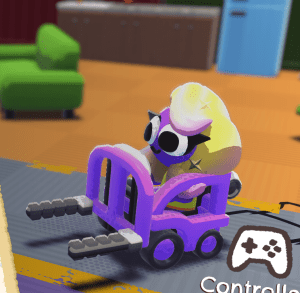
One of them is even this ridiculous Karen looking hair. If that doesn’t make Crashout Crew an all timer then I don’t know what does.
And with that, we’re done.
I’m acutely aware of how late I’ll be posting this. Thankfully, most developers leave their demos live after Next Fest concludes, so you should be able to play the demo for any titles that caught your eye.
And, again, don’t forget about wishlisting. It’s free, and helps a ton.
Did you enjoy what you read? Consider supporting my work by buying me a coffee over on Ko-fi.
 Frostilyte Writes
I only played two demos this time. A Story of Life: Tabitha which I liked and Cats & Cups which needs to grow on me but my mouse didn’t cooperate well with it.
LikeLiked by 1 person
I checked out Moonsigil Atlas and Dead Weight — both looking pretty good so far. Though I still can’t beat that bastard at the end of Moonsigil. I need to think more about the placement of those pieces.
LikeLiked by 1 person
Glad to hear! Well – glad you enjoyed the demos (not that the final guy is giving you some trouble).
I still need to go back and play some more of it myself, so I can try out the other class and see some of the other bosses. I only managed to get as far as beating the first boss before I decided to wrap it up, and move onto the next demo because I had 20 more to get through in the next 3 days.
LikeLiked by 1 person