Even though it’s been 3 months since I penned my Confidential Killings review, I’m going to feel like a bit of a broken record here by reiterating a point I made at the top of that review.
There are so many good Detective games now that we, the players, are completely spoiled for choice. Not a year goes by without a new one of these games leaving me in awe once I roll credits. Usually, that comes as a result of some new riff on a familiar foundation. For example, last year’s The Roottrees are Dead expanded on the search engine gameplay of Her Story giving the mechanic more depth, while also strengthening its integration within the game’s world.
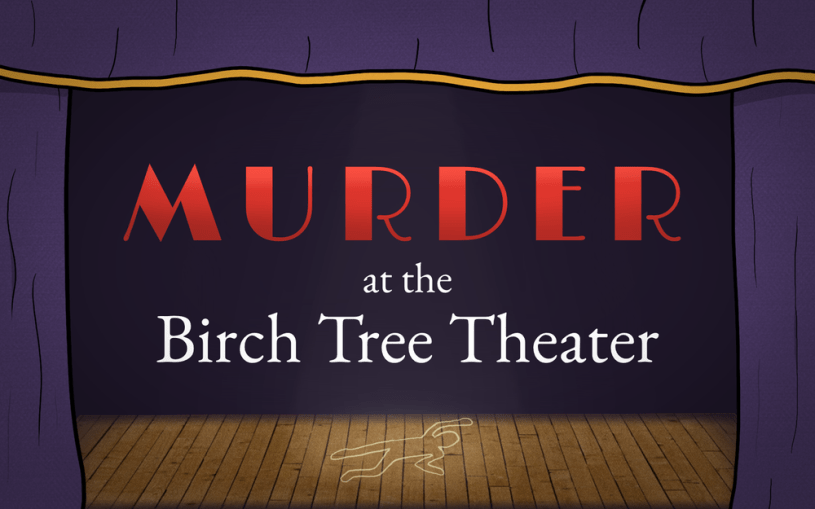
Unfortunately, this leaves good, but less ambitious titles, like Murder at the Birch Tree Theater, in a bit of an awkward spot. They’re perfectly well constructed, but I have a much harder time arguing why someone should check them out when there isn’t a new mechanical hook to anchor the experience.
That said, Birch Tree is a solo developed passion project that was created in the spare time of Mike Pettry, a composer and musician who has written and performed several pieces of music for film, television, and Broadway. It is exactly the type of game that we need more of. It’s a game that was made because its creator loves video games, and I believe that deserves to be celebrated.
Developer(s): Crucible Juice Games
Publisher(s): Crucible Juice Games
Release Date: March 16th, 2026
Released on: Windows, MacOS
Reviewed on: PC (Win)
Copy Provided by Developer
As I’ve already alluded to, Murder at Birch Tree Theater is a recently released Detective game by Mike Pettry. It heavily relies on the foundation that was established by Color Gray Games’ Golden Idol series. That is, players will explore a series of connected vignettes, examine the people and objects within those vignettes, and then try to piece together what happened. This is done through a fill-in-the-blanks puzzle, where you’ll need to apply the information you’ve gathered alongside some deductive reasoning to come to the intended solution.
While this is a great foundation to build from, it unfortunately invites comparisons to the Golden Idol games. I think quite highly of both of those, and I’m of the opinion that the puzzles in Birch Tree don’t quite measure up. I say this because many of the game’s chapters follow the same pattern for how players go about solving the fill-in-the-blanks puzzle. That is, you’ll rifle through the pockets of all of the characters within the scene, and inevitably find several handwritten notes that’ll outright explain who did what, when, and how. This doesn’t leave much for the player’s deductive reasoning, and ultimately results in puzzles that feel more like a test of if you were paying attention.
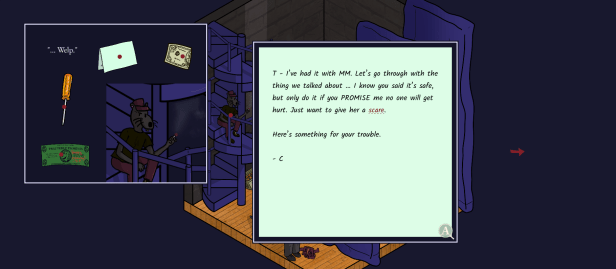
That said, there are a couple of chapters with additional curve balls that allow for players to piece together information without it being explicitly stated. One of my favourite examples of this was a puzzle in the final chapter where you’re meant to solve several riddles with each solution pointing you toward the location where you’ll find the next piece of the puzzle. Once you’ve collected all of the pieces, you’re then made to decode a message using a cipher. It’s a neat change of pace, and feels more puzzle-y than rifling through everyone’s pockets for handwritten notes.
However, as I said at the top of the review, Murder at the Birch Tree Theater isn’t trying to push the mechanical boundaries of Detective games. While I think the puzzles are on the weaker side, they’re still satisfying enough to solve. And focusing entirely on the puzzles ignores all of the other wonderful things that the game does, which is what I’d like to focus the remainder of the review on.
For starters, Pettry leverages their experience working in theatre as the bedrock for the game’s setting. All 9 of the game’s chapters take place within the eponymous Birch Tree Theater, which is a community theatre located somewhere in the American Mid-West. It’s the kind of location where small town folks with big dreams congregate while pining for the day that they’re finally discovered. It’s also the kind of space where personal drama, and cliques are liable to run rampant, which makes for an excellent setting for a whodunit story.
Though, I think the aspect of this setting that I appreciated the most was how many references Pettry crammed into Birch Tree. I’m not a theatre kid by any means, but still managed to clock Sweeny Todd, and Little Shop of Horrors when they came up. Mir also noticed a Chicago reference, which completely flew over my head since I’ve not seen it before.
That in mind, I have to assume that if you’re quite familiar with any of the referenced plays then you’ll get a lot more out of the references than I ever managed. Heck, during an appearance on the Post Games Podcast, Pettry even noted how they wrote some of the game’s music as a direct homage to the referenced plays with the hope that players would notice. As such, I’m confident in saying that if you love theatre, you’ll likely get a kick out of all of Birch Tree’s references.
Speaking of the music, Pettry, being a composer, wrote and performed all of the game’s music and holy shit. Birch Tree’s music is fantastic. It’s not the kind of music I’d typically get attached to – I strongly favour more upbeat tracks that you’d find in action-oriented titles – but I have to give credit where it’s due. Each of the game’s tracks perfectly compliment the associated scene, and help to set the mood. In fact, some of the tracks do such a good job at setting the ambiance that they disappear seamlessly into the background. That might not sound like high praise, but good music is kind of like good UI: when you don’t notice it, it’s doing a great job.
That said, I’m glad I went back and listened to each of the game’s tracks independent of playing Birch Tree. It was only then that I noticed just how gosh darn good the music was since it did such a superb job of accentuating every chapter throughout the game.
Finally, I wanted to touch on the story of Birch Tree, which I rather enjoyed. Each chapter does a fairly good job of answering questions laid out by the previous, while introducing some new hook to keep players on their toes. For example, and minor spoiler warning here, the game’s tutorial opens with recurring character Mason Wilder accusing the Birch Tree’s board of directors of corruption. We then hop 20 years into the past with the game’s first proper chapter, which left both me and my wife wondering if we’d get to see these alleged crimes play out in real-time. That’s a heck of a hook to lead with, and helped to anchor Birch Tree’s story, especially when the plot starts to heat up.
I also really appreciated the commitment to how the game ultimately concludes. I don’t want to spoil the specifics of the ending, so I’ll simply say: it was a bold choice. It’s exactly the kind of creatively brazen decision I love to see out of an independent project even though it’ll probably upset some people. Like my wife. It’s fine – I think she got over it after venting the next day over dinner.
Before we close things out there were 2 small criticisms I wanted to mention, starting with the game’s navigation: I thought it was a little fiddly. You’re made to navigate scenes by clicking on arrows that’ll take you to new screens within the current chapter. This works fine for smaller chapters, but it feels really clunky to navigate in the larger, later levels which feature upwards of 7 interconnected screens. In those specific instances, I think I’d have appreciated a map that let me hop directly to and from a specific location. It’d have been an improvement over slowly meandering from 1 side of the theatre to the other.
The second thing is just me being facetious: seeing the American spelling of theatre throughout the game drove me absolutely bonkers. I don’t know why you guys insist on spelling words differently than the rest of the English speaking world, but I guess that’s just one of those things that is what it is.
All said, I’m ultimately going to recommend Murder at the Birch Tree Theater. While I don’t think it does much to move Detective games forward, I do think the accompanying story, music, and setting do a lot to distinguish it from its contemporaries. It’s a video game that manages to combine 2 of its creator’s passions in a way that I feel celebrates a love for both of them.
However, if you can’t look past the derivative nature of Birch Tree’s mechanics then this might not be for you.
For my money, I thought the game was an excellent way to spend 2 evenings. As I already stated, this is exactly the kind of passion project we need to support more of across the industry. It shows a love for the medium that is sorely lacking in games made by studios with several thousand times the budget, and that ought to be celebrated.
Did you enjoy what you read? Consider supporting my work by buying me a coffee over on Ko-fi.

