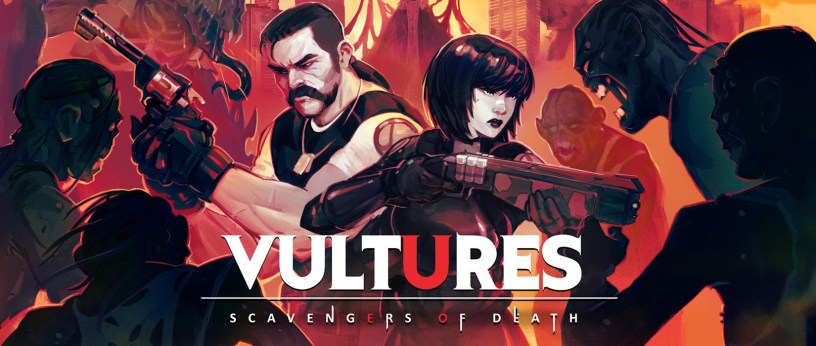
I think one of the most enjoyable things about running this blog has been when I’m affored the opportunity to see how fresh eyes will incorporate new ideas into established conventions. Games are a largely iterative field of art where developers are constantly adopting, improving, and remixing ideas. This leads to a ton of experimentation, at least in the indie scene, which produces a plethora of interesting, and (relatively) ambitious games.
Case in point, Vultures – Scavengers of Death is a genre mashup of Turn-Based Tactics and Survival Horror where you play as a group of military contractors fighting against a zombie invasion. It’s a very classic Survival Horror setup, though the inclusion of turn-based elements may seem incongruent at first brush. How exactly can a Horror game build, and release tension when everything acts in nice, orderly turns? That seems antithetical to the frantic scramble of aiming your weapon that this genre is typically known for.
Fortunately, Vultures has several answers to that question, but you’re going to have to read the remainder of the review if you want to find out what they are.
Developer(s): Team Vultures
Publisher(s): Firesquid, Gamersky Games
Release Date: May 13th, 2026
Released on: Windows
Reviewed on: PC (Win)
Copy Provided by Developer/Publisher
Let’s start by answering the big question: how exactly does a turn-based game build and release tension like a Horror title?
The answer is actually fairly straightforward: through encounter design. As it would turn out, there’s a lot of overlap between Tactics, and Horror when you lock the player into a small room, and tell them to fight their way out. It’s a scenario that asks the player to make careful decisions, while taking calculated risks otherwise they’ll quickly become overrun by a horde of zombies. Ergo, tension rises as players take risks, and is released once they finally overcome the challenge.
While not every encounter quite manages this balance, I do think enough of them do. Every mission throughout Vultures had at least a handful of times where I’d say to myself, “Shit. How do I get myself out of this one?”, which I appreciated. It meant that I was never totally comfortable while exploring the environment, which I’d argue is essential for a Horror title. It helps that it made for some fairly compelling tactical skirmishes too.
On that note, it isn’t just the encounter design that lends itself to both of Vultures’ constituent pieces: the weapons also manage to straddle a fairly nice balance between Survival Horror, and Tactics. To delve into exactly why that is, we need to talk about the pistol.
In keeping with tradition, the pistol can be aimed to target different body parts while shooting at enemies. However, there’s a catch: headshots cost more Action Points. Normally, headshots are balanced by the difficulty of performing them over simply shooting a zombie’s body. That’s not an issue in Vultures though because the player has all the time in the world to line up their shots during their turn. As such, headshots are balanced out by costing twice as much AP when compared to body shots.
As a direct result of this balancing, how you choose to shoot the pistol on a given turn becomes a really nuanced decision. Do you want to save ammo by going for a single high damage headshot, or is it better to take 3 consecutive shots at the oncoming horde? And that’s without considering your current ammo supply, which may alter your answer to the aforementioned question.
Furthermore, you could also target the legs of the reanimated corpses for a chance to temporarily immobilize them. This allows for a clean opportunity to reposition, which can be a valuable asset on future turns. Though, this isn’t a guarantee, so you’re always gambling with your ammo, and Action Points whenever you go for the high-value leg shots.
All of this culminates in an incredibly interesting weapon to use across the game’s encounters. There are so many decisions baked into simply firing the pistol at an enemy, which allows it to feel incredibly nuanced from a tactical perspective. All while emulating the same sorts of decision making that players make while scrambling to fire their weapon in a traditional Survival Horror title.
Honestly, I wish every weapon in Vultures was designed with this much consideration, but that’s unfortunately not the case. The pistol, and combat knife – both starting weapons – are among the only weapons that had this much thought put into how they could be used across combat. Many of the other unlockable weapons have only a single narrow use case, which makes them less interesting while also being generally less effective.
As a quick example, the second melee weapon, the stun rod, does comparable damage to the knife with a chance to cause paralysis. In practice, this is a strictly worse version of the knife owing to the fact that the stun rod requires ammo (batteries), whereas the knife doesn’t. The chance to temporarily stun an enemy is neat, but it doesn’t really distinguish the 2 weapons enough to where I ever seriously considered using the stun rod over the knife at any point throughout my playthrough.
Some of the other weapons are a little more obviously useful though, such as the shotgun which fires in a cone, and deals knockback. This gives the shotgun a unique niche that players can incorporate into their overarching approach to combat even though it isn’t as versatile as the pistol.
Before we move off combat and touch on other aspects of the game, I did want to mention the suite of combat maneuvers that are also available. Players can opt to reposition their foes with a push, which opens up a few gameplay benefits. Namely, if you push a zombie into a solid object, they’ll become stunned for a few turns, which can buy you some time to reposition, or reload your weapons. I loved this as it rewarded good positioning throughout the game, which always feels right at home in a Tactics game.
There’s also a grappling hook gun on the second playable character, Amber, which can be leveraged to pull enemies. This has some amazing utility in my favourite of the game’s levels where you’re exploring an apartment complex. The place is chock full of broken floor tiles, and Amber is able to dispatch foes without spending ammo provided she can either push, or pull them into the holes that are littered throughout the level.
Honestly, slight misgivings about some of the ancillary weapons aside, I loved the combat in Vultures. It feels super well put-together, and there’s enough variety across the game’s encounter design – both in terms of the physical layout of the spaces, and the types of baddies you’ll be fighting – that I could’ve easily played several additional missions worth of content. On that basis alone, I’d recommend the game, but I figured I should cover the other aspects of the game because not everyone is as single-mindedly focused on mechanics as I can be.
To that end, I’m a fairly big fan of what Vultures is putting down in the visuals department. The grainy camera filter, and blocky character designs put me in the mind of other Horror titles that I’ve played over the past several years including Crow Country, Eclipsium, and Mouthwashing. It’s a decidedly old-school approach to visuals, but I feel like it works wonders as Horror is often more effective when the player has to leverage their imagination as part of the experience. Ergo, the somewhat muddy visuals serve up exactly the kind of experience I wanted from Vultures.
That said, I do wish the visual appearance of enemies had a tad more variety. The bulk of the baddies are humanoid in appearance, so none of them ever had me saying, “what the hell is that?” That’s not necessarily a problem, but I do prefer when enemy designs are a little more unsettling. There’s only so much mileage you can get out of bipedal corpses after all.
As far as music is concerned, I think Vultures hit all the right beats. Most of the game’s tracks are sufficiently atmospheric with pregnant pauses or interludes of white noise. Given the turn-based nature of the game, this doesn’t always work quite as well as it would in a real-time offering, but I still felt like the sound did a good enough job of setting the stage. Doubly so since the same musical sting is used to announce combat, which will likely trigger an almost Pavlovian response in players by the time they’ve reached the credits.
I also rather enjoyed the story for what it was. The whole thing puts me in the mind of an 80s Action flick – the kind that’d be headlined by Stallone, or Schwarzenegger. It’s the sort of affair where you actively look forward to, and laugh alongside the cheesy 1-liners instead of groaning whenever they happen. The whole thing feels totally aware that it’s aping classic B-movie tropes, and I am here for it.
As a brief example of what I mean: within the first mission it’s established that the zombie outbreak stems from the local rich family doing illegal experiments in pursuit of immortality. They also sold the results of their research to a paramilitary group. And there’s a series of underground tunnels connecting all of the relevant locations to the game’s story via a secret subway. If that doesn’t wreak of B-Movie schlock then I don’t know what does.
Finally, to close out I wanted to briefly touch on bugs.
I’m of 2 minds here because many of the issues that I ran into while playing the review build were patched with relative haste. The 2 person development team pushed out a new patch just about every 48 hours over the past week, which usually fixed any of the issues I was running into. This meant that while I experienced spikes of frustration from running into bugs, the issue was addressed in short order.
As such, I decided to tackle the bulk of this review as if I hadn’t repeatedly slammed my head into a wall because I was actually having quite a bit of fun with Vultures outside of the bugs. Plus, all of the truly game breaking stuff that I found across my time with the game has been patched out, so anyone reading this review should have a much smoother experience than what I did.
So where does that leave Vultures – Scavengers of Death?
As I already stated, this is an easy thumbs up from me. The combat alone made the game worth experiencing, doubly so when I started trying to optimize fights to use as little ammo as possible. There are so many different decisions that players are afforded every turn, and I loved trying to find what felt like the most efficient path through each of the game’s fights.
That said, the smattering of more difficult fights that are deliberately placed to take players off-guard were always a pleasant surprise. Not in a conventional sense mind you. They’re the kind of surprise that I look for, and expect from a Survival Horror game – a moment to challenge the player when they’re getting too comfortable. The fact that Vultures can use these throughout its campaign without having them ever feel unfair is a true testament to how well put-together the game is.
Did you enjoy what you read? Consider supporting my work by buying me a coffee over on Ko-fi.


This sounds like such a cool concept that I think I have to give it a shot!
LikeLiked by 1 person
Looking forward to reading your thoughts if/when you decide to cover it. 🙂
LikeLiked by 1 person
This sounds super cool and original! I’m still playing through one of your previous suggestions (Cassette Beasts) but hopefully I can find time to give this a shot at some point too. Great post!
LikeLiked by 1 person
Thank you, thank you.
I hope you end up enjoying it. If I recall correctly you have much more experience with Resident Evil, so I think you might even get more out of Vultures than I did. Looking forward to your thoughts when you get around to it (same goes for Cassette Beasts if you decide to write about it too).
LikeLiked by 1 person
Thank you! I appreciate it – yes the visuals of Vultures definitely remind me of those early Resident Evil games, which has a certain charm. It certainly adds to my eagerness to give it a go myself – and I hope I find time to write about it too. Cassette Beasts is certainly on my list of post ideas, if and when I finish it. As a Steel type fan in Pokémon, I have been attempting to play in a similar way and focus on the Metal type in Cassette Beasts, which has been a fun way to approach it!
LikeLiked by 1 person
I could see that being particularly challenging – going for a mono-team – given how Cassette Beasts tends to rewards players for using a wide array of types (much in the same way as Pokemon). Sounds like an interesting challenge tho – especially given what I know of the later fights in the game.
LikeLiked by 1 person
Yeah, so far I haven’t had too many issues, but I am wondering if I might run into some troubles in later battles, as the game is clearly teaching me to learn all the different status effects and how to cause (and avoid) them. I’ll keep focused on Metal for now and see how it goes!
LikeLiked by 1 person