
Full disclosure: I wasn’t planning to write a full article for any of the games that I mentioned during my Thinky Direct recap as part of my Next Fest coverage. My thought process there was that I’d already called attention to the games in question, thus it made sense to spotlight other games. That said, I was so taken by the demo for Prophet Margin that I had to write about it.
Unlike last time, I have a much better handle on how to describe Prophet Margin now that I’ve played the demo. It’s a game about establishing, and managing trade routes. The gist is that you’re given a randomly generated archipelago that’s covered in resource nodes, which you’ll need to harvest, and trade among settlements. This is all done in service of preparing tribute for the local Gods, so that you can win their favour in pursuit of a bigger economic empire.
However, the natural resource nodes scattered across the map always contain raw materials, which are too paltry an offering for the Gods. No – you’ll need to process your ill gotten gains into fine fabrics, industrial tools, or powerful potions before you can offer them up as tribute. As such, you’ll need to establish a trade route that moves those raw materials through settlements, while simultaneously converting them into an appropriately auspicious offering.
That said, there is a catch to all of this: you can’t harvest raw materials indefinitely. Sooner, or later you will run out. Therefore, Prophet Margin isn’t just a game about establishing trade routes. Rather, it’s a game about extracting the most value from all of your trade routes.
This is where the first of several mechanical hitches within Prophet Margin is introduced: every time a good moves through a settlement, its value is increased. As such, it behooves the player to make extremely complex trade routes that see a particular item change hands multiple times before it is sacrificed. This will ensure that they’re maximizing all of the potential value out of every extracted resource.
Honestly, I’d have been happy to continue playing Prophet Margin if this was all that there was to it. In fact, this is all that I assumed it would be based on the trailer from the Thinky Direct. Trying to optimize your supply chain is already challenging enough that a suitably compelling game could’ve been built around it..
However, Prophet Margin is a much more involved game thanks to a few additional mechanical wrenches. Namely this:
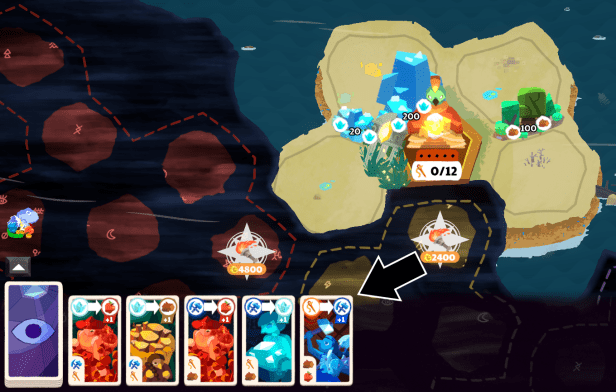
Now, before any of you run away in disgust, let me explain.
Prophet Margin provides players with a deck of cards where each card represents a city that they can build. Each card has a primary import, and export listed, which will determine how you can utilize it across your supply chain. Ergo, a portion of optimizing your trade routes isn’t just mapping out the longest potential route for a particular raw resource. Instead, you’ll want to consider what resource nodes are available, what the Gods desire for tribute, and which settlements are available within your deck. It’s a balancing act that adds a surprising amount of depth to decision making. For example, there were multiple times throughout the demo where I had to make concessions on my ideal supply chain design entirely because I didn’t have the card I needed within my hand, nor was it available in my deck. This forced me to pivot, and evaluate other potential solutions before I eventually arrived at a desirable outcome.
Basically, having all of the towns be abstracted as cards gives players an additional axis to manage, which helps to prevent situations where there’s an easy best case solution. For my money, this made solving the problem of how to best maximize my trade routes a far more interesting one to solve than it would’ve been were I able to freely choose each village type.
Having said that, there is more to utilizing the cards in your hand than simply drawing, and playing them. Namely, there’s a Solitaire-esque mechanic where players can stack cards that share an import, or export resource type. This will free up space in their hand so that they’re able to draw additional cards. However, only the top-most card in a pile is playable, so there’s an element of strategy here too. For example, if you’re fishing for a particular type of card, you won’t want to bury the other relevant cards within the bowels of your hand.
It’s also possible to fuse 3 cards of the same import, or export type into a singular powerful wildcard. For example, if you stack 3 cards that use food as an import then they’ll fuse down into a new card that imports apples, but exports everything. This can be extremely effective for helping to plug gaps in your supply chain, but it comes at the cost of using 3 of your available cards. As such, players will need to weigh the value in having a wildcard settlement with the cost of producing it in the first place.
Though, I would caution against going all in on wildcards. Creating them can clog up your hand, which is a whole other can of worms.
That said, I love this card-based system for towns. I was afraid that the cards would be totally vestigial like they are in so many other games, but developer Stellar Cartography Interactive has implemented them so well here. Having a limit on which types of cities you have available at a given time, while also providing players with a flexible way to manage their hand adds an additional layer of decision making to Prophet Margin – one which provides a host of additional depth. It’s the kind of thing that’d be liable to give you analysis paralysis, but I was totally enraptured by trying to figure out how to balance which cards were in my hand with how I wanted to play the board. It had me spinning my gears for several hours while I tried to work out what I believed to be the best possible solutions.
And you know what’s crazy? That’s not even the full breadth of mechanics on offer. You can also create a trade route that loops around on itself, which generates money. This is important for 2 reasons: an ever increasing amount of cash is required to establish new trade routes, and purchasing new land costs a boat load of cash. Ergo, you’ll have to manage everything that I’ve already mentioned, while also shuffling resources around to ensure that you’re generating enough moolah for expanding your economic empire.
As I said above, were Prophet Margin simply a game about optimizing trade routes, I’d have enjoyed toiling away with it. However, it is so much more. It’s a game that is packed to the gills with nuanced decision making. There’s seldom an easily forged correct answer for how to best layout your supply chain, and every decision that you make comes at the cost of another. This results in one of the most compellingly complex strategy titles that I’ve played in quite some time.
I feel like a bit of a broken record for saying it, but I’m keen to see more of Prophet Margin after having played the demo. Hell, I had so much fun with it that I snuck in another play session before I started writing this article. It was that good.
If you would like to try Prophet Margin for yourself, then you can download and play the demo right now as part of Next Fest. Don’t forget to wishlist it if you enjoyed the demo, so you’ll receive an email alert when the game releases fully.
Did you enjoy what you read? Consider supporting my work by buying me a coffee over on Ko-fi.


Thank you so much for review my game! I’m really happy you enjoyed 🙂
LikeLiked by 2 people
You’re welcome!
And thank you for shouting out the article over on your Bluesky. 🙂
Really looking forward to playing some more once you’ve finished the game.
LikeLiked by 1 person