
I never would’ve expected the next game from Evil Trout to come so hot off the heels of last year’s excellent The Roottrees are Dead. Good video games are not something that one can manifest into existence with sheer force of will after all. They take time. Energy. Creativity. And that’s without considering all of the work that artists leave on the cutting room floor before they finally share what they’ve been working on.
However, Evil Trout has a bit of a leg up in this regard. Namely because they’ve been focused on remastering lesser known games, so that a wider audience can experience how excellent they are. For instance, Roottrees began life as a free browser game. However, it generated far more buzz after it was released on Steam with a bevy of new features, a visual uplift, and an additional mystery to solve.
Though, I’m sure the shout-out from Bloomberg’s Jason Schreier also helped a ton too.
Regardless, Evil Trout have gone with a similar strategy for their latest release: The Incident at Galley House. It’s a complete overhaul of the award winning Type Help, which they’ve been working on in collaboration with the game’s original creator William Rous. The result is a frankly staggering reimagining of the text-bound Type Help that I believe will capture the hearts of both newcomers, and those who played and loved the original.
Developer(s): William Rous, Evil Trout Inc.
Publisher(s): Evil Trout Inc.
Release Date: July 14th, 2026
Released on: Windows, MacOS, SteamOS
Reviewed on: Windows
Copy Provided by Publisher
As I’m sure you’ve already surmised, The Incident at Galley House is a Detective game. You’ll be investigating the titular incident wherein 11 individuals meet their untimely end. Unfortunately, no one survived the tragedy. Ergo, there aren’t any witnesses, nor is there any record of what actually happened.
So that raises the question: how exactly will you be conducting your investigation?
As luck would have it, you’re in possession of a machine straight out of a sci-fi novel. It has the ability to show its user events that have already transpired. There’s a catch though: the machine can’t bring up events at random. It requires the relative time of an event, where it took place, and who was in attendance. As such, you’ll need to construct an entire timeline of events that tracks each of the victims throughout their time at Galley House, so you can eventually work out what exactly happened.
To that end, the bulk of Galley House’s core gameplay loop consists of identifying new scenes, listening to them, and pulling them apart for information. Where people were, where they’re going, and what they discussed all become potential clues as you piece together an otherwise highly obfuscated timeline. It’s exactly the kind of meticulous scrutinizing that made pouring over the likes of Roottrees so compelling, and I’m of the opinion that it’s just as compelling here.
That said, all of this deductive reasoning is now accompanied by a myriad of new features that weren’t available in the original Type Help. Chief among these changes is how the title is no longer shackled to a command line interface. As someone who used to work in software, I’m no stranger to CLIs, but I know they’re not for everyone. In fact, Type Help’s use of a CLI for everything was one of the most cited criticisms I heard while recommending the game to others. However, that’s no longer a barrier with Galley House featuring a ton of beautiful artwork, and a fully featured point-and-click UI.
On that note, I think the thing that I was most impressed by with regard to the newly added visuals was how much the titular house itself has come to life. Anyone who played the original Type Help will be keenly aware of how infrequently the writing chooses to describe anything that isn’t plot relevant. For all intents and purposes, Galley House might as well have been a series of connected white boxes that were completely bereft of any sort of furnishing save for a fireplace, piano, and several beds.
However, Galley House is a blank slate no longer. The living room has been transformed into a vibrant room for entertaining guests with a fireplace sitting at its centre. Each of the guest bedrooms has a distinct look, and theme that helps to tie them into the collective whole of the house. It might sound hyperbolic, but the folks at Evil Trout have done a marvelous job turning what was otherwise a nondescript dwelling into a living, breathing space – one that feels like it has a rich history beyond the scope of the game’s story.
It isn’t just the titular manor that received this treatment however, as the entire cast of Galley House received just as much attention to detail. Each of them feels a little more real now owing to the additional visual flair that comes with having a full body portrait to show exactly how they look. All of their lines are also fully voice acted, which helps to further bring each member of the game’s cast to life in a way that the original text couldn’t convey. The result is characters that, similar to Galley House itself, feel a lot more rooted in reality, which makes their eventual demise even more tragic.
Though, these changes aren’t just in service of Galley House’s visuals: they also bleed over into gameplay. When you begin your investigation, none of the portraits will be correctly assigned to any of the members of the house, so players will need to correctly puzzle out who’s who. This doesn’t ultimately affect the cadence of the investigation, but it is a neat little bonus bit of puzzling. I especially enjoyed how details that the text does call attention to were always accounted for within the portraits, which makes identifying a few of them a little easier for astute investigators.
Identifying who’s who with the new character portraits isn’t the only change to Galley House’s puzzles however. Several pieces of the original game’s story received minor writing revisions, and there are a host of additional puzzles for returning players to solve. I do not want to divulge the nature of these changes as that would actively undermine the puzzles that are associated with them, so, unfortunately, I’m going to have to ask you to take me at my word on this one. Having said that, I thought the changes did a great job of patching up how abruptly the original game ended, and thus finishing Galley House feels a little more satisfying when compared against Type Help.
Before closing things out, there are a few additional quality of life improvements that I wanted to highlight starting with the addition of a hint system. As some of you will already know, I lamented how there weren’t any in-game hints for Type Help, which meant I got stuck without recourse a handful of times during my investigation. That is no longer the case, which is huge. The newly added system also offers advice in graduated hints much like Roottrees. That is, the hints start by prompting you to look in a specific direction before outright telling you what you need to do to progress. I’m still a really big fan of this system as it gives players one additional opportunity to make progress, while still offering help to those who’re well and truly stumped.
Alongside the hints, there’s also a notebook for jotting down your observations, a search engine that’ll bring up every scene that contains the word within your query, the ability to bookmark every line of dialogue, and a directory that’ll bring up every scene associated with a particular room of the house. All 4 of these features make it far easier to keep track of the smaller details while you’re pouring over conversations without needing to scribble notes for yourself outside of the game. It also makes returning to dialogue from a previously observed scene a lot easier since you won’t necessarily need to remember exactly which scene you’re looking for. You can instead rely on searching up a specific phrase, keyword, or a bookmark to quickly return to a specific spot, and continue your investigation.
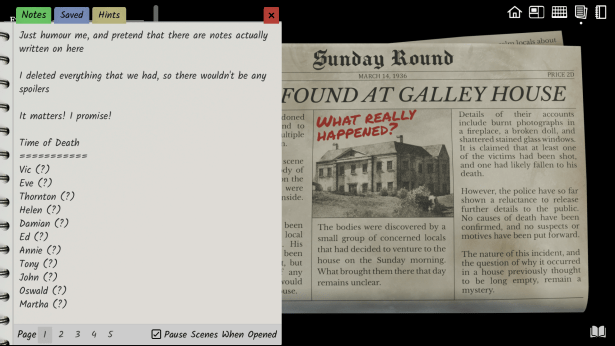
Having said that, I do wish there was 1 additional change from Type Help: a way to mark when someone died. I feel like that would’ve been an obvious addition, but neither my wife nor I could find a way to do this while playing. As such, I ended up redoing what I’d done with Type Help where I simply kept track of when a character died within my notes, and cross referenced that information throughout our investigation. Hopefully that’s an easy change to make because I think it’d feel right at home alongside the myriad of other QoL changes that feature throughout Galley House.
In all honesty, I feel like you already knew that I was going to recommend The Incident at Galley House before making it this far in the review. It is a direct improvement over Type Help in every regard, which is saying something because that game was excellent. That said, the newly added visual, and audio changes really help to bring the whole game’s setting to life in a way that the text-bound original couldn’t muster. That, alongside an excellent mystery to unravel, and a bevy of new QoL changes make Galley House an easy recommendation, especially if you’re already predisposed to Detective games like I am.
And even if you’ve played Type Help, I think Galley House is well worth a playthrough. I was quite light on the details within my review for spoiler reasons, but the story changes, I think, more than justify playing through the game a second time. I said it already, but I felt a lot more satisfied by the eventual outcome here than I did while playing the original. There’s just a little more pomp and circumstance when the dust finally settles here.
Either way, The Incident at Galley House should be a must play title for Detective game enjoyers, and I’d hazard a guess that it’ll rank among the year’s best Puzzle games once December rolls around.
Did you enjoy what you read? Consider supporting my work by buying me a coffee over on Ko-fi.

