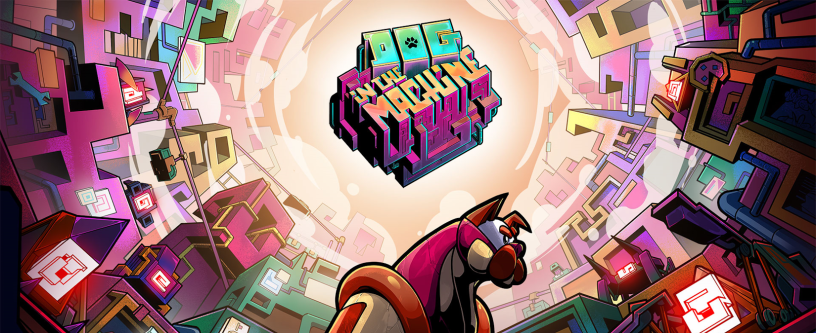
I feel like I’ve been seeing a lot of games lately that feature a blended Action Point system. That is, instead of having a distinct movement action that can be expended each turn, these games hand players a lump sum of AP and ask them to use it however they see fit.
There’s a couple of unique consequences of designing a Tactics game in this fashion, but the one that I find most interesting is how it widens what a player can do each turn. For example, if you want to spend several actions to reposition in an oddly specific, multi-step way then you’re able to do so since you’re not limited by a single movement action. Conversely, you could also just…not move at all, and use the extra AP on additional attacks, or supportive actions.
I won’t profess to know precisely why I’ve seen an uptick in games with this implementation of AP, but I can say that it works wonders in the subject of today’s review: Dog in the Machine. It’s a game where each turn challenges the player to unravel a seemingly insurmountable scenario. However, measured use of your AP will see you dodge, shove, and dismantle all of your opposition in this cleverly designed title.
Developer(s): Studio Chahut
Publisher(s): Goblinz Publishing
Release Date: September 29th, 2026
Released on: Windows, MacOS
Reviewed on: PC (Win)
Copy Provided by Publisher
So, Dog in the Machine is a Tactics game, correct?
Yes, and no.
It’d be more correct to call it a genre blend of Tactics with a Roguelike gameplay twist. Think Into the Breach, but with the rewind feature from Tactical Breach Wizards and you’re nine-tenths of the way there. In fact, the comparison goes further because Dog in the Machine feels just as puzzley as either of those aforementioned games do, which makes sense given the shared similarities.
Basically, you’re plopped into a 6 by 6 grid filled with enemies, hazards, and random bits of environment. You’re then tasked with defeating all of the enemies to escape, and move onto the next node. So far, so standard.
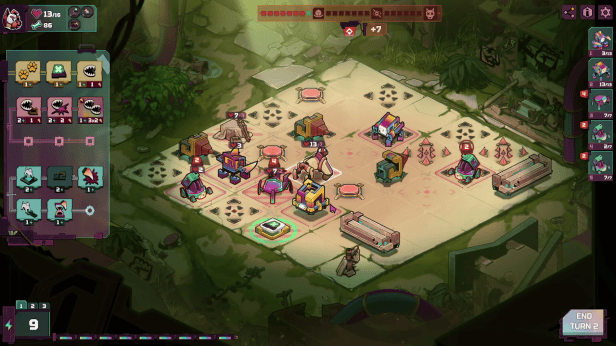
Where things start to get a little different is in how your abilities are categorized. There are 2 categories: Attacks, and Tricks. Attacks are self explanatory, so I’ll focus instead on the more interesting Tricks. These are (mostly) passive parameters that augment the next attack that you perform. For example, Ferocious causes your next attack to deal 1 additional damage. As such, you’d ideally want to perform Ferocious before you perform an attack that can take advantage of it.
Okay, so the game has combos? Why does that matter?
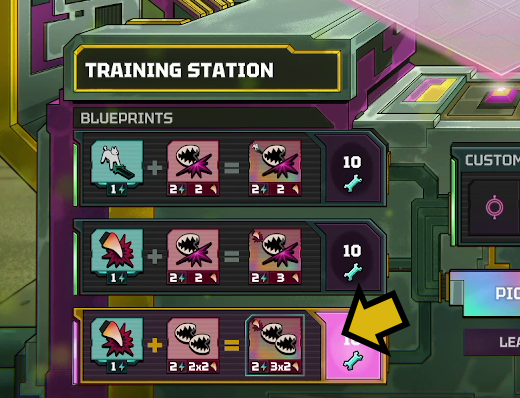
Well, to answer that we need only look at how Training Stations work. Here you’ll improve 1 of your Attacks, by augmenting it with one of your Tricks. For example, instead of manually using Ferocious, we could instead have Ferocious automatically combo before one of our attacks so that it’ll always do additional damage.
Again, I hear you asking, why does this matter?
For starters, you no longer have to manually use Ferocious, which means that the Action Point that it costs to use can now be leveraged for something else. Furthermore, you’re only able to use each of your abilities (Tricks, or Attacks) once per turn. By augmenting an Attack with Ferocious, we’re now able to use it twice in a single turn – once as part of the upgraded Attack, and another additional time by performing the standalone Trick.
That’s all a really long way of saying that Dog in the Machine is a game primarily about combining multiple Tricks together with an Attack to create these truly heinous combos that cost very little AP, but have a devastating impact.
And it’s a good thing that you’re able to do this since the game is hell bent on putting you into situations that, at first brush, seem unwinnable.
In order to properly explain how it creates these seemingly unwinnable scenarios, we first need to talk about the Alarm System. It’s basically a secondary health bar that is split into 3 partitions. As each partition fills, you’re hit with a debuff that makes combat more challenging, and you lose the run when the bar is completely full.
To that end, every turn a random smattering of enemies will threaten to raise the Alarm, which can only be countered by attacking said enemies. This means that players are forced to walk a tightrope wherein they puzzle out exactly how to eliminate all of the Alarm raising enemies before they run out of AP. In combination with an infinite rewind, this turns each turn into an interesting combat puzzle that I always had a joy trying to solve.
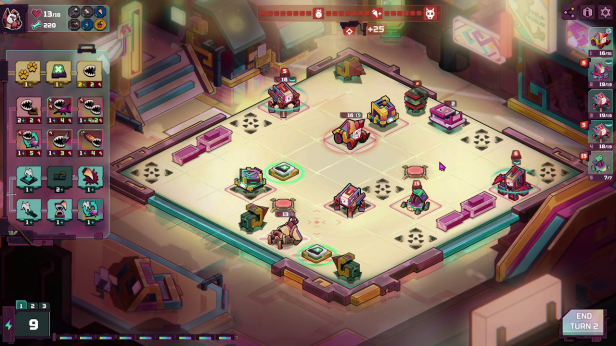
It’s also worth acknowledging that the puzzley nature of combat helps to encourage liberal use of the rewind mechanic, which I think is a good thing. Players essentially have infinite freedom to experiment with, and poke at each turn of combat until they can find the perfect solution given their available resources. Generally speaking, I think that’s a good thing because it helps to coax the player into using their full complement of available tools, which will ultimately lend to a better understanding of said tools across multiple playthroughs.
Plus, rewinding helps to keep Dog in the Machine from feeling extraordinarily punitive. I say this because there are environmental hazards littered throughout each of the game’s randomly generated maps. It’s fairly easy to predict how one such hazard will interact with your actions, but things become a lot more murky when you accidentally kick off a 10 part chain reaction. I couldn’t even tell you the number of times where I accidentally killed myself with what seemed like an otherwise innocuous attack because I didn’t correctly anticipate all of the follow-up nonsense I was about to kick off.
That said, some of the funniest – and I mean laugh-out-loud funny – moments I experienced while playing Dog in the Machine manifested for this exact reason. I wish I had footage of it, but there was 1 turn where I pushed an enemy hoping they’d collide with another, and this kicked off a chain reaction that killed 80% of the board. It was akin to a Mr Bean sketch. You do this fairly unassuming thing, and then accidentally destroy everything. It was great.
Honestly, I think my only real point of contention with Dog in the Machine is that it’s a Roguelike, but doesn’t really have the level of variety that I’d want from such a title. For instance, the game’s store page advertises 8 different playable classes (or dog breeds), but I’d argue that there’s only 2.
Essentially, there’s 2 broad categories of dogs with 4 subclasses a piece. While the 4 subclasses start off unique, they share the same pool of Attacks, and Tricks. This means that you’ll invariably run into the same handful of abilities each run, and will likely combine them in familiar ways. That’s fine, but it means that a Shover, Juggler, Toy Master, and Wrestler all feel similar to the point where, I’d argue, they’re fundamentally the same class.
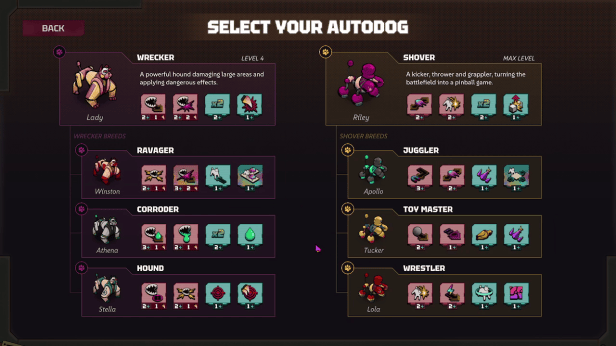
This holds true for the environments, and enemies as well. You’ll cycle through the same pool of biomes (and their associated hazards) each run, and will likely defeat at least 1 of every single enemy (and boss) type by the time you’ve won. That can make runs feel a little less engaging – like you’re simply going through the motions – instead of providing the player with truly unique problems to solve each time they start another run.
To be clear, neither of these complaints are deal breakers on their own, but in tandem it makes me wonder why Studio Chahut decided to make a Roguelike. It doesn’t seem like they had the breadth of ideas needed to really flesh out the otherwise excellent bones that they have on offer here. As such, Dog in the Machine feels a little threadbare, despite how enjoyable it otherwise was to play.
All considered, I would ultimately still recommend Dog in the Machine, but that recommendation does come with a qualifier. I think the tactics are excellent, and a lot of the supporting systems, and mechanics work wonders. It manages to deliver a tactical experience that’s both fun to pick apart, and genuinely funny when something goes horribly wrong, or right.
That said, I don’t know that the Roguelike format really works here. The game gets a little repetitive after you’ve completed a handful of runs, and I wasn’t terribly motivated to continue playing once I completed a handful of runs with each of the game’s different subclasses.
So, if you’re in the market for a new tactical game then you’d be well served here. Dog in the Machine is a buffet of tactical goodness with a few unique twists that help to give it a distinct identity of its own.
However, if you’re looking for your next Roguelike addition then this probably won’t be it.
Did you enjoy what you read? Consider supporting my work by buying me a coffee over on Ko-fi.

