
There’s a common media trope known as the Friendly Rivalry. You’re probably already familiar with it. It occurs when the protagonist, and a secondary character have a recurring competition to outdo one another. The specifics beyond that aren’t terribly important. However, it is worth noting that the involved parties usually develop a respect for each other throughout the process.
One of my personal favourite rivalries takes place in the original Dragon Ball anime between Goku, and Krillan. Goku has the clear advantage, but only achieves his full potential because Krillan continually pushes him to become stronger. The inverse is also true: Krillan’s first appearance demonstrates a huge ego with nothing to back it up. However, his desire to surpass Goku drives him to become far stronger than he’d have ever managed by training on his own.
That constant ebb and flow between 2 combatants in perpetual competition makes for great storytelling, which is likely why the friendly rivalry has cemented itself as a trope. However, I also believe it has the power to help players improve at fighting games. You could find yourself locked in a continuous cycle of improvement, just like Goku and Krillan, given the right opponent. And over repeated training sessions, the two of you could break through barriers that used to seem impassable.
My On-Going Rivalry with Totsu
Instead of trying to explain why I think rivalries can be so helpful, I’ll instead share a story. My friend Totsu, and I are the single best example I can share on the subject of rivalry. We’ve been playing on-again, off-again with one another for the better part of the past 2 years. Usually this manifests in playing longer sets on Friday evening after I get off work, but our exact cadence can fluctuate quite a bit. Throughout that time, we’ve helped to mould one another into far stronger players through practice, feedback, and a genuine desire to see each other grow. It’s great. Everyone needs a Totsu.
It all began when I was looking to get more practice against Ky in Guilty Gear Strive. I found him particularly challenging to fight, despite most folks claiming he was easy to beat, especially as May. This led me to reach out to Totsu to ask for long sets (30+ games) as a means to practice. Thankfully, Totsu agreed despite being a far stronger player than I was at the time. He used the time to refine his existing skills, while I got the opportunity to practice against the same handful of techniques I was really struggling against.
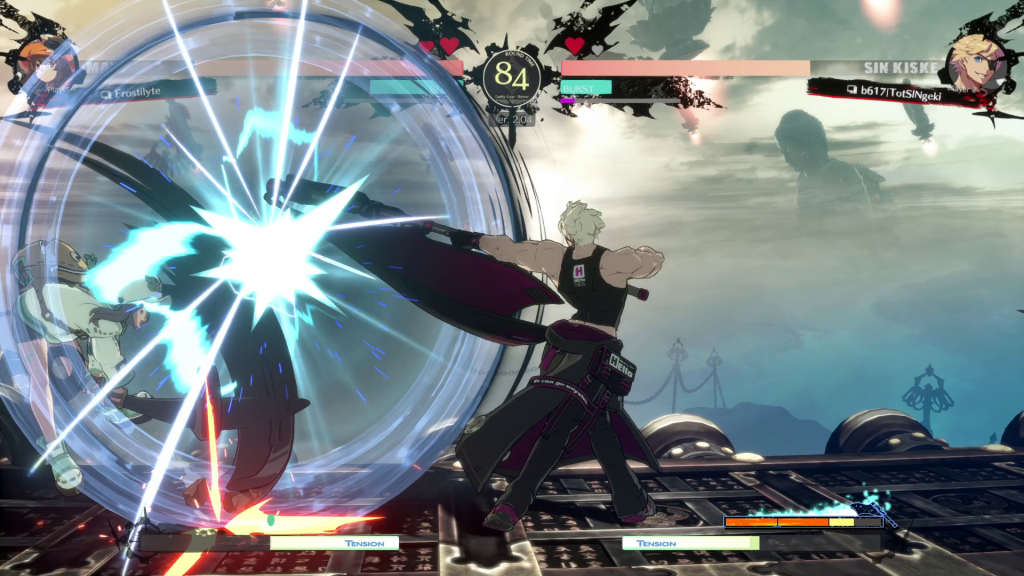
It was a win-win! Except it wasn’t.
I’m under no illusion that Totsu appreciated the time we spent playing together. We’re both firm believers that practice against a live opponent is always more effective than repeatedly smacking the dummy in training mode. However, I didn’t feel like I was getting much out of our sets. I’d occasionally win, but I couldn’t quite piece together why. What was I doing differently when I won? Fighting Ky still felt like a complete mystery even though we’d collectively put in a dozen hours of practice. What was I missing?
So I did what I always do when I have questions: I asked. I asked Totsu what I was doing well, and, crucially, what I needed to start doing. He then spent some time walking me through why certain attacks were really strong for May, and how I could go about better utilizing them. I’m fairly certain I cut him off before finishing because he’d already overloaded my brain, so we called it there for the day.
The next time we played, I would remind myself of the advice I had received from Totsu, and would try to apply it. This usually gave way to a ton of immediate success until Totsu figured out how to deal with whatever it was that I was doing. I’d then hit another wall, and would invariably ask about how to counter whatever he was doing after we’d finished, thus repeating the cycle.
Somewhere along the way, I developed my analysis skills. I couldn’t tell you when it happened, but it did. Totsu’s biggest strength as a player is his analytical skills, and I’m guessing I learned through osmosis. It was at this point that I was no longer solely reliant on his advice. I could come up with my own solutions to problems I encountered, and I started learning how to adapt my play mid-match.
It was at this point that we started going even during our Friday Night Fisticuffs, and, on rare occasions, I even managed to walk away with more wins than losses. Finally! Results!

Unfortunately, these positive results started a bit of an arms race between the 2 of us. We’re both fairly competitive, and hate losing. When I’d finally demonstrated that I could win, that gave Totsu renewed resolve to beat me. This took many different forms, but most commonly it would involve cleaning up his existing fundamentals, practicing a new higher damage combo route, or gaining a better understanding of system level mechanics in Guilty Gear Strive. This, in turn, would prompt me to do the same thing. Every Friday was a testing ground to prove who had the more effective week of training. The results don’t lie, and only one of us was walking away the winner.
What was really cool is that neither of us were interested in holding these advantages for a prolonged amount of time. We’d still chat about our games afterwards, and point out what we’d been doing, or where we thought the other player needed to make improvements. In fact, I’d hazard a guess that we probably learned more during our discussions as we were no longer focused on destroying one another. It was a space to breathe, process, and learn. Hopefully we could apply those teachings in the following week, which would allow us to continue pushing one another to greater heights.
I’m a firm believer that my relationship with Totsu really encapsulates the benefits of a healthy rivalry. There is an understanding that we both want to improve, and know the best way of doing that is to keep our training partner sharp. We actively discuss strategy, and help one another solve problems as we encounter them. This has continued to help us improve even when we’re not actively playing.
Speedrunning With My Future Brother-in-Law
Up until now, I’ve focused almost exclusively on fighting games. While that is where I’ve derived the most benefit from friendly rivalries, it isn’t the only place where having someone equally willing to bash their skull into mine has led to a better experience. No – I’ve also experienced similar benefits while playing Neon White.
I wrote about Neon White last year, but the elevator pitch is that it’s a platforming game that encourages players to speedrun. Each level is designed loosely enough so that players are able to skip past entire subsections with clever use of their different abilities. It’s a game that makes you feel quite clever as you discover various shortcuts. That’s doubly true if you manage to find one that lets you blow past the developer’s best completion time for any given level.
Anyway, I bought Will a copy of the game for his birthday this past year because I thought he’d enjoy it. To my credit, I was correct, but I could have never predicted how this would transform my own experience with the game for the better.
Shortly after starting the game, Will let me know that he was enjoying Neon White. He also told me that he was systematically beating every single one of my completion times. Neon White shares a leaderboard of your friend’s best times, alongside the global leaderboard, which makes determining this information very easy. It also fueled a competition between the 2 of us.
For the next several weeks, I’d boot up Neon White after work and would go through beating a handful of Will’s times on a variety of different levels. He’d then burn the midnight oil while reclaiming every single one of the best times. We’d rinse, and repeat the next day, while continually sending good natured taunts to one another through discord.

What’s great about all of this, was how it pushed the 2 of us to understand the mechanics of Neon White to a much greater degree. You really come to appreciate just how flexible some of your different tools are as you fight to shave another 200 milliseconds off your best time. There’s also the thrill of either finding a new skip that saves several seconds, or finally working out how your rival managed to drop their time by so much.
I know it won’t be everyone’s cup of tea, but, similar to my on-going arm’s race with Totsu, repeatedly competing with Will opened up a whole new dimension to Neon White’s gameplay. We both really embraced the speedrunning mindset that sits at the heart of the game’s design, and I had an even better time replaying it earlier this year.
Well there you have it – 2 different times where a friendly rivalry helped me to actively improve at a game. Keep in mind, this only worked out because I am a fairly competitive person to begin with. I’m not entirely certain that I’d have enjoyed either Guilty Gear Strive, or Neon White in this way were it not for my desire to both compete with my friends, and with myself.
Having said that, I do believe there’s a lot of value in developing friendly rivalries. Both Totsu, and I helped to shape one another into better competitors, and further develop our understanding of fighting game fundamentals. And in the case of Will, and I playing Neon White, we were able to better tap into the core of what makes speedrunning so enjoyable. You don’t need a rivalry in either case, but having one helped to facilitate a much more enjoyable experience for all parties involved within the stories I’ve shared.
So what are you waiting for? Try engaging with the community of games you enjoy, or try to get your existing friend group involved in new games that you’d like to play, and compete in. You might just find yourself enjoying those games better with the added thrill of some friendly competition.
 Frostilyte Writes