Welcome back.
I reread last month’s MiR post, and realized something: I didn’t actually describe what most of the games I wrote about actually were. On one hand, I feel like some of them (ex. Street Fighter 6) are games that require no introduction. However, I do end up playing a handful of titles that I’d hazard a guess most people haven’t heard of, or that they’ve only heard about in passing. That in mind, I’m going to make a better effort to describe some 1-off stuff that makes an appearance here. Returning visitors are still going to be talked about like a familiar friend though.
That said, let’s get into things with Peglin.
Peglin
Some of you might have already clocked this from its name, but Peglin is an alternative take on Peggle.
For those unfamiliar, Peggle is a game where players shoot a ball onto a peg-covered game-board, and try to hit as many pegs as possible before the ball falls through the bottom. It’s a bit like Pachinko, though I’m unsure if that’s a relevant frame of reference for the majority of my readership. Regardless, it’s a simple, but well-executed concept, and is fun to boot.
Peglin is much the same deal, but with some added elements of deckbuilding for good measure. Instead of drafting cards, players will draft different balls which have their own bespoke effects. What’s interesting here is that, much like in deck builders, there are synergies that players can find between different balls. In this way, there’s an additional meta-layer to Peglin’s gameplay. It isn’t just about how players take their shots – they also want to build a “deck” with complimentary ball effects.
While I had fun with it, I wasn’t over the moon with Peglin. It was fun enough for about a dozen hours, but I started seeing a lot of repeating content by the 6 hour mark, and decided to drop the game once I’d finished half a dozen runs. The initial novelty of the concept had worn off by that point, and individual runs of Peglin started to blend together.
A big contributing factor for that last point about runs blending together is Peglin’s lack of “deck” variety. Each of the game’s 4 classes feature unique ball types, which help to differentiate them from one another. Unfortunately, these same unique balls tend to completely define what strategies actually work with said character, so you end up using the majority of them in a given run. This substantially cuts down on the run-to-run variety, and ends up making individual games of Peglin feel a lot less distinct, which is why Peglin’s novelty wore off so quickly for me.
Despite my misgivings, Peglin is a good bit of fun, and I would still recommend it. That’s a soft recommendation though. Unless you love Peggle in which case you probably already bought the game before you finished reading this.
Thank Goodness You’re Here
There’s this Monty Python sketch that I really enjoy where a group of men are attending a self-defense class. However, there is a twist: they’re learning to defend themselves from fruit. The entire time, all the members of the class are deeply annoyed by this, but the instructor repeatedly insists that learning to defend yourself from fruit is sensible, and necessary.
Evidently, none of the members of the class have had a run-in with Agent 47 from Hitman.
Regardless, I bring up this Monty Python’s sketch because I think it encapsulates why Thank Goodness You’re Here is so funny. It’s an incredibly dry comedy game that delivers its jokes in much the same way. You’re constantly put into these situations that are just strange enough, but they’re played completely straight. I found this highly entertaining, and it made the whole game feel a bit like an interactive British comedy sketch. In fact, now that I’ve written it out, I’m realizing that’s probably what the folks at Coal Supper were going for. Kudos, folks.
On that basis, I would recommend Thank Goodness You’re Here. It doesn’t really have any mechanics, or a coherent narrative, but I don’t think it needs them. It’s just a 2 hour long gag, sometimes at the player’s expense. And it does a fantastic job at actually sticking the landing, which is something that so many other attempted comedy games fail.
Arranger: A Role-Puzzling Adventure
The final new game for September was Arranger, which I actually wrote about earlier this year. It was one of numerous Steam Next Fest demos that I played back in June. At the time, I was on the fence about it, but I still picked it up shortly after launch while it was on discount.
Arranger’s premise is fairly straight-forward: it’s a puzzle game where the entire world is like a sliding puzzle. This means that moving the player character Jemma will cause other features in the environment to move, and that becomes the crux upon which basically all of the game’s puzzles are built. I will admit (again) that Arranger is a lot easier to understand if you see it in motion, so I’ve attached the game’s trailer here so you can give it a watch.
The other notable factor for Arranger is that it’s the only game I played this past month which attempted to tell a story. Players will follow Jemma, a young woman who’s a bit of a misfit in her hometown. This prompts her to leave on a journey where she hopes to discover a place, and, more importantly, people who will accept her for who she is.
So, how does Arranger actually manage on either of these fronts?
Ehhhhhhhhhhhhh
It’s fine. Like very, very fine.
Upon reflecting, I think where I come down on Arranger is that it could have used more in-depth puzzles. It throws out a lot of ideas, but players are rarely asked to use those mechanics for more than 2 puzzles. This means that the overwhelming majority of Arranger is introductory puzzles, which gives the game a very flat difficulty curve. I know not every game needs to be challenging, but I think I’d have enjoyed Arranger more if it didn’t feel like it was constantly pulling its punches.
I have a very similar opinion when it comes to Arranger’s story. It’s sweet, but I didn’t feel like I needed to know how it concluded like I do when I’m reading a good book. The different points of conflict don’t feel that impactful, and Jemma’s constantly reaffirmed by various side characters. That’s nice, but it also robs the story of having any truly fulfilling high points since you’re never really allowed to experience the low points. It just sort of feels like there are no stakes, and I have trouble getting invested in a story when that’s the case.
Street Fighter 6
I’m going to keep this one brief because I already dedicate a lot of my mental space to fighting games on the regular.
This past month we had 3 Street Fighter 6 brackets at my local scene. As some of you may know, I swapped who I’ve been playing back in August, so this was my first kick at the can using Marisa instead of Manon. I’m happy to report that in all 3 brackets, I managed to place in top 8. The week where I got fourth was especially fun because I became the fan-favourite that night, so I had an entourage cheering me on throughout my whole run.
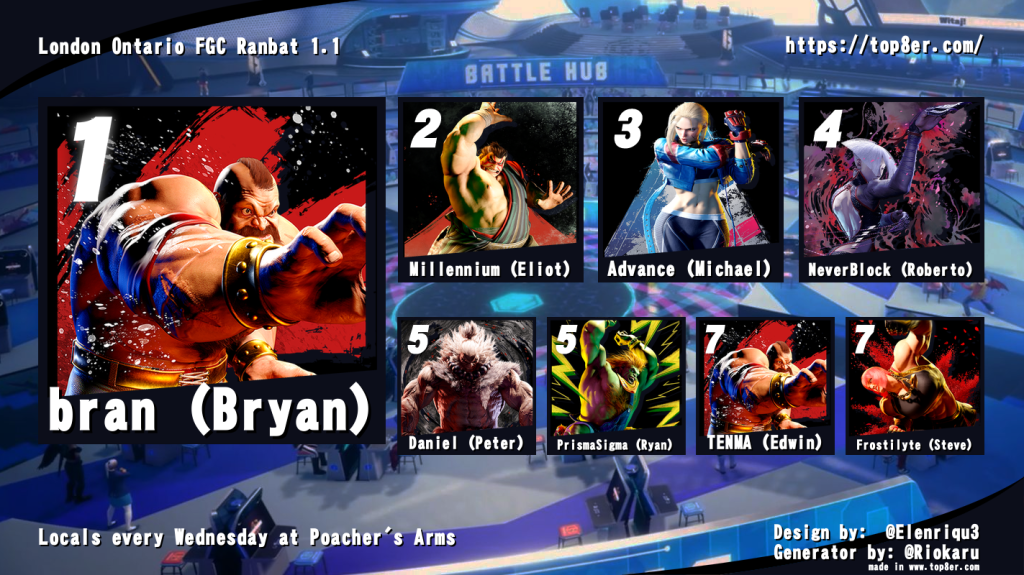

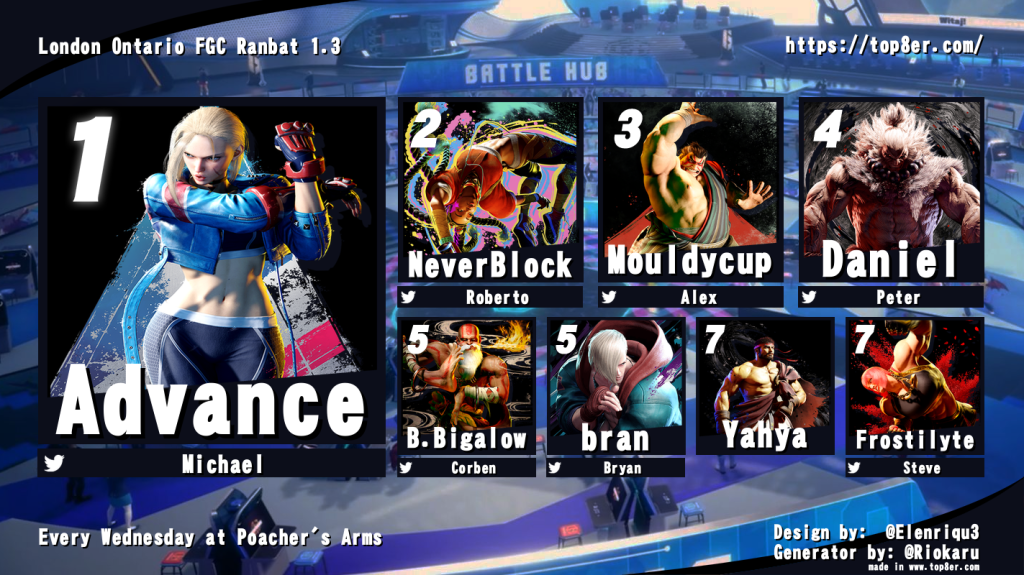
While I still can’t consistently win enough games to actually make it to Master rank on ladder, it is nice to see that I can bring my A game with Marisa during our local brackets.
That’ll do it for me. Thank you for reading, and stay safe out there!
 Frostilyte Writes
Congrats on your success in the local Street Fighter VI tournament👊💥Sounds fun.
LikeLiked by 1 person
I enjoy seeing these SF6 usernames, 10/10.
LikeLiked by 1 person
I still can’t get over how Peter’s name in-game is Daniel. Man is wild.
LikeLiked by 1 person