January was a bit of a weird month. I say that because typically I’ll grab some games during the various Winter sales, and then I’ll play those alongside whatever my Winter RPG of choice happens to be. While I did play me some Metaphor, quite a bit of it actually, I only managed to play a couple of the games I picked up during the Winter sales. There’s a reason for that, not a good one, but I’ll have more on that later.
Either way, here’s the stuff I played throughout January 2025.
Jump To:
- King of the Bridge
- Timberborn
- Portal 2
- Rabbit and Steel
- Metaphor Re:Fantazio
- Pokémon Mystery Dungeon: Blue Rescue Team
King of the Bridge
Yes, really. I promise it’s a lot more interesting than just a “chess game.”
In King of the Bridge, you’re trying to defeat a bridge troll at Troll Chess so that you can cross over his bridge. What exactly is Troll Chess though? Good question. It’s a shame this goofy bastard never actually tells you any of the rules until after you’ve accidentally broken one of them.
Unfortunately, breaking a rule in Troll Chess is considered cheating. Even more unfortunate is that if you’re called out for cheating, which you will be, then your opponent has an opportunity to cheat back at you. This invariably leads to you immediately losing the game because the bridge troll will always teleport one of his pieces to claim your king as his reverse cheat. Huzzah!
As such, King of the Bridge is a game about experimentation, and observation. There’s almost no chance for you to win without learning some of the rules to Troll Chess, and the easiest ways to do that are by observing what actions your opponent takes, while deliberately trying to push the boundaries to figure out what you can, and cannot do. This gives King of the Bridge an almost detective game texture, albeit the deductions require far less mental gymnastics than something like Golden Idol.
That focus on deduction, and experimentation likely explains why I enjoyed playing King of the Bridge, but it’s also a nicely compact experience. I don’t even have 2 hours played in the game, and I was able to earn both the good, and poor ending. For 3 dollars that’s a steal, especially considering how interesting the concept of King of the Bridge ends up being in practice.
Timberborn
The next game I tackled in January was Timberborn. It’s an Early Access city-builder where you manage a colony of beavers, which is all I needed to know about the game before deciding that I wanted to play it. There’s actually quite a bit more substance to Timberborn, but I needed all of you to understand how 1-track my mind can be sometimes. Beavers = buy. It’s really that simple.
Regardless, after a couple of hours, I started to get into the swing of things with Timberborn, and discovered that it wasn’t just a silly beaver game. Or, maybe it’s more correct to say that I discovered it was even more of a silly beaver game than I expected. What I mean is that most of the game’s challenges are about building dams, and redirecting water to terraform the land around your base.
For example, here’s one of the easier maps:
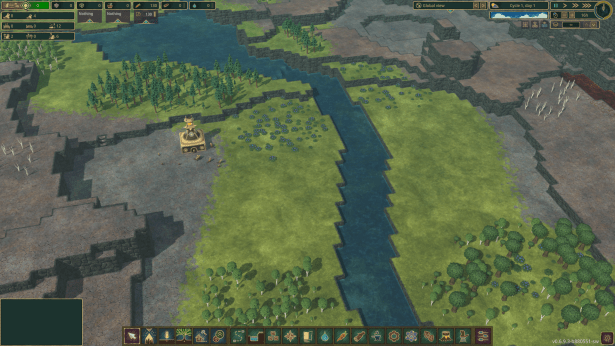
As you can see, there’s a river running straight through the centre, which provides you with irrigated land on either side of the riverbed. This gives you plenty of space to grow crops, and trees so that you can expand your settlement. However, the river will empty during the dry season, which will cause all of your crops to wither and die.
There are multiple potential solutions to this problem, but all of them involve using a dam to help trap water around your base. This – learning how to control the water on the map – is the hook of Timberborn. While I might not have known that when I purchased it, I really enjoyed figuring out how best to manage my settlement’s water in Timberborn. Doubly so when I finally figured out how to maintain water levels throughout the ever lengthening dry seasons, and redirect polluted water during the flooding seasons.
It’s a neat game.
I’m not quite sure that there’s anything else quite like Timberborn on the market. Maybe Oxygen Not Included? That feels like a bit of a stretch though. Give it a looksie if you’re jonesing for a city-builder with a different set of challenges beyond managing the flow of traffic, and balancing the books.
Also, because sharing what you’ve created is half the fun of these games, here’s what that map from earlier looks like now:

Portal 2
In continuing on from December’s Month in Review, I actually did get around to playing Portal 2. As previously mentioned, I had intended to replay both Portal games in December, but the sequel slipped through the cracks. I enjoyed the original game more, so if either game was going to get skipped then it was always going to be the sequel.
Regardless, I made time for Portal 2 in January, and, yeah – I still enjoy Portal more. The sequel is nicer looking, has a wider variety of mechanics, and the additional performances by J. K. Simmons, and Stephen Merchant were an audacious change over Ellen McLain’s solo vocal performance in the original. But Portal 2 feels very video gamey in a way that Portal doesn’t, and that’s why I still prefer it over the sequel.
I know that reasoning is going to sound like a crock of shit to some people so here’s an example of what I mean: compare how the 2 games start. Portal begins with a tutorial that seamlessly flows into the first several levels of the game. Portal 2 on the other hand, starts with a tutorial that is interrupted by a bombastic cutscene. Then players walk through a few decorative hallways before they reach the first proper level of the game. One of those immediately breaks my immersion, and the other doesn’t. I’m sure I don’t need to elaborate on which is which.
Speaking of interruptions, Portal 2 has a ton of them at really weird spots. For example, you’ll be running through an action set piece (usually trying to escape certain death at the hands of either Glados or Whetley), and will hit a loading zone halfway through. Why? Why would you intentionally kill the flow of the escape with a loading screen? I don’t understand.
To be clear, I’m not disputing that there wasn’t a technical reason for that loading screen. I’m instead curious why you wouldn’t try to design the whole sequence in a way where it could be 1 seamless event without any loading zones. Just picture how silly it’d be if there was a loading screen halfway through the bit where you escape from Glados during Test Chamber 19 in the first game. That’d be ridiculous, and would completely kill the momentum of the scene.
However, flow breaking interruptions caused by loading screens happen all the time in Portal 2. It makes the game feel incredibly dated in a way that the original doesn’t because it was actually designed around the limitations of both its engine, and the technology of the time. Sure – Portal doesn’t look as nice, but the better sense of flow makes it feel more modern than Portal 2, which feels like a game from 2011 thanks largely to the awkward loading zones.
If you love Portal 2, don’t let my sour grapes retroactively spoil your experience. I just prefer the first game, and likely always will. This is something we’re just going to have to shake on, and agree to disagree about.
Rabbit and Steel
Now for something totally different: Rabbit and Steel.
For the first time in a longtime, I was able to trick some of my friends into playing a multiplayer game with me. I use the word trick because I think I’ve enjoyed playing Rabbit and Steel the most out of the 3 of us. Either way, I’m glad they humoured me because Rabbit and Steel is a super interesting game.
That begs the question however: what is Rabbit and Steel?
It’s a game that attempts to simulate the feeling of fighting MMO raid bosses, but in a bite-sized package. Almost all of the aspects of MMOs that related to Role-Playing (grinding for exp, crafting, questing, etc.) have been removed in favour of creating a completely streamlined experience. You go from boss, to boss, to boss learning new mechanics, and eventually fight a super boss that combines a series of those mechanics into a single fight.
The only thing I miss about my MMO days (aside from the people) is raiding, and Rabbit and Steel does a wonderful job of translating that experience. There’s a surprising number of different mechanics across its 30-ish bosses, as well as multiple difficulties to ramp up the complexity of each fight. It’s basically the perfect game for someone who loves raid fights, but doesn’t have the patience to grind up a character, nor maintain friendly relationships with several like-minded players.
That said, I don’t think it’ll be everyone’s cup of tea. Rabbit and Steel plays largely as a bullet-hell title thanks to its focus on emulating the stress of high-intensity raid bosses. That’s something that I found fun, but I already know some of you will have immediately bounced off the idea of playing it upon watching the attached trailer.
Regardless, if you enjoy raid bosses, but can’t be bothered with all the other things that MMOs require from players then give Rabbit and Steel a look. Obviously, it’s better with friends, but the few times that I ventured into public lobbies were also fun. Plus, the community is mad friendly thanks to how niche the game is, so even if you’re new and learning people aren’t likely to flame you (which I know is a concern in any online game).
Addendum while editing: I FORGOT TO MENTION THE SOUNDTRACK! IT’S SO GOOD!
Here’s a yt playlist. It’s also on Spotify. Trust. Rabbit and Steel’s OST is chef’s kiss.
Metaphor Re:Fantazio
I’m sure it’ll come as no surprise to anyone that I’ve continued playing Metaphor Re:Fantazio throughout January. Metaphor also took the spot for the biggest article (by way of time spent writing) that I wrote in January as I reflected on how playing it sparingly has helped me to enjoy it despite my usual apprehension toward long, drawn out RPGs.
I’m also glad that I actually took the time to pen those thoughts because they helped me to realize that I need to approach certain games differently. That’s something I think I already kind of understood, but having it more concretely laid in a written article has made it feel more actionable.
I hope that makes sense. I’m going to trust that it does, instead of editing what I’ve written to death.
Regardless, I believe that I’ve gotten to the point where I’ve experienced most of what Metaphor has to offer, and don’t imagine that I’ll be writing about it again. That could change – I’m not naive enough to say anything with absolute certainty – but I imagine this will be the last time I mention Metaphor during a Month in Review unless I have something new to say about it.
Pokémon Mystery Dungeon: Blue Rescue Team
Hooooooo boy. What do I even say about this one?
I guess, for starters, this game is why this post is several days late. I finished everything I planned to write in January about a week early, and decided to use the final week of the month to play through Blue Rescue Team. It’s an old favourite, and was the game that introduced me to roguelikes even though I wouldn’t become familiar with Rogue, or roguelikes (as a genre name) for another 10 years.
Anyway, it’s been about 12 days, and I’ve put over 100 hours into Blue Rescue Team.
Please send a search party with water, and sandwiches. My wife has been wondering where the fuck I’ve been.
On a more serious note, I do think that I’ll be writing a longer post about my experience with Blue Rescue Team at some point in February. I imagine it’ll be along the lines of the Fire Emblem Fates post that I wrote after I exited my Fates-induced coma last year. That is – I don’t imagine the post will be very accessible to anyone who doesn’t already have extensive knowledge of the game. Regardless, I have a lot of thoughts that are starting to spill over in my head, and I need somewhere to put them all.
I suppose, the short and accessible version of what I want to say is as follows:
Replaying Blue Rescue Team has reminded me that this specific flavour of roguelike is still my favourite. That’s not to say that I don’t love how the genre has exploded out into all sorts of different forms thanks to a ton of pioneering developers over the past decade and a half. I do. I just really like the more Rogue-inspired Mystery Dungeon games a teensy bit better.
I also didn’t realize this until I was talking to a friend about Blue Rescue Team, but a bunch of Mystery Dungeon games have been released onto Steam over the past decade. I remember looking for games like it back when I first signed up for Steam in 2014, but I came up finding no results. In the time since then, Japanese developers have gotten a lot more comfortable releasing titles onto Steam, and PC Gaming has grown a lot in general. As such, there are now a handful of Mystery Dungeon, or Mystery Dungeon adjacent titles on Steam, which is a bit like discovering a giant pile of cocaine in your basement.
Either way, I’m glad that replaying this old favourite has helped to remind me of a specific style of game that I’d kind of forgotten about. I’ve played a few games that are like it, but nothing quite hits the same as the real thing. Doubly so because I think I’m going to get a ton of mileage out of exploring the different Mystery Dungeon games strewn across Steam in the coming months (or years).
Okay – that’s over 2000 words probably (yep, it is) so I think that’s where I’m going to call it for January. As always, I hope that you got something out of reading my ramblings even if it was just a new game to check out in your spare time.
Thank you, as always, for reading, and I’ll see you in the next one.
Did you enjoy what you read? Consider supporting my work by buying me a coffee over on Ko-fi.
 Frostilyte Writes
Pokémon games – and roguelikes – do tend to have a way of suddenly grabbing hold of your time when you get into them, so I’m not too surprised to hear that Mystery Dungeon has this effect, haha! I’ve also been having the Pokémon craving recently, but am trying to focus on playing new games… !
Good to hear you’ve been playing such a variety of games 😀
LikeLiked by 1 person
It almost feels like it was a mistake to indulge that craving to play PMD because now I feel like I’m behind on both my blogging, and my gaming schedule haha. Ah well – I’m sure I’ll catch up eventually. Or I won’t. The experience was valuable, and I had a lot of fun replaying an old favourite, which is enough for me.
I do try to play a variety of things. Probably because I get bored easily, but I also find that it helps to keep gaming fresh. I don’t know if you find yourself in a similar boat. I just…kind of get bored of video games if I keep playing too much of the same thing too often.
LikeLiked by 1 person
If adult life has (eventually) taught me anything, it is that a “gaming schedule” doesn’t really exist, there’s not enough time and too many games – if you enjoy PMD, I reckon go for it! Too easy to get caught up finishing games you don’t enjoy as much.
I agree on the variety too though – it’s a balance to be struck. I deffo get burned out eventually – of course it depends on the game. It happens a lot with card games – I delve into them deep, but eventually just stop. GWENT, DC Dual Force, Slay the Spire, it always happened eventually.
LikeLiked by 1 person