
Welcome back to Demo Dive where we’ll be looking at another demo for an upcoming game. Today’s subject is The King is Watching, which comes to us from developer Hypnohead. It was featured during the recent Steam Idle Games Fest, though, admittedly, I was a little too slow to cover the demo before that sale wrapped up.
Regardless, you came here to read about The King is Watching, so let’s get into it.
I suppose the best place to begin is with my playtime for The King is Watching’s demo. You may wonder what relevance that has, but I think you’ll understand once you see it:
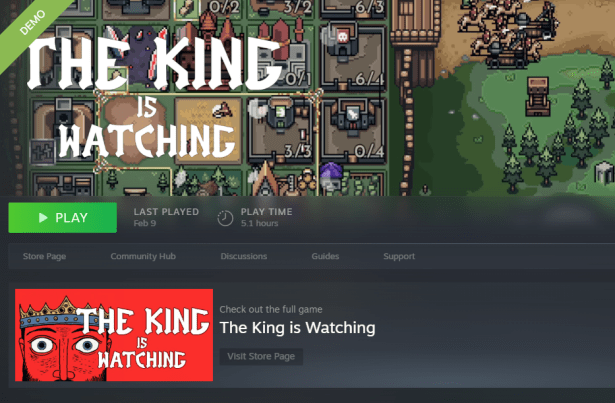
Yes. That’s 5 hours clocked in just a demo.
To be clear, this isn’t a Lies of P, or Metaphor: ReFantazio situation where the demo has 5 hours of unique content to work through either. Instead, that time was accumulated playing, and replaying the one level that’s included in the demo. Hopefully that speaks volumes about how gripping The King is Wathcing’s core gameplay loop actually is.
That said, what is the core gameplay loop?
To put it in as few words as possible, The King is Watching is an Auto-Battler with some light Strategy elements. You’re tasked with defending a kingdom from hordes of goblins, as all kings must, but won’t have direct control over how your army fights. Commanding soldiers to fight is far too barbaric for someone of your royal constitution after all.
Instead, you’ll be managing your kingdom’s economic development. How exciting!
Well, that, and keeping a scrutinizing eye on your lazy peasants. Whenever they’re not under your dutiful gaze, your peasants stop working. Hence the name: The King is Watching.
Were it not already clear, keeping watch over your peasants to keep them working represents The King is Watching’s X factor. It’s the thing that differentiates it from the host of other Auto-Battler titles, and creates a lot of interesting moment-to-moment problems to solve because your vision can only be focused on 1 area at a time. As such, how, and where you let the king’s vision linger will determine a lot about the success of your long-term strategy, which is why I sunk so much time into The King is Watching’s demo.
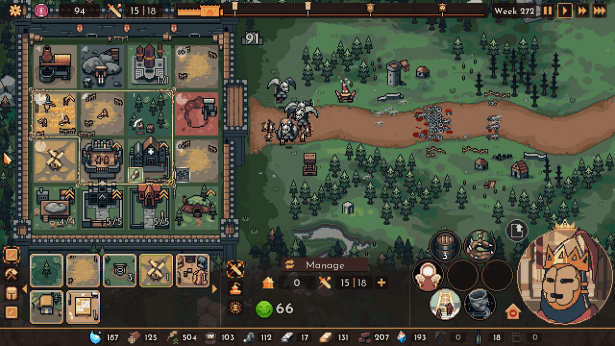
It’s not just deciding how much time a building will spend actively producing though: you’ll also be choosing which facilities to build. Your fiefdom has 20 tiles of land upon which to build. This will allow you to start collecting basic resources like water, wood, and wheat. Unfortunately, the basics aren’t enough to supply a strong standing army, so you’ll be stuck guarding your walls with humble peasants armed only with farming equipment for the first little bit.
From these quaint beginnings, you’ll have the ability to expand your kingdom in a number of different directions. There are additional resources like iron and clay that you could begin gathering, several facilities, like the Mill, which can make processed goods like flour (made from wheat), and a number of different military garrisons. What you build is ultimately dependent on which resources you have available, and which blueprints you decide to draft.
Speaking of blueprints, this seems like as good a time as any to discuss them.
Every time you successfully defend yourself from a wave of smelly goblins, you’ll receive a reward. Most of the time, these rewards contain new blueprints. You’re given 3 choices to select from, and this will allow you to build whatever you’ve selected within your walls.
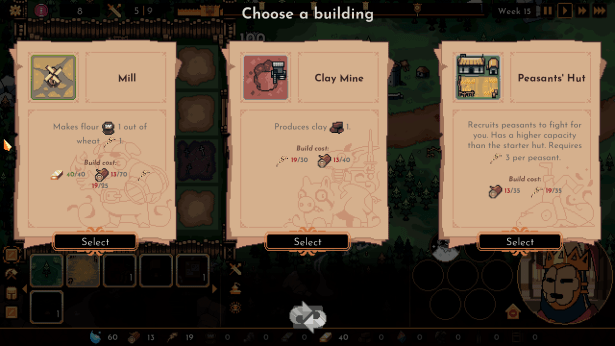
Naturally, different buildings require different resource types in order to be built, so successfully running your kingdom involves choosing new facilities that synergize with your existing setup. This means that the early game has a disproportionate effect on the trajectory of your run, but that’s true in most games that play like this. It’s super common to build an entire deck in a Deck-Builder around the first few cards that you draft in a run for example. The King is Watching is no different in this respect.
Plus, this randomness to which blueprints you’re able to draft means there isn’t a single dominant strategy that players can optimize around. In this way, The King is Watching has a bit of a Roguelike seasoning, which really helps to bring out the most from its mechanics.
Having said that, I did have some concerns about the longevity of the game based on my initial impressions of the demo. My first several runs were nearly identical, and it felt like there was only ever 1 direction that I could take my kingdom in long-term.
However, these misgivings were completely unfounded. After a few runs, I discovered there are 4 different skill trees (only 1 was available in the demo), which feature permanent unlocks. Ticking off a few of these upgrades added new unit types, spells, and resource gathering facilities to the existing roster of options. This made it more challenging to form a cohesive strategy, but it did mean that my runs started having the same kind of variety that I’d expect from a title like this. That is – run-to-run I began having to experiment and roll with completely new castle layouts, and army compositions.
All said, The King is Watching’s demo was a fairly strong showing. It’s compulsively replayable, and permanent unlocks helped to add a ton of variety beyond my initial few runs. That gives me a lot of hope for this game’s full release.
If you’d like to follow The King is Watching, or try the demo for yourself then you can do so by checking out the game’s steam page here. Hypnohead also appears to have an older version of the demo available on their itch.io page as well if that floats your boat instead.
Additionally, consider wishlisting The King is Watching if you enjoy the demo as that’s always helpful for developers, and will send you a notification when the game releases.
Did you enjoy what you read? Consider supporting my work by buying me a coffee over on Ko-fi.
 Frostilyte Writes