
Welp. It’s official. Monster Train 2 has taken over my life.
You’ve probably noticed a lull in articles on the site throughout June. That can be partially attributed to me playing Monster Train 2, and very little else. I have a lot of thoughts on the game, but chief among them is that it’s very fun. It iterates on exactly what made the original so damn compelling to play, and offers even more variety thanks to a tremendously expanded roster of available cards.
Having said that, Monster Train 2 does have quite a bit of a learning curve. As such, I wanted to share everything that I’ve learned about the game.
As of writing, I’ve finished 68 of the different clan combinations at Covenant 10 with 46 of those being Titan wins. I’d argue I’ve got a fairly good handle on how to win, though I don’t know that I’ll ever have the patience to do all 180 combinations.

Either way, let’s get into some tips that I hope will be valuable for players of all skill levels, but especially those looking to push into Covenant 10.
Note: the last revision to this guide was on v1.1.3 or Build Number 12000 of Monster Train 2.
Revision History
July 18 2025: added sections about Dante, short-term decision making, and forcing specific deck archetypes
Navigation
- How do I Build a Winning Deck?
- How do I Beat Seraph?
- Focus on Unlocking All of the Pyres
- Your Champion is NOT a Carry
- When to Visit Celestial Alcove (Event Tiles)
- When to Duplicate Cards
- Why Card Rarity is Important
- Always Recruit Dante
- Don’t Be Afraid of Making Short-Term Decisions
- Don’t Force Specific Strategies
How do I Build a Winning Deck?
There are definitely some patterns that emerge when looking at how I’ve constructed my decks while playing Monster Train 2.
In general, I try to come up with answers to the following 3 questions:
- How do I soak damage?
- How do I remove annoying backline mobs?
- How am I going to scale damage for later encounters?
Basically any run where I don’t have a good answer for all 3 questions will end in failure. However, Monster Train 2 provides a ton of great answers for each of these problems so let’s take a look at how we go about solving each of them.
Designing Your Frontline
To start, let’s answer the first of the three questions that I asked at the top of this section: how do I soak damage?
Thankfully, this is the easiest of the three questions to answer. Basically any Unit is capable of taking hits (repeatedly) with the right upgrades, or equipment. All you need to do is make a decision about which of your available Units you’d like to fulfill this role, and appropriately upgrade them to the task throughout your run.
However, some Units are built a lot better to fulfill this role than others. Obviously, a Unit with high base Health like Silent Sentinel is going to have a much easier time soaking hits than a low Health Unit like Miser. For that reason, you’ll typically want to convert a Unit with high natural bulk into (one of) your core defensive piece(s).
Here are some examples of bulky Units with high Health:
- Steadfast Crusader
- Gildmonger
- Silent Sentinel
- Demon Fiend

Similarly, Units with abilities that increase, or maintain their Health (or Armor) will make for better candidates to hold down the frontline. There’s even a keyword that synergizes with this exact premise: Revenge. This keyword triggers whenever the Unit in question takes damage, regardless of the source. This naturally synergizes with the hit-taking role of frontline a Unit.
In any case, here are a few examples of Units with beneficial abilities that lend themselves to holding down the frontline:
- Titan Sentry
- Prickly Puffball
- Shadeguard
- Greed Dragon
- Firebrand
- Avenger

Reanimate
I think it’d be remiss of me to not make a section specifically calling out the Reanimate keyword while talking about defensive Units. The reason being is simple: Reanimate might just be the single best defensive keyword in the entire game. It’ll cause any affected Unit to instantly respawn with 1 Health. This will allow said Unit to absorb another hit, or provide an opportunity for said Unit to recover their Health with Lifesteal (or healing Spells) so they can continue to hold down the frontline.
There are even some Units in the Lazarus League specifically designed around this keyword, which have additional defensive properties. For example, the Hulking Mass gains 40 Armor whenever Reanimate is triggered, meaning it’s incredibly adept at repeatedly soaking hits. This hit taking potential only gets more outrageous with a few simple upgrades, or the correct supporting cards.

Regardless, this keyword is very strong, and should be considered as part of your defensive strategy while running Lazarus League as either your primary, or secondary clan.
Some notable Reanimate Units include:
- Overworked Assistant
- Hulking Mass
- Nine-Lived Nightmare
- Makeshift Golem

And some notable Reanimate Spells include:
- Spike of the League
- Forevermore Serum
- Pseudoscience
- Secret Ingredient
- Mixology
Upgrade Considerations
As you can no doubt surmise, there’s a very wide array of options when it comes to exactly which Unit(s) you choose to bulk out your frontline. Having said that, there is a far more rigid structure when it comes to which upgrades are most well suited for the task.
In most cases, you’re going to want to throw a Titanstone upgrade onto any card that you’re planning to use for frontline support. This will halve all incoming damage, which is effectively like doubling the Unit’s Health. That makes this upgrade invaluable for soaking hits.
By the same principle, the Largestone upgrade also helps to improve the bulk of a Unit. This will increase a Unit’s Health by 50, which will more than double the hit taking potential of said Unit in the overwhelming majority of cases.

Unfortunately, the Largestone does come with the downside of increasing a Unit’s size by 1. However, this can be played around by taking a Heaven’s Light Artifact as your reward from either the Ring 3, or Ring 6 boss encounters. In addition, you could also make use of the 0 cost Room card Steward’s Quarters to expand the size of a floor to accommodate a Largestone infused Unit.
There’s also a few niche cases where Duality can come in handy. For example, Guard of the Unnamed normally only gains 3 Armor on Incant triggers. This is…not good. It won’t even really keep up with the damage output of later fights by any stretch. However, that Armor gain is increased to 6 with a Duality upgrade, which greatly increases your ability to stack Armor onto Guard of the Unnamed.
As far as common upgrades are concerned the Heartstone, which increases Health by 20, can be a useful upgrade for bulking out your frontline. Ideally, you’ll want to pair this with either a Largestone, or Titanstone upgrade, but you can always slot 2 of these onto a Unit in a pinch.
There’s also a few upgrades that are locked to specific clans, which can help to increase the longevity of a Unit. Namely, the Underlegion’s Mossystone (10 Regen), Lazarus League’s Frankenstone (1 Reanimate), and Stygian Guard’s Runestone (2 Armor on Incant). However, I think that only the Frankenstone has enough defensive utility to where you can thoughtlessly slap it onto something.

Having said that, any of these upgrades could prove to be more valuable than a straight 20 Health increase with the right supporting cards, or Artifacts.
For example, Founding Seal (Artifact) doubles Incant triggers, which would increase the value of a Runestone upgrade to where it could realistically outpace 20 additional Health. And Loamcoat pairs really nicely with both Mossystone, and Frankenstone.
Finally, I wanted to touch on Immortalstone (gain Endless), which has some niche application on your defensive pieces. Endless seems like an ideal pairing on a Unit that’s designed to take hits as you’ll be able to replay it immediately after it dies. This would give the Unit in question effectively infinite Health.

However, there’s a downside to using Endless in this way: it slows down the rate that you draw new cards. Whenever Endless triggers, the card will be placed on top of your deck. This means that you’ll draw 1 fewer new cards on the following turn. This can impede your ability to draw crucial setup cards in a timely fashion if you’re not careful.
Though, it’s hard to deny that Endless isn’t extremely effective counter to Corruption, which is where it often shines brightest.
Equipment Considerations
There are only a few Equipment cards that fulfill a defensive purpose, and I think it’s fairly straightforward to identify them. Basically anything that increases health, or has some sort of restorative effect will work here. Some obvious stand-outs include:
- Meat Shield
- Loamcoat
- Lava Armor
- Stoic Platemail
Though, realistically, any additional Health that you can equip onto your frontline won’t go remiss.
Just be careful using something like Stoic Platemail as it’ll cancel out both active, and passive abilities.
Clearing Out the Backline
In my opinion, this is the most interesting of the 3 questions to answer from my opening to this subsection of the guide. The reason being that Monster Train 2 provides a ton of potential answers. The key is actually narrowing down your options, and choosing appropriately based on your drafts, available upgrades, and the overall structure of the map in your run.
That’s all a really long way of saying that I use a wide variety of cards to clear out the backline shitters from run-to-run.
Ideally, you’re going to want to have your solution to this problem ironed out by the Flying Boss fight against Cael in Ring 6. He’s extraordinarily difficult to defeat if you can’t reliably clear out his army of Cherubs. Nevermind how annoying all of the other backline support foes are within this fight.
This problem only gets exacerbated in later fights, especially on higher Covenants, so let’s take a look at some different ways that we can clear out squishy-support mobs.
Sweep
This keyword is the most obvious solution to the problem of dealing with annoying backline foes. Sweep lets your Unit hit every foe simultaneously, which means you’re able to nail the backline without first defeating the chunky frontline foes.
However, at the time of writing, the strongest Sweep Unit only has 10 Attack. That’s nowhere near enough damage to reliably clear out the likes of Cael’s Cherubs (nor Chosen Heralds, Assassins, and Supplicants).
As such, I’d recommend investing in the offensive properties of Sweep Units whenever you draft them.

It’s also worth noting that Quick synergizes with Sweep for some defensive utility. Backline enemies often have higher offensive stats, so clearing them out before they can attack will reduce the pressure on your frontline.
One final note, Sweep also synergizes really well with Bloodthirsty Blade, and Pyre of Savagery. In both cases, the Sweep Unit is able to regularly trigger the permanent attack increase, multiple times in a single turn, which will snowball exponentially making this an incredibly powerful combination.
Advance & Retreat
This may come as a surprise, but almost every card with the Advance keyword works on both sides of the field. The only time that’s not true is when the card specifies Friendly Unit like Imprisoned Zephyr, or Heroic Dive. As a result, Advance can often be used to shift your foes around such that you can expose their squishy backline with relative ease.

Retreat works much the same way, though you’d want to use it in the opposite fashion. That is, you should use Advance on squishy backline foes, and Retreat of tanky frontliners.
In either case, these cards give you a lot of power over the orientation of enemy lines, so don’t sleep on them. Most cards with either keyword (Advance, or Retreat) are excellent additions to any deck.
Explosive
One of my favourite new keywords that was added in Monster Train 2.
Explosive deals excess damage to all other enemies on a given floor, provided the Explosive attack kills its target. This makes it an extremely effective keyword for dealing with several backline threats simultaneously.
A stand-out Spell in this regard is Fanning the Flame, which gains an additional 3 damage every time it kills something. With a Keepstone upgrade, this Spell can absolutely run away with games regardless of what you encounter.

Unfortunately, Explosive is exclusive to the Pyreborne clan, which limits how often you’ll be able to make use of it.
Unstable
Surprisingly similar to Explosive.
Unstable deals damage equal to the affected Unit, and all foes at the end of combat. However, it only triggers once the value of Unstable is greater than, or equal to the Health of the creature with Unstable. For example, if a foe with 10 Health has 9 Unstable then Unstable will not activate. However, if they instead had 10 Unstable then every foe will take 10 damage.
It’s worth noting that damage explosion from Unstable only affects enemies even if the Unstable was stacked on one of your Units. This means that you can stack a near infinite amount of Unstable on your side via cards like Tome of Horrors, Secret Ingredient, or Overworked Assistant without actually damaging any of your unaffected Units. Though, you will want to leverage cards that apply Reanimate if you’re going to do this, so you don’t lose your Unstable host.
Multi-Target Spells
There isn’t a particular keyword associated with these cards, but many of Monster Train 2’s best Spell cards hit multiple targets simultaneously. As such, it can be an effective strategy to draft 1 of these cards, and upgrade it with Holdover so you can repeatedly play it to clear out the backline.
Bonus points if you also add Permafrost to said Spell so you don’t need to play it every single turn.
Some examples of multi-target Spells include, but are not limited to:
- Cleave
- Flicker
- Make it Rain
- Celestial Storm
- Acid Shower
- Vent
- Glimmer
- A Fatal Melting

Multi-Target Abilities
Similar to multi-target Spells, there are some Units in Monster Train 2 whose abilities target the entire floor. This is always noted on the card by the use of a plural Enemy Units instead of Enemy Unit.
Obviously these effects are very powerful, and many of the cards with them are among some of the best Units in the game. Examples include, but are not limited to:
- Spore Launcher
- Hot Head
- Molting Imp
- Titan Sentry
- Morel Mistress
- Devourer of Death

Due to the nature of these abilities, many of them often pair extremely well with a Duality upgrade. This can double the effectiveness of said abilities, which provides a ton of additional value throughout a run.
Designing Your Backline
Now for the final of the 3 questions: how do I scale my damage output for the later encounters?
If you’ve played even a single run of Monster Train 2, and made it past Cael then you’ve definitely run into this fat chungus:

The Avowed Gladiator is very important because it is the fattest enemy in the game. If your deck can reliably kill it then your deck can win. If you struggle to eliminate it then you’re probably not going to be able to go the distance. As such, this Chunkasaurus Rex is going to be your damage threshold for every single run of Monster Train 2.
By default, the Gladiator has 325 Health. This increases to 375 Health at Covenant 1, and 500 Health at Covenant 8.
It’s also worth noting that from Covenant 2 onward, there will be a wave in both the Ring 7, and Ring 8 fights where 2 of these guys spawn together.
Knowing all of this information gives us a fairly clear target for what kind of damage thresholds we’re going to need to be able to hit at different levels of play.
Covenant 0: 325 damage
Covenant 1: 375 damage
Covenant 2-7: 750 damage
Covenant 8+: 1000 damage
Unfortunately, Monster Train 2 scales up the damage thresholds that players are required to hit much faster than the original game. That’s not necessarily a bad thing per se, but it does force players to learn the game’s most broken card combos a lot more quickly than they needed to in the original.
So – how do we go about breaking Monster Train 2 in half?
Units With Built-in Scaling
Let’s get the obvious one out of the way first: some Units have built-in scaling mechanics. This will cause said Unit to naturally increase its Attack over the course of combat. The best of these Units require little oversight from the player, which can make them effective for use across all 3 floors of your train.
Some examples of Units with damage scaling include, but are not limited to:
- Alpha Fiend
- Shattered Shell
- Steelsinger
- Nameless Siren
- Bounty Stalker
- Wickless Baron
- Demonic Fledgling
- Goldtooth
- Astrologer
- Reforming Ooze

In the overwhelming majority of the examples highlighted, these Units require minimal support to effectively punch massive holes through enemy lines. They just gain a lot of extra attacking power over the course of combat, or cumulatively across a run, which makes them ideal candidates for damage focused upgrades.
Pyre of Savagery
There’s no getting around how easy of a solution Pyre of Savagery offers for damage scaling. It permanently increases the Attack of a Unit whenever it kills something. With some good planning, this can lead to massive Attack increases for your key damage dealers across a run, which can greatly simplify actually winning a run.

In my opinion, Savagery is best used on clans with easy access to Sweep, Multistrikes, or Trample. All of these keywords benefit greatly from the additional attack, and have a much easier time reliably scoring kills to accumulate heavy additional Attack bonuses by the end-game.
Upgrade Considerations
Frenzystone is the obvious choice here. Any Unit that naturally gains more attack gets increased value whenever Multistrike enters the equation. This is doubly true when the Attack increases are permanent, which they will be while using something like Pyre of Savagery.
The common Strengthstone, which increases attack by 14, can also be a nice companion for your damage dealers. This will simply give them a higher base attack to springboard from, which will reduce the number of turns that it takes before they become truly lethal.
The other potential stand-out upgrade here is a little unintuitive: Smidgestone. This reduces the size of a Unit down to 1, which has a couple of different benefits.

The first benefit of Smidgestone is that it allows you to stuff more copies of a particular damage dealing Unit onto a floor. If you couple that with a duplication from an Empyrean Well, or the Lifemother Pyre then you can quickly stack up several high damage dealing Units onto a single floor.
Smidgestone also has a niche interaction with Hall of Mirrors. By shrinking the size of your damage dealing Unit(s), you can make use of Hall of Mirrors to summon multiple copies of them on a single floor. This can reduce your reliance on Empyrean Wells, while still letting you deal respectable damage output.
The other major benefit of Smidgestone is an interaction that it has with Overgrowth Carapace. Normally, Overgrowth Carapace will provide additional Attack, and Health increases while increasing the size of whatever it is equipped to. This means that the Unit in question will eventually stop gaining bonuses once it completely fills out a floor.
However, Smidgestone prevents the size increasing effect of Overgrowth Carapace, which means that it provides (effectively) infinite damage (and Health) scaling. This is an incredibly powerful interaction on just about any Unit.
It also bears mentioning that any Unit with Multistrike (by default) absolutely runs away with games by leveraging this specific interaction between Smidgestone, and Overgrowth Carapace. Don’t sleep on this.
Alternative Damage Scaling Keywords
Now that we’ve covered the obvious stuff (built-in scaling, Pyre of Savagery, Smidgestone + Carapace, Multistrike), let’s cover everything else. I say this because there are going to be runs where you will not find Frenzystone, or Smidgestone upgrades, nor will you be blessed with 1 of the ~2 dozen cards that are best suited for dealing damage.
So what the heck do you do when that happens?
Use 1 of several other keywords to absolutely punch a hole through the enemy forces.
Decay
We’re starting with my favourite alternative damage scaling which is Decay. This is ostensibly poison, or a more powerful version of Frostbite. It deals damage equal to 3 times the total number of Decay stacks on an enemy. The best cards at inflicting Decay also target the entire floor’s worth of enemies, so you can hit those double Gladiator waves simultaneously for massive damage.
Ideally, you want to inflict Decay on the first floor of the train. This will give it 3 turns to accumulate damage on its target before reaching the Pyre. Using a 500 Health Gladiator as our benchmark, we’d need to inflict 57 stacks of Decay in order to ensure that they take 500 damage by the top floor.
However, that example assumes that they’re taking no additional damage. Realistically, if you can stack around 20 to 30 Decay onto something (an additional 60 to 90 damage per turn), then you’re likely to kill it before it reaches your Pyre.
Some of the stand-out cards for applying Decay include:
- Morel Mistress
- Spore Launcher
- Pandemic
- Prickly Puffball

It also bears mentioning that Decay isn’t affected by Sap, so this is a source of damage that completely ignores the mechanic of the Entropy Seraph (and Titan) fight.
Conduit
In terms of potential damage output, I’d argue Conduit falls just behind Decay. It increases the damage (or healing) of Spell cards by 1 for every stack of Conduit. It also affects anything with the Mageblade keyword as if it were a Spell, which can be especially useful when you draft the Moonlit Glaive Equipment card. Combine that with a few Attuned Spells, which receive 5 times the benefit from Conduit, and you’re cooking with fire.
Unfortunately, Conduit has a fairly limited distribution being almost exclusively locked to the newly added Luna Coven. However, there are plenty of ways to apply Conduit within that card set, which can make it a reliable way to increase your damage output whenever you’re playing with them.
As far as notable cards are concerned there’s 3 categories to keep in mind when utilizing Conduit.
Firstly, notable cards that apply Conduit:
- Planetarium
- Ethereal Seelie
- Moon Pixie

Secondly, noteworthy cards with Mageblade, or Attuned keywords:
- Moonlit Glaive
- Moonguard
- Celestial Storm
- Silver Ink
- Pyreclasm
- Cosmic Bolt
- Crypt Builder
- Duality

And finally, some Spells that become substantially stronger with Conduit support:
- Flicker
- Fanning the Flames
- Make it Rain
- Vent
- Glimmer
- Helical Crystalis
- Ice Tornado
- Icestorm
- Plink
- Blazing Bolts
- Excavation Eruption
- A Fatal Melting
Pretty well anything that hits multiple targets, or multiple times becomes substantially better with even a little bit of Conduit support. If you’re running Silver Empress, or Celestial Spellweaver Ekka then some of those aforementioned Spells can become hilariously busted with no investment.
Conduit Tethys Titansbane also works in a similar fashion, though her value in this regard is a little limited.
Pyregel
Next up is Pyregel. This keyword increases all forms of damage received by the target equal to the value of Pyregel. For example, if your target has 10 Pyregel, and you attack them with a spell that does 15 damage then they’ll take 25 total damage instead.
As with Decay, you’re going to apply Pyregel on the bottom floor of your train. This will give you 3 turns to maximize the value of those Pyregel stacks, letting all of your minions on floors 2, and 3 deal additional damage to Enemy Units.
It’s also worth mentioning Pyregel is especially strong when combined with Units, or Spells that attack multiple times. The bonus damage is applied to every hit of the attack, which can add up to a lot of additional damage.
As such, here are some notable cards that apply Pyregel:
- Magma Cultist
- Lava Flow
- Magma Mauler
- Hellfurnace
- Dragon’s Breath

And here are some notable beneficiaries of Pyregel soaked enemies:
- Horned Warrior
- Animus of Will
- Eel Gorgon
- Draff
- Follower
- Dante the Dependable
- Make it Rain
- Plink
- Icestorm
- Helical Crystalis
- Ice Tornado
- Excavation Eruption
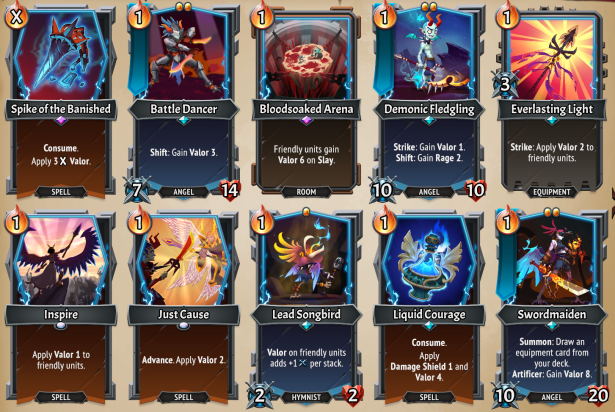
Valor
Of the newly added keywords that seem specifically tailored for damage output, I find Valor the least effective. That’s probably because it has both offensive, and defensive properties. As such, the folks at Shiny Shoe didn’t want to make it too powerful.
Regardless, Valor increases the attacking power of a Unit by 1 for each stack of Valor. It also doesn’t decay, so any Valor that you add to a Unit is permanent for the duration of the combat encounter. This makes it an especially effective form of damage scaling when you have several Units stuffed into a single floor gaining Valor from cards like Bloodsoaked Arena, or Everlasting Light every single turn.
Some notable Valor cards include:
- Bloodsoaked Arena
- Everlasting Light
- Demonic Fledging
- Battle Dancer
- Lead Songbird
- Divinity
- Windblade
What About Monster Train 1 Keywords?
At the time of writing, most of the clans from the original Monster Train need a bit of love. I had originally written sections detailing the different scaling mechanics that each of them have (ex. Reform, Rage, Incant), but, in doing so, I realized how underwhelming most of them are.
Fact of the matter is that none of the original Monster Train clans were designed to work within Monster Train 2. As such, there are far fewer solutions available to them for solving the game’s problems. In a lot of cases, clever use of Equipment, and Room cards and/or the Pyre of Savagery will be key to winning a run, especially if you’re running 2 clans from the original game.
Having said that, Shiny Shoe is planning a rebalance of some of the MT1 cards in a major patch, which is currently slated to release later in 2025.
I’ll take a look at adding some additional sections covering off MT1 specific keywords depending on how that patch shakes out.
How do I Beat Seraph
I’ve included a few high-level tips for each of the 3 Seraph fights. Part of me wants to do a more detailed guide given how often I’ve seen questions about how to beat Seraph. I don’t know if I’ll actually write that, but I couldn’t post this guide without at least addressing how to deal with this chucklefuck, so here are a few tips for dealing with each form.
Dominion Seraph
Recommended Keywords:
- Mute/Silence
- Dazed
- Ascend/Descend
- Sap
- Endless
The worst part about this fight is dealing with Seraph’s ability to double the Corruption stacks on your frontline defensive Units. Unless you have nearly infinite scaling Health, there’s no way to sustain through all of that damage.
Instead, you should focus on damage mitigation.
To that end, Dazed and Sap work quite well. The doubling only happens if Seraph actually attacks, so if you can stack enough Sap onto him then he won’t be able to double the Corruption stacks on your frontline Unit.
Ascend or Descend can be used much to the same effect. Simply send him away whenever he tries to attack your key floor. Ideally you’d send him to an empty floor, or a floor that otherwise won’t have to field as many mobs.
Mute basically hard-counters Dominion Seraph. It completely disables his ability to stack Corruption, meaning you just have to deal with the Corruption stacks from the various foes who flood the bottom floor of your train.
Also, you’ll need to upgrade all of your squishy backliners with extra Health if you don’t have a way to mitigate Seraph’s attacks. Without some padding, Seraph will immediately pop your backline thanks to his ability to apply Corruption to an entire floor. Note that this still happens even if he has 0 Attack.
Finally tip: there are 2 Room cards that work really well for this fight. Both Zone of Silence, and Inferno Room hard-counter a lot of the nonsense in this fight. You’ll want to deploy either Room on floor 1, clear out as much of the backline as possible, and then clean up the remaining dregs on floors 2 and 3.
Personally, I prefer bringing Inferno Room to this fight whenever I can as it substantially reduces the difficulty even on Covenant 10.
Entropy Seraph
Recommended Keywords:
- Mute/Silence
- Decay
- Melee Weakness
- Unstable
- Frostbite
- Pierce
This fight can take 2 different forms.
The first is a test of your deck’s ability to scale up damage under extreme pressure. Seraph will dump a Curse of Entropy into your deck every single turn, which will slowly drain all of your Unit’s Attack. If you can’t continue to scale up your damage output then you’ll be overrun, and will lose the fight.
Alternatively, if you enter the fight with more than 40 Pyre Health then you should be able to tank through the damage from the Curse of Entropy cards. This will prevent Sap from accumulating on your minions, which will allow you to continue fighting unimpeded.
I’m a big fan of Decay, when it’s available, for this fight since it isn’t affected by Sap whatsoever. The same goes for Unstable (in most cases), and Frostbite. Ergo, these keywords can continue to provide value regardless of how much Sap stacks on your Units thanks to the Curse of Entropy cards.
Alternatively, you can mute Seraph which will prevent him from adding additional Curses to your draw pile (until Mute runs out).
Finally, do NOT bring a strategy that relies on Spell cards to this fight. The overwhelming majority of the waves include Incant trigger enemies, and high damage backliners. If you’re casting Spells every turn then you’re likely to get completely bowled over by all of the Attack buffs that you’ll provide to the enemy.
It’s also worth mentioning that Inferno Room works as a catch-all solution for floor 1 for this version of Seraph provided you don’t find anything better across your run.
Savagery Seraph
Recommended Keywords:
- Titanite
- Damage Shield
- Reanimate
- Armor
- Spell Weakness
- Quick + Sweep
I’m of the opinion that this is the hardest of the 3 Seraph fights. Mostly because the other 2 fights get shut down so easily by Inferno Room (seriously guys, it’s a good card).
The main problem to build around here is that your Units will be inflicted with Melee Weakness once they hit the field. In a standard run, this will double the damage from the first attack, but in a Titan run Savagery Seraph will inflict 2 Melee Weakness which will triple the damage of the first attack.
In either case, you really need for your frontline to be able to sustain massive hits, while passively recouping their defenses throughout the fight.
To that end, Titanite is the easiest catch-all solution. This will reduce the impact of Melee Weakness, and the obscene damage output of Rage boosted Enemy Units.
Other potential solutions for tightening up your frontline include Damage Shield, Reanimate, and Armor granting Spells. Healing is also good, though not every clan has access to it. In either case, the main trick to this fight is figuring out how to keep your frontline from crumpling under pressure, so try to build with that consideration in mind.
Also, it’s worth noting that Spells are really powerful in this fight. None of the foes deployed here counter Spell usage, so you can spam extremely powerful Spells with reckless abandon throughout the fight. That can prove to be a viable way to help support your frontline Units, especially if you have a powerful multi-target Spell with Holdover.
Focus on Unlocking All of the Pyres
We’re going to begin general gameplay tips with something that I think is very obvious, but very important: focus your early efforts on unlocking the different Pyres. I know it’s tempting to focus on actually winning runs, but I think it’s a lot easier to do that, especially in the beginning, when you aren’t stuck with the default (Proto Heartcage) Pyre.
The reason for this is simple: most other Pyres contribute some kind of useful ability to your run. For example, the Lifemother’s Pyre adds an option to all shops that lets you pay to duplicate cards. That’s extremely powerful since it’ll let you create multiple copies of your most powerful cards on the fly, which can make winning a lot easier.

There are 12 different unlockable Pyres in total, with 3 of them being reserved as rewards for your first Titan win. You’ll be able to access the Titan fight once you’ve unlocked the other 9 Pyres, so try to focus on unlocking them as soon as possible. Heck, it’s even worth intentionally throwing if it means that you’ll unlock the different Pyres faster – they’re that good.
Your Champion is NOT a Carry
Sure, there are Champions that you can absolutely build your entire strategy around, and rely on to carry you to victory. Fel is a great example of this. She has Multistrike, and all 3 of her upgrade paths give her access to extremely high damage output. This can make her seem like an ideal candidate to build your entire strategy around.
However, most Champions aren’t built like Fel. In fact, the majority aren’t. Most of them offer strong supporting capabilities, but aren’t able to single-handedly hold the line against enemy forces. As such, you should NOT rely on them in this capacity.
Instead, you’ll want to build your deck using your Champion as a single piece of your overarching strategy.
For an example of what I mean, I’m going to use my favourite Champion: Madame Lionsmane.
All 3 of her upgrade paths are powerful, but won’t actually do much for you in isolation. However, when paired up with other cards, they really start to shine.

For example, Everbloom, which spawns Funguy Units, pairs really nicely with Amorous Enoki, and Spore Launcher. Both Units have Rally effects that trigger whenever Madame Lionsmane spawns in new Funguy, which allows the pair to feed off one another for a much greater combined effect.
Similarly, Morel Mistress, and Prickly Puffball both get a lot of benefit from Sporesinger, which increases the number of Decay stacks that are applied by their effects. This can dramatically increase the damage potential of Decay to an absolutely lethal degree.
Finally, there’s Maneating which applies Sap, and Mute. The former can make it easier to build up your army of Funguys which allows Squad Leader to shine, and Mute completely shuts down annoying enemy abilities.
In all 3 cases, Madame Lionsmane isn’t really the star of the show. Instead, she’s helping to strengthen other cards, which result in a powerful combinatorial effect. Ideally, this is how you want to use your Champion since many of them have similar combo potential with other cards from their respective factions.
Besides, your Champion can’t be upgraded with some of the completely busted Celestial Alcove upgrades. These sorts of events are often how you create a game-breaking card that’ll carry you through harder fights, especially after you duplicate said card. As such, your focus shouldn’t be on your Champion, who has a limited potential damage ceiling.
When to Visit a Celestial Alcove (Event Tile)
This one is fairly straight-forward: always visit Celestial Alcoves after you’ve finished shopping. There are not an insignificant number of Alcove events, which allow you to upgrade a card in your deck. These upgrades can be added onto a card in excess of the 2 upgrade slots that are normally available by default. As such, you’ll typically want to use both upgrade slots on a card before you place an Alcove upgrade onto it whenever possible.
When to Duplicate Cards
Instead of upgrading several Units (or Spells), you’ll want to upgrade a few, and then duplicate them throughout the run. This reduces the number of times that you need to find rare upgrades like a Titanstone since you can simply duplicate your key defensive pieces to extract additional value from the single Titanstone upgrade you already purchased.
As such, my recommendation for duplication would be to duplicate a card once you’ve finished upgrading it. Obviously, you need to make a judgment call about your immediate needs on a run-by-run basis. Sometimes you’ll need a second copy of your frontliner before you’ve finished fully upgrading them. But, ideally, try to save your duplications for after you’ve finished upgrading a card, so you can maximize the value of the duplication.
Also, it’s worth noting that you should take note of where your Empyrean Wells are before you do anything in a run. This will help inform your decision making in early rings (figuring out which shops you need to prioritize), and will also help you to prepare a card for duplication prior to reaching this point in your run.
Why Card Rarity is Important
This might seem a little weird, but understanding how card rarity works in Monster Train 2 is a fairly big part of breaking into higher Covenant levels. So I wanted to break it down here, which will hopefully help with increasing the consistency of your runs.
To start, here are the 3 different rarities, and how to identify them:
- Common – denoted by a white circle
- Uncommon – denoted by a blue diamond
- Rare – denoted by a purple diamond
And here’s a picture of what each of those card types look like:
Common: feature all of the common keywords for a clan, and are designed to anchor the foundation for your deck. They will largely determine the trajectory of your overarching strategy throughout a run depending on which Common cards you choose to draft.
For example, we can look at my favourite clan: Underlegion.
Here are the Underlegion Commons:

Do you notice any patterns?
There are 4 keywords that are heavily featured across their cards: Spawn, Propagate, Sap, and Decay. As such, we can determine that, broadly speaking, Underlegion cards are designed to do 2 things: create mountains of Funguy, and spread Debuffs.
Regardless of which Commons we draft, Underlegion cards will still be able to do both of these things. However, choosing cards that lean into either of these 2 main functions can help us to clearly define the strengths of our deck.
It’s also worth noting that you can only draft Common cards from the reward packs of the first 2 Rings. This means that you’ll have a very limited time to establish which keywords, and strategies your deck is most well suited to support.
Uncommon: features much stronger effects than Common cards, but also has more specific activation criteria. Uncommons are typically weak in a vacuum, but become much stronger when paired with the appropriate companion cards.
Sticking with Underlegion (again), let’s look at an example of what I mean:
Morel Mistress is a 15:15 1 cost Unit that applies 8 Decay whenever the Consume keyword is triggered (Etch). In isolation, she’s a fairly mediocre Unit. In fact, I’d argue she’s a downright bad card if don’t have a reliable way to trigger Etch.
However, she becomes a lot better looking as a potential draft when you consider how many Common, and Uncommon Underlegion cards have Consume as a keyword.

Playing these cards in combination helps to increase the value either card provides, which dramatically increases the value of Morel Mistress, and any Consume cards that you play. As such, you’d want to draft Morel Mistress whenever your deck relies on powerful Consume cards. The inverse is also true: if you’ve already drafted Morel Mistress, then you should double down on powerful Consume cards.
In either case, these Uncommon cards become much stronger when used in conjunction with other cards.
As a direct result of all of this, you’ll want to lean into your deck’s existing strengths, and draft Uncommons that synergize with your existing Common, and other Uncommon cards whenever possible.
Uncommons can appear during reward packs throughout the entire game. However, they’ll appear a lot more frequently during your Ring 4, 5, and 7 reward packs.
Rare: feature some of the strongest effects in the game, but have the most narrow use cases. Rares are often only worth drafting when they compliment your deck’s strategy, otherwise they’ll be dead weight.
Sticking with Underlegion for a third time, let’s dive into another example:
Deadly Variant is a single use card that applies Decay equal to 5 times the number of Sap stacks on a target. If your deck can’t apply Sap, or only applies it in limited qualities, then this card is going to be completely useless.

However, if you have cards like Pandemic, Mushy Room, Waxcap, or (Maneater) Madame Lionsmane then suddenly Deadly Variant might prove to be an effective tool for crippling Flying Bosses.

Furthermore, you could also derive use from Deadly Variant if you’re running Stygian Guard as your secondary Clan and gain cards like Drain, Guardian’s Amulet, or Lodestone Totem.

In all cases, Deadly Variant only becomes worthwhile once you have reliable, repeatable ways to apply Sap to a single high Health target. Otherwise, Deadly Variant is simply an expensive, and mediocre card that isn’t likely to apply enough Decay to be worth playing.
As such, you’ll want to be very selective with the Rare cards that you draft. You should only draft them when they compliment your existing strategy, or you have time to build around them.
Similar to Uncommons, Rares can appear in all of your drafts throughout a run. However, they’re guaranteed to appear in your reward pack for Rings 3, and 6.
That was a lot of information, so let’s quickly run through the key points I was trying to make:
- Your Common card drafts will determine which strategies will be open to you
- You can only draft Common cards in the first 2 Rings, so it’s important to create a solid foundation for your intended playstyle(s)
- Draft Uncommon cards that synergize with your Commons, and Uncommons because they’re (often) too weak to carry themselves
- Only draft Rare cards that synergize with the kind of deck you’re building
- You’re guaranteed a Rare after both Flying Bosses (Ring 3 & 6)
Knowing all of this should help you to draft cards a little more thoughtfully. Just about any combination of synergistic cards can carry you through a Covenant 10 Titan run. The key is identifying cards that properly combo off each other, and investing in them throughout your run.
Always Recruit Dante
Most of the Celestial Alcove events in Monster Train 2 are extremely beneficial for improving your odds of successfully winning a run. That much was already clear from some of the different screen captures that I’ve included as examples throughout this guide.
However, there is 1 event that stands a head taller than all others: the event where you recruit Dante the Dependable.
Dante is a returning unit from the original game, though he’s been renamed from Dante the Deceptive to Dante the Dependable. I don’t know exactly why that was, but I’d hazard a guess it’s because he was inextricably broken in the original Monster Train. He was one of the most reliable ways to turn your run into a successful win, and that holds true in Monster Train 2.
As such, I’d recommend that you immediately pivot into using Dante when you’re lucky enough to get his Celestial Alcove event. With a couple of offensive upgrades, and a little defensive support, Dante becomes an overwhelming force that can easily carry you through the remainder of your run.
Here’s an example video to demonstrate what I mean:
One thing I would also recommend if you’re running Dante is to pick up Limbo’s Solace (the Blue Boss Artifact) as either your Ring 3, or Ring 6 reward. This will help prevent you from being completely overrun by Blight cards in the late-game.
Also, when it comes to which of Dante’s 2 additional rewards to pick: I generally think Dante’s Candelabra is a better pick than Dante’s Inferno specifically because the Candelabra helps to reduce the amount of damage your Pyre takes during the Titan boss fight. Though, Dante’s Inferno can be great on Conduit focused decks, or with a deck that struggles to take out backline enemy minions.
Don’t Be Afraid of Making Short-Term Decisions
I don’t think it’s a contentious thing to say that Covenant 10 runs are difficult. That’s the whole reason why I wrote this guide in the first place.
Regardless, once you’ve attempted (or completed) a few Covenant 10 runs, you’ll likely begin to notice a pattern: surviving Rings 1 through 3 are often the most challenging part of the run (unless you’re using the Dominion Pyre). The reason for this is fairly straightforward: you haven’t been given many opportunities to make decisions yet by this point in your run. Couple that with the increased Attack, and Health that everything has, and you’ve got a recipe for wiping during the Arkion boss fight.
So what do we do to prevent early game wipes?
Identify what your deck struggles to deal with, and immediately patch up any of the holes.
For example, if you get saddled with a Banner Unit that has less than 20 Health during your starting draft then you’ll likely want to hit up the Merchant of Steel in Ring 1 to upgrade 1 of your Shield Stewards with additional Health. Even if you intend to get rid of said Steward later in the run, the extra Health will help to patch up your lackluster defences in the short-term.
Another example, albeit with some longer term thinking, can be seen from a run I just completed:
The final boss was Savagery Seraph, so I ended up investing in an Endless Cheery Deathcap so I’d have some way to deal with the enemy sweepers on Floor 1. It wasn’t a perfect solution, but I was running out of Rings and needed some way to deal with them.

However, I later found Hallowed Halls, which syngerized really well with the 4 (Multistrike) Wickless Barons I was relying on for damage. As such, I ended up pivoting away from my Endless Deathcap solution by the time I entered the fight against Seraph.
Was this a waste of resources? I’d say it wasn’t. I had no way of knowing that Hallowed Halls was coming, and I’d have needed the Endless Deathcap had I not gotten lucky with my Ring 5 reward draft pack.
In summary, while thinking long-term is a very important part of winning against Seraph (and the Titans), sometimes you need to make a short-term decision so that you can actually make it to those later fights.
Don’t Force Specific Strategies
I’ll be completely honest here, I’ve thrown so many runs by trying to force a specific strategy.
A perfect example of this is basically any time I’m running Talos. She, and Banished cards in general, really reward the player for stacking all of their Units up on a single floor. Then you can dogpile all of your critters with a bunch of buffs from different Spell cards.
Unfortunately, that sort of strategy doesn’t always work. If you don’t find a copy of Rising Rage early on, or a Tome of the Lost Path after Ring 3 then you’re probably screwed. You might be able to drag your run out for a few more Rings, but, eventually, you’re going to run out of gas by trying to force a strategy that you don’t have the proper cards to support.
Instead, I’d recommend carefully considering what sorts of strategies you’re more likely to execute on. Look at what cards you got in your starting draft, and consider what type(s) of strategy they’re best suited for.
Also, look ahead at Ring 2 to see which clan your Banner Unit draft pack is from. If both of your early Banner Unit drafts are for your secondary clan then you probably don’t want to lean into a strategy that works better with your primary clan.
Obviously, how true my previous statement is (or is not) will depend on which 2 clans you’re using, but I still think it’s a good practice to look ahead at what’s available to you in your first few Rings before you start making decisions.
Okay – I think that’ll wrap up all of the gameplay tips that I had to share about Monster Train 2. Hopefully there was something in there that you didn’t already know. I still feel like the biggest source of difficulty with Monster Train 2 is simply how much there is to know. Once you start to learn about the cards, and various interactions between them then, I think, the game gets a lot more manageable.
I do also read comments, so if you’ve got a question, or would like to see a dedicated guide focusing on a particular area of Monster Train 2 then let me know.
Was this guide helpful? Consider supporting it, and similar work like it by buying me a coffee over on Ko-fi.
 Frostilyte Writes
Nice article, thanks for the hard work!
LikeLiked by 1 person