
You know, as someone who writes about games, I’ve done a fairly abysmal job of actually sharing the majority of my experiences. This is especially true for Fighting games, which is a genre that I think most of my readership don’t have a ton of experience with. And it isn’t like I’ve done anything to help on that front either, since I tend to keep most of my time with the genre to myself.
I mean, just look at my Steam Replay for 2024. You’d think I would have more to say about the game – Street Fighter 6 – which accounts for almost a quarter of my playtime.
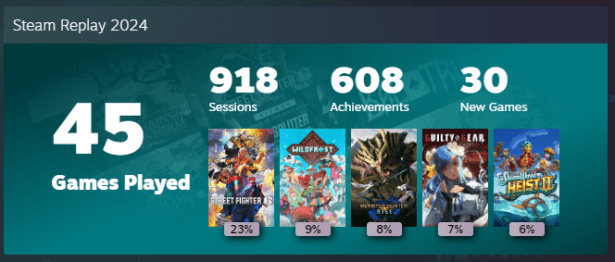
Anyway, I wanted to rectify that by sharing more of my experiences starting with how I began attending locals.
Firstly, a quick primer: what does ‘locals’ even mean? In short, it describes an in-person meet-up to play Fighting games that’s in your area. If it helps, think of it like a book club, trivia, or an adult sports league. The difference being that everyone here is meeting up to play video games.
Our meet-up happens weekly at a pub where we set up a handful of computer monitors, and Playstations for people to play games on. Other folks are free to bring their own equipment as well, so we usually have a couple laptops kicking around too.
This is what that looks like if you’re curious:
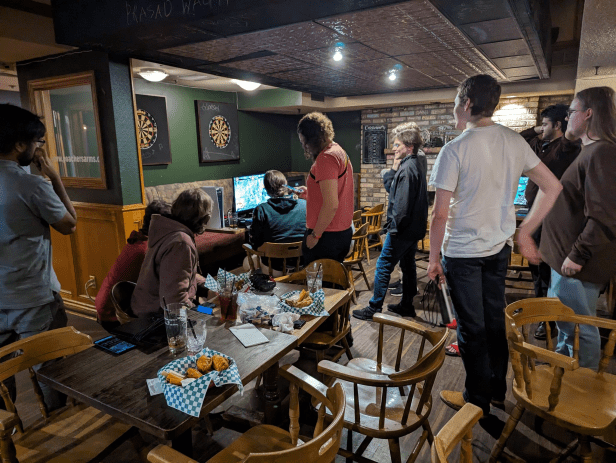
It’s definitely a bit of an oddity the first time you see it. It’s like, “what are these people doing?”
Anyway, that’s the basic setup for locals, and is what people are referring to when they say locals in the context of Fighting games.
As for why locals exist when you could just play online – that’s got a two pronged answer.
The first reason is arcades. If you go back far enough, arcades used to be the place to play video games. In the grand scheme of things, home consoles (and computers) are actually a fairly new innovation. You only need to go back about 45 years, and you’d find that the majority of people played video games outside their houses in a more social setting.
That’s where the culture of Fighting games really started. You’d show up to the arcade, put your money where your mouth was, and play in-person. There’s a ton of people who still remember those arcade days, and wanted to keep that spirit alive even after arcades started to disappear in North America throughout the 90s, and early 2000s.
The second major reason for meeting in-person is that Fighting games have had notoriously terrible netplay until relatively recently. The reason for this is that Fighting games require a completely different solution (known as rollback netcode) for playing over a network compared to what many other games use. The first example of this was with Street Fighter 2: Super Turbo HD Remix, which released in 2008, but rollback netcode wouldn’t see widespread adoption across the industry until over a decade later.
As such, the experience of playing Fighting games online has, historically, been complete dogshit. In fact, were it not for the world-wide pandemic in 2020, I don’t even think we’d have it as good as we do now. Everybody being locked in-doors forced every developer to evolve the online component of their games unless they wanted to risk financial ruin. This has resulted in a much better netplay experience across all Fighting games released in the past 5 years, with many older titles being updated to retrofit rollback solutions.
While it is true that we now live in a proverbial golden age for playing Fighting games online, that wasn’t always the case. Ergo, you’d have to attend locals if you wanted to have a good quality experience playing others in your favourite Fighting games.
So that explains why locals exist, but it doesn’t answer another question that I bet some of you are wondering: what would possess me to show up to an in-person event? We’re in the era of good netplay, so, realistically, I could continue to play Guilty Gear Strive, or Street Fighter 6 in the comfort of my home. And, despite being in my 30s, I don’t have any memories of the arcade era of Fighting games, so it’s not like I have a nostalgic anchor for this sort of thing.
Well, that’s another 2 pronged answer. There’s lots of 2s today.
The first is that I was starting to become feral.
I’d quit my day-job back in February 2024, and hadn’t been outside to interact with anyone for almost 4 months. As such, I started reverting back into a goblin. What I mean by that is that there were several days where I didn’t bother to get dressed, and I’d grunt by way of reply while being spoken to. Obviously, Miranda took issue with this, and told me to, “get out of the fucking house, and interact with other human beings before you forget how to.”
The other reason was a Majin Obama video that I happened to watch the same week my wife told me to go outside. I don’t specifically remember what it was about, but the gist was that Majin was criticizing new players, specially those that joined in the online-centric era, for having no sense of community values.
To make sense of Majin’s remarks, we need to look at the circumstances that surrounded Fighting games, particularly in North America, throughout the 2000s. During this time, arcades were in decline, which forced people to organize their own in-person meet-ups. That’s not an easy thing to do, especially if you’re working alone. However, it becomes a lot easier to organize, and attend these events if you’re working together with other like-minded individuals.
What I’m trying to say is that locals breed a certain sort of comradery between people. That’s why Fighting game players always refer to the broader community as the FGC: Fighting Game Community. It’s a community because people would come together as a community in order to facilitate these kinds of grassroot events.
Hearing all of that, I couldn’t help but feel like I was part of the problem. Not specifically for the points that Majin raises in his video, but because I rarely engaged with the wider community. I wasn’t attending locals. I wasn’t participating in community events. I wasn’t reaching out to new players to help them improve.
What’s worse is that I knew the value of doing all of this because I’d been the recipient of it.
For example, Toronto moved to hosting their weeklies online over the pandemic, and I participated in a lot of those. I met so many fantastic people in the process, and having that weekly anchor kept me playing Fantasy Strike, my game of choice at the time, for several months while I slowly improved at it.
That last point about sticking with the game is especially noteworthy as, historically, I’d drop off playing any Fighting game I picked up less than a month after starting it. However, with locals as an anchor, I managed to stick with Fantasy Strike for almost 18 months. That taught me how to find the fun in slowly improving at a game, and also taught me the value of surrounding yourself with like-minded individuals in a semi-competitive setting.
Funnily enough, it was 1 of the Toronto folks, MrMKL, who told me that London also had a local meet-up. He let me know once Toronto returned to doing in-person events so that I didn’t have to lose out on playing with people every week.
And I’ve already written, at length, about my experience playing against Totsu every week. He was the far better Strive player when we started, but after months of practice, I’d caught up to him. This meant that he had someone of equal skill to play against, which sits at the heart of Majin’s video – you need to help build the community that you want to be a part of.
After reflecting on all of this, how could I continue to keep to myself? There were so many people that helped me to get where I was with Fighting games. I owe it to them to pay that forward to others. That’s how we, as players, help to nurture and grow the audience for Fighting games.
It wasn’t just my sense of guilt for having not given back though, I was also starting to feel kind of lonely while playing Fighting games. Totsu hadn’t really come over to play Street Fighter 6 with me, so most of my playtime was spent churning through faceless, nameless opponents in ranked. That doesn’t exactly help to keep you invested in a game longterm, nor does it create an environment where you can feel socially fulfilled.
I was lucky to find a community while playing Strive, and Fantasy Strike was small enough to have a dedicated, moderated community Discord server. Ironically, I had a much harder time finding a community of like-minded players while playing Street Fighter 6 despite it being a much larger game.
Either way, I needed some kind of social anchor, or I was set to completely burn-out on playing Street Fighter 6 before its first anniversary.
As such, I grabbed that info that MrMKL sent me years earlier, and looked up details about my locals before attending later that week.
Well, okay – that’s a bit of a lie. I started by joining their Discord server to verify that none of them were weirdos. You know what I mean – I didn’t want to show up, and find a bunch of guys who casually threw out slurs every time they lost at a game. That’s not the kind of thing I want to be around, nor be associated with.
Luckily, there was none of that. In fact, almost everyone who regularly attends is super friendly. And the folks who aren’t as immediately friendly are all good people. They just take a little bit more time to warm up to others, which is totally understandable.
Either way, the first night I showed up, I’d already introduced myself to the Street Fighter 6 players on the community Discord, and was immediately greeted by them when I walked in. They’d correctly assumed the person they didn’t recognize was the new guy.
After a quick round of hellos, I was immediately shuffled over to 1 of the stations so I could play some games. I didn’t realize it at the time, but this was the real hello. There’s a lot you can learn about a person based on how they choose to approach playing their character. As such, playing someone in their preferred game is often an additional form of introduction.
As luck would have it, locals did exactly what I hoped it would. I suddenly had a community of like-minded folks that I could talk to about Street Fighter 6. I also had the ability to help other players improve at both Strive, and Street Fighter 6, while improving at the latter myself. There’s just such a wealth of expertise, and players at various points in their journey across several games. That helps a lot regardless of your skill level when you’re looking to learn, or improve at any given game.
It’s also just nice to have adult friends that share a common interest with you. Up until now, I’ve gone through most of my adult life making very few new friends. I’d go out drinking with coworkers after work, but they seldom played video games. Never mind that the ones who did were only interested in latest AAA releases, which I usually skip.
But here, at locals, there are several folks who share a common interest. That gives you at least 1 thing to talk about, though, as I’ve learned, many of the attendees are far more interesting if you get them talking about their other interests too.
I suppose that’s the real reason to start attending locals: it’s about community. It’s about finding a place where you can talk about, and share something you’re passionate about.
If you regularly play Fighting games then I’d encourage you to take the same steps that I did. I’ve had a great time shuffling down to the pub every week to play games, and socialize with other folks. It really can’t be understated how much more fun it is to regularly play Fighting games when you’re using it as a social activity instead of just something to pass the time.
And that goes double for anyone reading who’s looking to improve. Nothing will help you improve quite like showing up, playing people in-person, and then talking about the set afterwards. Heck, I’ve received so much advice over the past 12 months, which was tailor made for me. That’s helped me to break down concepts faster than I otherwise would have, which has made it far easier to improve compared to when I was doing everything on my own.
Oh, I guess it also got me out of the house too. Rest in Peace, Goblin Steve.
Did you enjoy what you read? Consider supporting my work by buying me a coffee over on Ko-fi.
 Frostilyte Writes