
Warning: the following article contains several unmarked spoilers for Hollow Knight, and Hollow Knight: Silksong.
There’s this really cool moment in Hollow Knight that I think encapsulates exactly why I enjoyed it so much. Shortly after entering the City of Tears for the first time, you’re greeted by Hornet. She’s a recurring boss fight character, but this time she’s here with information instead of a challenge. We’re told that we need to seek a Grave of Ash, and then she takes off.
The grave in question is a large monument located within the Resting Grounds, and is a required pit stop for players along the main quest of Hollow Knight. Despite this, no additional direction is provided by Hornet, nor is the location of the grave marked on your map.
Instead, Hollow Knight’s developer, Team Cherry, provided 4 different access points to the Resting Grounds for players to stumble upon. If you’re curious, the 4 paths are as follows:
- A tram from Forgotten Crossroads if the player has found the Tram Pass in Deepnest
- A path through Blue Lake if players have acquired the Crystal Heart
- A (seemingly) bottomless pit which you can accidentally fall down while exploring the Crystal Peaks
- An elevator located on the East side of the City of Tears that allows you to approach the graveyard from below
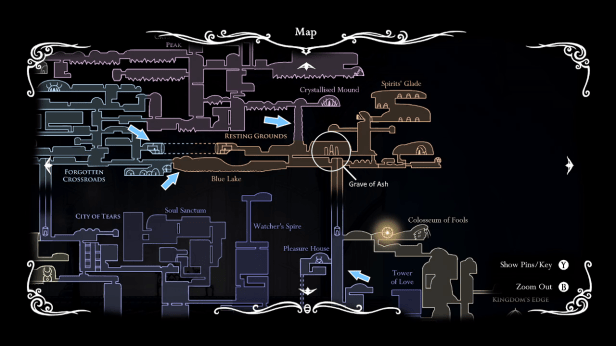
By providing 4 different entry points into the Resting Grounds, Team Cherry has dramatically increased the odds for players to find this essential part of the game. As such, they don’t need to explicitly spell out where to go next. Instead, players are free to explore, and stumble into the Resting Grounds of their own accord.
This whole sequence – a vague hint resulting in the discovery of the Resting Grounds – was the key to what made Hollow Knight’s exploration tick. Team Cherry trusted that I’d get where I needed to go, so I was able to explore as I deemed fit. That made my whole journey feel like an adventure even though I was doing, and going exactly where the developers intended at every step.
It isn’t just the original Hollow Knight that encourages this type of organic exploration: the sequel Silksong does too. For example, after clearing the tutorial, we come across a dilapidated settlement called Bone Bottom. Here we’re informed that we’ll need to make a pilgrimage to the holy city, the Citadel, which sits at the apex of Pharloom. From there, we’re left to find our way up the mountain, and discover the entrance to the Citadel.
Oh. My mistake. It appears Silksong has actually marked the location of the Citadel on the map. That’s…a little disappointing. Though, I suppose that does clearly articulate where the game wants us to go, while also showing how much progress we’ve made towards our destination.

That’s not really an example of organic exploration though.
How about after we enter the Citadel, and encounter Lace for the second time. She fulfills a role similar to Hornet from the first game, and informs us that we need to ascend to the top of the Citadel to find, and defeat the God who cursed the entire kingdom of Pharloom.

Oh.
Again with the quest marker showing exactly where we need to go next. That’s a little frustrating.
In fairness, Lace did give us fairly explicit instructions for where we ought to go next. That’s a stark contrast from the previous game where Hornet shouted about a grave, and took off without providing any context. On that basis, I suppose it isn’t that egregious to mark where we’re headed next on the map.
We’re 0 for 2 here, but I promise that I’ve got the perfect example this time.
After reaching the peak of the Citadel, we’re greeted by a locked lift. We’re then informed that in order to unlock the lift, we’ll need to search around the Citadel for 3 ancient melodies – 1 for each of the major factions within the holy city. Once we’ve collected all 3, the way forward will finally open, and we can break the curse that has beset Pharloom.
Perfect! I bet this’ll be when Team Cherry finally relinquishes the responsibility of exploration. It’ll be just like how finding the Resting Grounds was left entirely up to the player without any explicit guidance, or quest markers to get in the way of organic exploration.
Right?

Fuck.
At this juncture, there’s no point in pretending anymore: there is no moment in Silksong that’s akin to discovering the Resting Grounds. The game is way too afraid of letting players become lost for that to happen. As such, clear directions are provided at every step of the journey alongside quest markers that spoil the fun of actually discovering anything.
The single exception to this level of hand holding is the hidden trigger for Act 3. As such, many players will finish Silksong without fighting a third of its bosses, nor seeing its true ending.
Don’t get it twisted though: once you’ve started Act 3, the quest markers return in full force. It doesn’t matter that this part of the game is obviously intended for the most dedicated players looking for an additional challenge. Nope. You’re never going to get a chance to flex those navigation chops whatsoever, nor will you be expected to explore the remainder of Pharloom organically.
As a brief aside, I think it’s also worth mentioning that Silksong provides this same level of guidance within its various side quests too. A perfect example of this can be seen with courier quests where players make deliveries to named NPCs throughout Pharloom. The quest giver lets players know exactly where they’re meant to go, and the delivery only becomes available after they’ve met the recipient. Regardless, a quest marker is still slapped onto the map.
I also realize that I’m (probably) going to sound like an asshole for complaining about the increased volume of guidance in Silksong. There are several people that I’ve spoken to over the years who bounced off Hollow Knight because of how directionless it felt. Having quest markers to clearly define where players are expected to go completely sidesteps this problem, which is a huge boon for anyone who couldn’t get into the original game.
For me though, I can’t help but feel like something was lost in translation going from Hollow Knight to Silksong. The sequel doubles down on challenging platforming with areas like Bilewater and Mount Fay, while introducing several bosses like Karmelita, Trobbio, and Last Judge which meet or eclipse the difficulty of Hollow Knight’s most infamous fights. By comparison, I’ve felt starved for the quiet exploration that made the original such an enjoyable experience. That lack of direction made Hollow Knight unique in a way few games dare to be.
After all that, I’m left asking the question: is it wrong of me to want less guidance in Silksong? Perhaps. There’s a not insignificant chance that these changes have made Silksong far more accessible to a wider range of players when compared to the original game. That’s gotta count for something, even if these changes are a massive turn off for me.
That said, I don’t really want Silksong, or games like it, to be made exclusively for rat-brained people like myself. Rather, I’d appreciate an option to disable quest markers, and explore as I see fit. Just give me a chance to actually breathe in Pharloom, and explore at my own pace instead of whisking me through a guided tour.
Did you enjoy what you read? Consider supporting my work by buying me a coffee over on Ko-fi.
 Frostilyte Writes
Even though I tend to prefer it when games don’t give me a lot of direction, I didn’t mind it as much in Silksong for a couple of reasons. For one, Pharloom is WAY bigger than Hallownest, like to a pretty crazy degree. Without something to provide direction, I feel like even more people would have bounced off of it, especically with places like Chapel of the Beast just sitting there.
Silksong also likes to outright hide things a lot more than Hollow Knight does. Like without the marker for Skarrsinger Karmelita, I would have never figured out that there was even more of Far Fields to be found. There’s almost no indication that it’s there other than the quest marker. Some locations you can miss entirely, too. I only found Wisp Thicket because there was a flea marker there.
Also, I feel like Pharloom is harder to explore in general since most enemies are legitimate threats that you can’t just bypass. You can eventually get powerful enough to kind of wander like you did in Hollow Knight (while still needing the compass), but there’s no doing that in Act 1 and throughout much of Act 2. (Quick aside: I kind of hate that I needed the compass on most of the time in Silksong. In Hollow Knight I could navigate by room shape alone after only a few hours. In Silksong though….nah.)
I too wish Silksong was more explorable in the same way that Hollow Knight was, but I think much of its design demands the extra guidance, unfortunately.
ANYWAY, I think I’ve got the perfect game recommendation for you (assuming you haven’t played it yet). It’s called Animal Well, and it’s an absolutely fantastic experience if you don’t like having your hand held. It provides basically no guidance; you wake up in a strange (and wondrous) place and you just gotta figure it out. And by that, I mean everything. Where to go, what to do, what items do, what items are for…and yet somehow you never really get stuck. You’re always making little discoveries for yourself that keep pushing you forward!
It’s…it’s a really special experience. You gotta try it!
LikeLiked by 1 person
I have no doubt that most people would’ve bounced off Silksong if it had just as little direction as Hollow Knight. Hence why I ultimately landed on “can I have the option to flip this stuff on and off” rather than saying the game would outright be better if that stuff wasn’t there. Kind of along the same lines as the assist modes in Hades (1 & 2), or Celeste. But in reverse.
And, more to the point, I didn’t use the compass at all in Silksong, nor did I feel the need to. There is clearly something very uniquely wrong with me, which is why I don’t want other players to be subjected to the same experiences as I enjoy (as it relates to navigation). I really do just need my own special sadist chamber that’s cordoned off from everyone else.
Re: Animal Well – would it surprise you at all to find out that I’ve already played Animal Well? I picked it up back around its release last year, and all of what you’ve said is true, though I do wish that some of the games items (like the Top) were distributed a little earlier on. Having to go back through everything a third, or fourth time just to test 1 new tool wasn’t exactly my favourite thing in the world. I don’t know if I missed the signposting for where certain items were meant to be used though, which is always a possibility.
LikeLiked by 1 person
Yeah, I get what you’re saying with wanting an option to turn markers off. I just wonder if that’d be enough. I mean, in my case, just know that the option to turn something like map markers on would claw at the back of my mind (if they were a feature I didn’t want).
For Animal Well, glad to hear you’ve played it!
You probably didn’t miss anything when it comes to signposting in that game, though. If I remember right, items like the top weren’t needed at all to reach the end. They just came into play once you started looking for all the Easter eggs, so I don’t think the game really does anything to clue you into how to use them.
LikeLiked by 1 person
Oh man, I’m one of those people who bounced off Hollow Knight because I had no clue where to go. Even tried several times with the same result.But seeing the reaction to Silksong has made me so curious that my plan is to give Hollow Knight a proper go and actually get somewhere in it, so I can try out Silksong afterwards.Excited to see where I land on the handholding.
LikeLiked by 1 person
Honestly, I feel like you could potentially just skip straight into Silksong since, in my mind, there isn’t a ton of cross-over between the 2 games. I know some people might take umbrage with that, but Hornet moves, jumps, and attacks in a completely different way to the Knight from the original. Heck, I feel like half the disdain Silksong got at launch stems from how Hornet just…wasn’t the Knight haha.
Either way, I hope you find your footing with either game, and manage to really sink your teeth into it this time. I enjoyed both, and always find it nice when I’m able to share that with others even if it’s just in convincing someone to play the thing and see it for themselves.
LikeLiked by 1 person