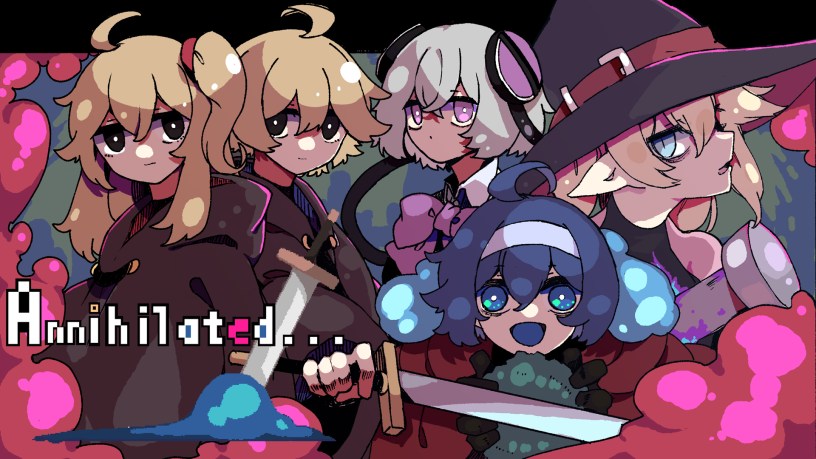
Normally, I like to begin reviews by stating what genre a game finds itself within, but I feel like doing so with Annihilated would be a bit of a disservice to it. My reason for thinking as much is thus: the bulk of the game is focused upon its narrative. In a lot of ways, it reminds me of a Visual Novel, especially those where the story branches into multiple mutually exclusive paths. As such, Annihilated is defined primarily by its writing, which is somewhat incongruent with the mechanically defined genres of video games.
That in mind, Annihilated is about a doomed expedition to save the legendary Hero’s party. You are the sole survivor from the rescue team, and discover the 4 heroes in shambles. The aptly named Hero has lost his ability to communicate, the Mage can’t perform magic, the Warrior has lost his strength, and the Priest has lost his marbles. Seeing this, you resolve to save, and escort 1 of the 4 to the surface. Thus, your journey begins anew with whichever companion you’ve selected as you fight your way to the surface in turn-based combat.
Developer(s): Death Kumiai
Publisher(s): Death Kumiai, Flashlight Games
Release Date: November 10th, 2026
Released on: Windows
Reviewed on: PC (Win)
Copy Provided by Publisher
With that in mind, I feel like the first major question that I need to answer is whether, or not Annihilated’s different story routes actually warrant additional playthroughs. Honestly, I’m somewhat mixed on that myself.
==Story Spoiler Warning Start==
On one hand, the individual story beats within each route can vary wildly depending on your choice of partner. For example, the fourth major boss is a fairly significant moment during the Hero’s story-line. You’re battling against someone who is ideologically opposed to the Hero, and defeating them in combat is meant to symbolize how the Hero’s values are stronger.
The same fight during the Mage playthrough has almost no narrative significance, and can be brushed aside and forgotten upon completion. In fact, the game makes a joke about this, which won’t make sense unless you’ve already completed the Hero’s playthrough.
That said, not all of the narrative beats were given this level of diversity. For example, the first major boss is largely uniform across the cast. He’s a former member of the Hero’s party, and is bitter about being exiled because he couldn’t keep up with the stronger members of the group. Thus, he’s taking his revenge, which sees hims spout the same laundry list of complaints irrespective of whom you’re travelling with.
==Story Spoiler Warning End==
As such, the individual story beats come across as a bit of a mixed bag. Though, I felt like there were more differences than similarities, but that’s something I can only claim anecdotally instead of empirically.
However, there’s no question that combat feels very different depending on who you’ve chosen to drag along. For instance, the Mage can’t perform magic so she ends up being somewhat of a liability until you find equipment that actually synergizes with her complete lack of combat prowess. By contrast, the Hero can turn just about every weapon into a sledgehammer that deals massive damage without much forethought from the player.
With both of those factors in mind, I think whether or not Annihilated actually warrants multiple playthroughs will largely depend on the type of person playing it. For my money, I completed 2 of the 4 before I felt satisfied with my experience. Admittedly, I’m still curious about what narrative, and mechanical twists are buried within those remaining routes, but not enough to play through another ~17 hours of the game.
That said, I wanted to circle back around to the writing because I haven’t really said much beyond making a point about how much individual story beats will (or won’t) change from run-to-run.
In general, I enjoyed the writing, but I felt like it was a little uneven. For instance, I wasn’t really a fan of the Hero’s story. There’s nothing especially wrong with it. I just found it harder to connect with the characters given the bulk of the dialogue is the main character muttering to themselves since the Hero can’t really talk. This meant that there was almost no chemistry between the 2 protagonists, which made the whole journey a bit of a slog.
By contrast, the Mage’s story-line was an absolute delight. You get an excellent sense of who both of the characters are, and are able to see them play off one another in a way that’s genuinely endearing. This made the eventual climax, and conclusion of the story hit perfectly, and it almost convinced me to give those additional 2 playthroughs a go.
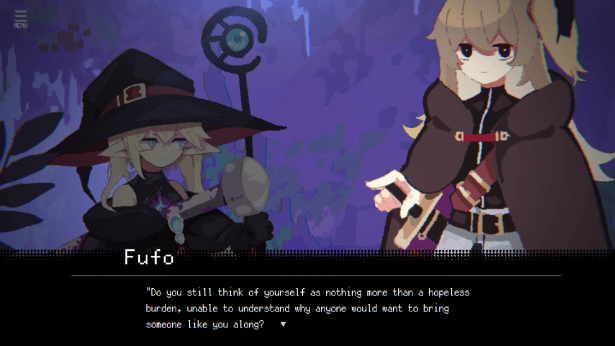
While I found the overall quality of writing a little uneven, I can’t say the same about the pacing, which was great. Story beats come regularly, and the player is never left dangling in the wind. Furthermore, when a major revelation drops, time is provided for the player (and protagonists) to digest what happened. This ensures that every single beat hits with exactly the emphasis that it needs, so that it’s felt to the fullest. That’s a surprising rarity among video game writing, so I was left fairly impressed with how well paced the story of Annihilated ended up being.
To this point, I’ve spent most of the review talking about Annihilated’s writing, but I think it’s finally time for me to stop dancing around the combat. Though, I have nothing bad to say about it. In fact, the combat was one of my favourite parts of the game. The reason being is simple: Annihilated has one of the most unique flavors of turn-based combat that I’ve ever played. Though, to elaborate on exactly why that is, I’ll first need to explain how it works.
For starters, all of your weapons have a limited number of uses before they break. That might sound off-putting, but Annihilated bakes this constant loss of equipment into the core of its combat. Basically, any time a piece of equipment is about to break, its power increases. For example, if you had an iron sword that normally deals 28 damage, then it will deal 56 on the turn that you destroy it.
This is super neat because it adds a dimension of logistics to combat that normally isn’t present in other turn-based games. For example, you could prepare a subset of your weapons to be primed to break right before you enter a boss fight by deliberately using them up to their final use in the preceding fights. Then you can chew through the boss with ease leveraging all of your equipment at their absolute apex of power.
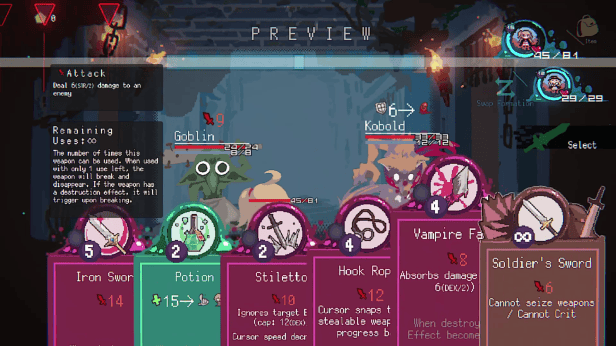
Though this raises a question: if I’m constantly breaking my equipment, won’t I run out of ways to hit the bad guys? Yes. However, Annihilated has an answer for that too. Whenever your inventory drops below a certain threshold (usually between 3 and 5 items), you’re able to pilfer the pockets of your enemies by using a powerful special attack. This will award a weapon, unique to each class of enemy, which players can then leverage in upcoming battles.
It’s also worth noting that every character has a “basic attack” with unlimited uses. So you’re never truly out of options, though weapons that break are far and away the better option in the majority of cases.
Plus, breaking equipment is also how players access weapon upgrades. Basically, you’re awarded a currency that you can spend on upgrades whenever a weapon breaks. This can then be used the next time the player is resting at a camp site.
As such, the flow of combat in Annihilated sees the player constantly chewing through their available inventory, stealing weapons off fallen foes, and then increasing the power of those weapons for future battles. This ensures that a new influx of powerful equipment is always at the player’s fingertips, and it prevents a single dominant strategy from completely trivializing the entire game. After all, when you can’t count on your best weapons lasting forever, you’ll need to adapt, and evolve your strategy as you go.
Though, for as much as I enjoyed Annihilated, there was a persistent problem that plagued my entire time with the game: the English translation is not very good. To put it bluntly, some parts of the game read like a manga, or anime fan translation. That is to say, certain sections of dialogue read as if they were translated verbatim, instead of being written how an English speaker would expect to read them in English.
This is going to be easier if I just share an example of what I mean:
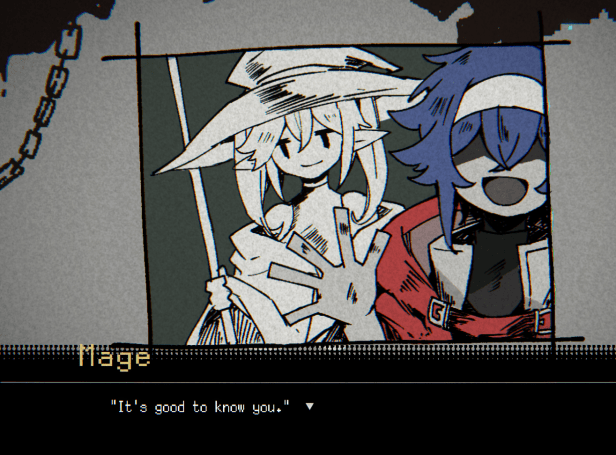
“It’s good to know you.”
No. Absolutely not.
No one who speaks English as a first language greets other people like this. You’d say, “It’s nice to meet you.” In a literal sense, there is no difference between either of these phrases, but the latter is used as a common English greeting, while the former feels totally alien.
This is far from the only example of awkwardly translated dialogue, but I don’t want to dwell on it too much because translation is a very fixable problem. You just need to hand things off to someone with a little more experience, and a lot of the awkward dialogue would completely disappear.
It’s also worth highlighting that the review copy of Annihilated was patched twice throughout the review period, and translation mishaps were reduced with the first of those patches. The second patch came out less than 24 hours before I had to publish this review, so I can’t comment on it, but there’s a chance that even more of the translation oddities (including the one I highlighted above) have been found, and were removed.
Before we close things out, I wanted to highlight the game’s music by Ninomiya Yuji. I thought all of it was fantastic. Some of the more emotionally charged songs felt like they came at exactly the right moments, and the main battle theme was a total bop which is good because you’ll hear a lot of it throughout your time with Annihilated.
Also, all of the art is great. The character sprites are all fantastic, and the different vignettes are especially striking. Though, I feel like all of that was self-evident to anyone who has watched Annihilated’s different trailer videos.
So, where does that leave us with Annihilated overall?
Generally speaking, I feel quite positively about my time with Annihilated. Sure – I didn’t finish all 4 playthroughs, but, translation oddities aside, I rather enjoyed what I played of it. The story has some genuinely compelling moments, and the combat has to be one of the most compelling implementations that I’ve played in a turn-based RPG that didn’t include a grid. As such, I’d happily recommend Annihilated to anyone in the market for a slightly more experimental take on a traditional RPG.
Did you enjoy what you read? Consider supporting my work by buying me a coffee over on Ko-fi.

