It is, once again, time for me to awaken from my slumber to blog.
I say that as if I wrote the entirety of this post today, which isn’t the case. I’ve been slowly transcribing bits and pieces of it throughout the month. I figured it’d be a better approach to finish something, let my brain stew on it a bit, and then write about it. That way I avoid any future occurrences of, “I don’t even remember playing this game,” like I had with Granblue Fantasy Relink earlier in the year.
Regardless, here’s what I got up to in October starting with the game I teased in my last post – The Legend of Zelda: Echoes of Wisdom.
The Legend of Zelda: Echoes of Wisdom
Normally, I prefer starting each subsection off with a short description, but that feels a little self-defeating for a Zelda game. I feel like everyone that plays video games knows what The Legend of Zelda is. And, if you don’t, then you’ve likely played a game that is partially inspired by it. That may sound like a stretch, but The Legend of Zelda: Ocarina of Time was so influential that it defined the direction of all 3D Action-Adventure games during the early 2000s.
Regardless, Echoes of Wisdom is the latest in Nintendo’s long running The Legend of Zelda franchise. However, this time there’s a twist: you get to play as the titular Zelda. Otherwise it’s exactly what you’d expect from a Zelda game: exploration, and puzzles. The former happens as the player roams the world doing quests, and engaging with the game’s primary story. The latter takes place, mostly, in self-contained dungeons that are built around a handful of different mechanics.
Echoes of Wisdom also borrows a few pages from the Breath of the Wild playbook by focusing on tools with a wide range of properties, instead of single use gadgets. This is because Zelda has the ability to copy most objects from the overworld, and summon them ad hoc throughout her adventure. For example, players gain the ability to create fire fairly early on, which they can use to burn wood, melt ice, or illuminate darkness. In this way, fire has multiple potential uses, and it is up to the player how they choose to use it.
Fire is just one example, but there are a handful of other tools that players gain throughout Echoes that work similarly. One of my favorites was using boxes, and wooden beds to create bridges. This allowed me to access a few different areas fairly early into my playtime with Echoes, which felt great.
I’m aware that not everyone likes open-ended puzzles with multiple solutions, but I do. As such, I really enjoyed how the majority of Echoes’ puzzles were designed in this way. This meant that the puzzles made good use of Zelda’s primary mechanic of being able to summon copies of objects that she’s found throughout the world. I also find puzzles like this a lot more satisfying to solve since I’m not simply trying to work out the developer’s intended solution for a problem. Instead, I’m using a variety of tools that I intuitively understand to sort of invent my own solution to the problem. That might seem like only a minor framing difference, but it means the world in terms of my overall enjoyment for puzzle-focused experiences.
Having said that, Echoes of Wisdom still feels like a very Nintendo game, and I mean that in the most derogatory way possible. There are several instances where the game feels the need to repeat basic information, or reiterate events that the player just witnessed, which feels very patronizing. This is doubly true while playing on hard mode. Evidently, only the game’s combat is made more challenging when players opt into the higher difficulty.
It’s not just patronizing dialogue that feels like a uniquely Nintendo problem though, as Echoes of Wisdom is yet another Nintendo game where you have to craft everything individually. This was the bane of my existence in Animal Crossing, and I dislike it just as much here. I spent around 30 hours playing Echoes, and at least 2 of those hours were spent brewing healing potions. It was awful. That might seem like a ridiculous thing to get worked up about, but brewing potions was almost 10% of my playtime. Is crafting really this pivotal to the overall experience of Echoes of Wisdom? I don’t think it is. So why does it take up so much of the game’s runtime?
Neither of those 2 aforementioned issues come close to the third problem I have with Echoes of Wisdom though: it’s a little bit sexist. There’s a great article on CBR that highlights how, and why turning Zelda into Link so that she can swing a sword completely undermines her first outing as the hero, and I’m inclined to agree. That’s doubly true during the final boss, which I’m not going to spoil here, but those who’ve also finished the game will know exactly what I’m referring to. Plus, Swordfighter mode is often the most effective way to engage with combat, which mechanically reinforces the idea that Zelda is entirely dependent on Link throughout her journey.
Obviously I’m not a lady, so I can’t speak to that perspective, but even I can see why turning Zelda into a boy so that she can fight baddies might be narrow minded. At least I now understand some of the frustration my wife experienced while playing through Echoes of Wisdom.
So where does that leave Echoes of Wisdom? I’d call it a solid middle of the road experience. If you’re craving a new Zelda title then you’ll probably enjoy it. By all accounts, Echoes is a very safe Zelda game that’ll likely appease fans who were disappointed by the other less traditional Switch Zelda games. Though I think there are certain aspects of it that could be altered, streamlined, or removed for a better experience overall.
Steam Next Fest
I know this isn’t a game per se, but playing demos throughout the Next Fest accounts for an entire week’s worth of my playtime in October. I don’t know what possessed me to play more demos than I did during the Summer Next Fest, but I did, while also writing about the whole lot. Well, mostly. There were a few demos that I popped in, and out of so fast that I didn’t see the point in mentioning them. They just weren’t for me, and that’s A-Ok.
Regardless, if you missed any of that, and were curious about some of the highlights from my time with the October Next Fest, I’ll include all 4 of the articles here:
- Round 1 ft. Rise of the Golden Idol, Nurikabe World, Rift of the Necrodancer, Glitch Dungeon Crystal
- Round 2 ft. Warside, Knights in Tight Spaces, StarVaders, Sliding Hero, Sorry We’re Closed
- Round 3 ft. Dimensionals, Citizen Sleeper 2, Wilmot Works It Out, Zero Order Tactics
- Round 4 ft. OMG Words, SULFUR, Critter Café, Guidus Zero, Letalis
At the time, I found covering Next Fest alone to be a bit much. It’s not a lot of time for a single person to go through so many demos, and it isn’t as if many of the demos are short either. Just the demos I covered took me around 25 hours collectively, so it was a bit like finishing an entire game in the span of 5 days before writing several articles about it.
However, I’m glad I put as much effort as I did into Next Fest now that I have some hindsight on the event. I bulked my Steam wishlist up quite a bit, but I also realized that I’ve purchased almost all of the games that I profiled positively during the Summer Next Fest. Better yet, I enjoyed most of them. Knowing that, I think that I’ll continue to use Next Fest as a way to discover new indie titles. It turns out that actually playing games is the best way for me to determine what I’m most interested in continuing to play. Who’d have thought?
I should also say that I appreciated the positive response I received to my coverage of the Next Fest. Not just the October one – also the Summer one. I’d be lying if I said that didn’t make trawling through the mountains of trailers, store pages, and demos feel a lot more worthwhile. So, thank you if you’ve left me a nice comment on any of my Next Fest coverage. I appreciate it. A lot.
Cataclismo
Speaking of the Steam Next Fest, next up is Cataclismo. It’s a game that I covered during my round-up of the Summer Next Fest, and I’m happy to report that it’s fantastic.
First up: what is Cataclismo? It’s a Strategy game where the main hook is that players can create fortifications with an insane level of customization. You’ll be creating your own towers, walls, and gates using modular building-blocks, instead of simply selecting prefabricated options that were provided by the developer. For me this made Cataclismo feel a lot like playing Stronghold Crusader. However, the extra emphasis that Cataclismo placed on base building means that it feels like a natural evolution of Stronghold’s gameplay.
There’s also a lot of emphasis placed on building vertically in Cataclismo, which I found very refreshing. From a purely mechanical perspective, taller structures have higher hit points. As such, players are encouraged to build the largest possible defenses they can muster with their available resources. This is especially notable for me because I will not engage with a game’s more creative aspects when I’m too focused on micromanaging my resources. However, Cataclismo had me spending an inordinate amount of time making giant, multi-layered affronts to nature to protect my settlements because they offered a strategic advantage.
It’s not just fortifications where Cataclismo encourages players to build vertically though: it also does so in actual settlement construction. I frequently found that I didn’t have as much space as I needed across the majority of the missions that I played in Cataclismo. This wasn’t a problem however, as many of the game’s buildings have partially flat roofs. This means that they can be built upon quite easily, so players can maximize the value they get out of their limited space.
It’s also just a lot easier to defend your settlement if everything is stacked in a single place. Having your town spread all over shit’s creations means you need to spread your soldiers thin, and also spend a lot more resources to wall everyone in. That’s not always possible, but building up is always an option.
That’s all without mentioning that building vertically just looks super cool. At least, I think it does. The structures I constructed across my time playing Cataclismo were so asymmetrical in their design, which meant that every settlement that I created had a ton of character. I know that won’t be important to most folks, but just look at how neat some of this looks:
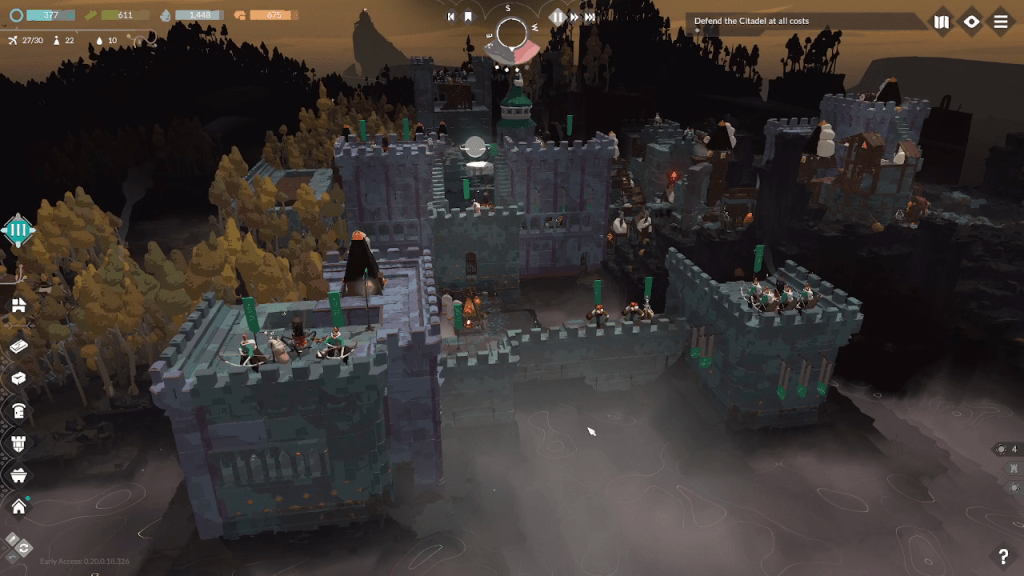


While I’ve spent a lot of time praising Cataclismo’s base construction, and that’s absolutely the game’s X factor, the campaign was fairly fun in, and of itself too. Once players are through the first few tutorial missions of the campaign, they’re let loose on a handful of different missions. Most involve hunkering down in a single area, but there are a few where players command a squad while exploring. Those missions in particular felt akin to old-school RTS games. There’s also a tower defense level, which I’d like to see more of when the campaign is actually complete. All that variety helped to keep things interesting from mission to mission.
And yes, you did read that correctly: Cataclismo’s campaign is unfinished at the time of writing. The game is in Early Access, and ends the story on a cliff-hanger for, what I assume, is the second half of the campaign. There are already some achievements in-place for the remaining campaign missions, so I’m excited to see what new mechanics, and scenarios the dev team are cooking up
All said, Cataclismo gets a strong thumbs up from me, even in its current state. I think the game will only continue to get better with time, and I’d argue that the current offering of available missions are more than worth the asking price. It’s the kind of game that I think a certain group of people will go absolutely nuts for, and I’m glad I picked it up since I appear to be one of those people.
Street Fighter 6
Finally, we’ll close out this month with another obligatory look at what I’ve been up to in Street Fighter 6.
Last month, I reported on how I’d been managing some success while playing at my local scene’s weeklies. I’d managed to place in top 8 during all 3 of September’s Street Fighter 6 brackets, which I was fairly pleased with. I’m similarly pleased to announce that I kept that kind of performance going with top 8 finishes during all 3 of the Street Fighter 6 brackets we played during October.
I’ve included images of the top 8 banners for all 3 brackets, and you’ll notice I did a little better with these 3 than the previous 3. There’s another fourth place finish, and 2 fifth places. Obviously getting top 3 during any of the weeks would have been really exciting, but I’m still pleased with my showing overall. If nothing else, I proved that I’m a consistent competitor.

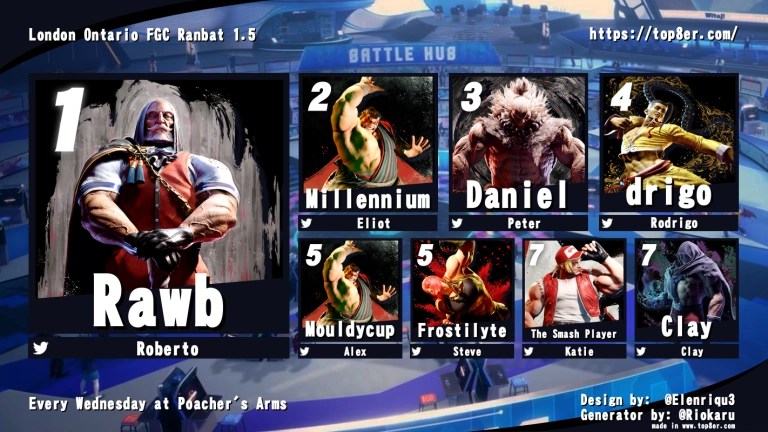

That last point about consistency is also important because these 6 brackets were part of a wider event called a Ranked Battle. What that means is that we were awarding points based on how well everyone did each week. Getting into top 8 across all 6 weeks gave me enough points to tie with Alex for seventh place overall, which, in a roundabout way, gave me yet another top 8 finish. Unfortunately, we don’t have a top 8 poster for the whole event, so you’ll just have to take me at my word for that one.
There’s also one final bit I wanted to share about Street Fighter 6 as it wasn’t just offline events where I’ve been enjoying success: I finally made it into Master rank for the first time ever.
I went on a bit of a tear and had a 14 game win streak in Diamond 5. I don’t typically manage that many consecutive wins, but doing so awarded me a ton of league points. So much so that I actually got within striking distance of Master rank for the first time. From there, it only took a couple more wins against some folks to secure myself a spot in the highest online rank. Well – technically Legend is the highest rank, but that’s a vanity title for the top 500 ELO players which is entirely populated by people who play Street Fighter 6 in some professional capacity. Personally, I’d like to remain pragmatic here, so Master is as high as I’m going to shoot.
Either way, I’m fairly chuffed about it even though achieving Master rank doesn’t really change anything. There’s still a lot of combo routing that I need to continue fine tuning on Marisa, and I’ve still got massive knowledge gaps for dealing with certain characters. Regardless, it was nice to finally hit Master rank so I can add another notch to my belt.
That’ll wrap things up for October. It was a fairly busy month all things considered. The good kind of busy though.
If you made it this far, thank you for reading. I know this was a lot. It turns out I can write a lot more when I space out my writing across several sessions instead of doing 1200 to 1500 words all in one go.
As always, thank you for reading, and stay safe out there.
 Frostilyte Writes
You should be chuffed about getting master rank in SF6, its solid. Lord knows I’ll never ever get that (I would prob need to start playing SF first…)
LikeLiked by 1 person
Congrats on climbing into Masters!
I’m still very much resisting jumping into ranked play for Overwatch, but… That resistance may be losing the battle. Hah.
LikeLiked by 1 person
Thank you.
Is there a particular reason that you’re avoiding playing in ranked with Overwatch? That’s always my default in games with a multiplayer focus as I don’t necessarily see a point in playing with looser matchmaking. I just tend to have a better experience when I’m consistently ranked with other players of roughly the same skill level. I’m curious about your perspective since it seems that it’ll be rather different from my own in this regard.
LikeLiked by 1 person
I know this isn’t the case for every game, but in OW at least, there is some (loose) SBMM going on even outside of the ranked context.
You have a hidden MMR that comes into play even for quickplay matches.
But as to why *not* ranked, it’s more of a mental thing. I can be pretty easy-breezy even about a QP loss streak if one happens and not get mad at the idiots (be that someone on the team or myself) in the match, which is a switch I haven’t reliably turned on for Ranked when a rank up or worse, rank down is in the cards.
I’ve never been more angry as a gamer than when I used to play League ranked back in the day. xD
Having said all that though — went through and did my placement matches for Support in OW2 yesterday. Managed to do well enough that I narrowly avoided bronze hell entirely from those, my matches are still subject to extra % movement for calibration at the moment, but have gone up to mid-silver from a starting position of bottom of silver last night.
I think climbing into Gold should be fairly comfortable, after that we’ll see.
LikeLiked by 1 person
That’s part of why I avoid team games entirely. When it’s 1 on 1 there is less chances for someone that is ostensibly on my side to fuck everything and everyone over lol
Though I will say that I tend to ignore rank a lot while playing ranked myself. Sure you do get a bit of heighten awareness on a rank up match, but for the most part it’s better to simply ignore the ranking as you play. I know most people don’t view it like this, but it doesn’t really do anything aside from match you against players of a similar skill level. It’s more a cosmetic than anything.
LikeLiked by 1 person