
Isles of Sea and Sky is a bit of a weird game to talk about. At least, I think it is. I loved it, but, in editing the original draft of this review, I realized that how I chose to describe the game made it sound intensely unfun. And I have no doubt that for some people it would be. However, that doesn’t accurately reflect the experience that I had, so I’ve had to come back to the drawing board. Actually, I’ve come back to the drawing board a few times now.
Regardless, I hope that in the following body of text I’ll manage to accurately convey just how neat of a game Isles of Sea and Sky is. It’s something that I compulsively played from start to finish in the span of 3 days. I can’t remember the last game I was that enamoured by. In my mind, that’s gotta mean Isles of Sea and Sky was doing something special.
Developer(s): Cicada Games
Publisher(s): Cicada Games, Gamera Games
Release Date: May 22nd, 2024
Released on: Nintendo Switch, Windows, Linux
Reviewed on: PC (Win)
Copy Purchased
I suppose the easiest place to start is by answering the following: what even is Isles of Sea and Sky. The simple answer to that question is: Sokoban. For those who aren’t familiar, Sokoban is a puzzle game from the 80s where the primary mechanic is to push boxes around. There have been no short supply of games that were either partially, or wholly inspired by this incredibly influential game whether it be the myriad of puzzles from The Legend of Zelda about moving square objects around a room, or more recent games like Baba is You, or Void Stranger which are wholly built upon a foundation of moving boxes.
Isles of Sea and Sky follows in the footsteps of other Sokoban inspired indie games being wholly dedicated to pushing boxes to solve puzzles. Don’t let that description mislead you though: despite the simplicity of its mechanical foundation, Isles of Sea and Sky can be fiendishly challenging. It also gets a ton of mileage out of overlaying several different mechanics with its block-pushing core.
I’m sure that this is the point where you’re questioning my sanity. Sokoban is cool, an’ all, but what makes Isles of Sea and Sky special? What is the sauce?
Metroidvania progression.
Yes – really. Throughout its runtime, players will find a handful of different power-ups in Isles of Sea and Sky that fundamentally change how they’re able to interact with the world.
What’s wild is that, despite having Metroidvania progression, Isles of Sea and Sky doesn’t devolve into a frustrating nightmare. It would have been so easy for that to happen. Can you imagine spending 30 minutes trying to solve a puzzle only to realize you don’t have the tools to even begin solving it yet? That’d be a fucking disaster. I, for one, would probably close the game, uninstall it, and try to purge the memory of it from my brain. And I don’t think that’d be an overreaction either. Thing is, that doesn’t really happen in Isles of Sea and Sky, and there’s a couple clever things that the game does to make sure that’s the case.
The first of those aforementioned ways that Isles of Sea and Sky tries to address the very obvious pitfall in its design is by being (mostly) non-linear. Because a not-insignificant number of people have their own idea of what that means, I’ll elaborate on what I mean. When I say Isles of Sea and Sky is non-linear, I mean that you can skip entire sections of the game, while still finishing the game. There is a set number of things you’re expected to complete like the tutorial puzzles, and the final 4 puzzles that wall off the ending, but there are huge swaths of this game that you can completely ignore.
This lack of linearity also means that there are portions of the game where you can become stuck on a puzzle, but that doesn’t mean you have to remain stuck. For example, I got completely bamboozled on my first visit to the third major island in the game. I could not for the life of me figure out how to solve the introductory puzzles for that island’s unique mechanics: water, and rapids. So you know what I did? I hopped back onto my trusty sea turtle companion’s back, went to a completely different island, and continued my adventures.
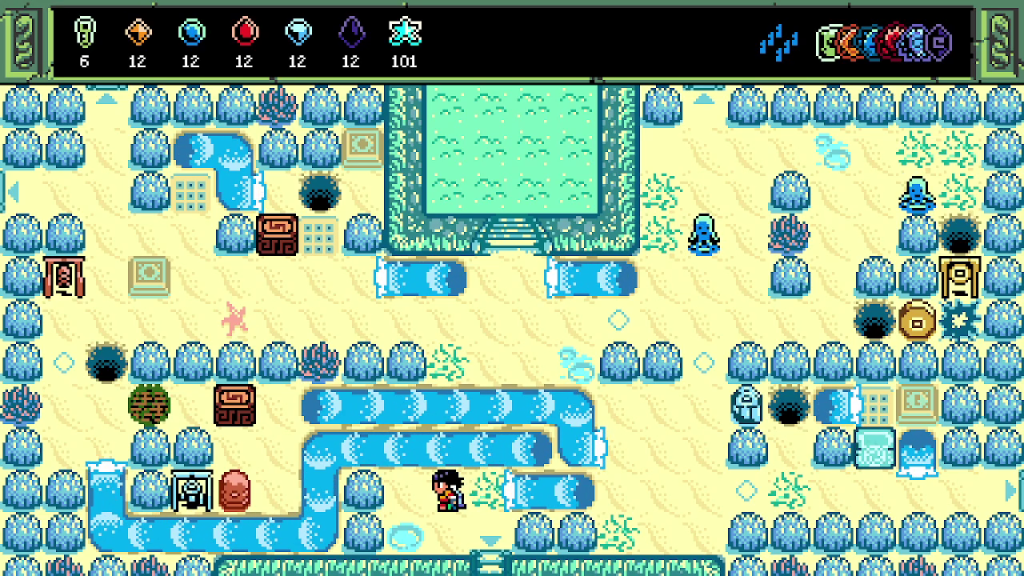
I appreciated this as I’m increasingly finding that puzzle games don’t always have the most clear cut difficulty curves. It is a monumentally difficult task to properly determine exactly how difficult puzzles are in relation to one another. This is even more challenging in games where there are a wide array of different mechanics, which is the case for Isles of Sea and Sky. Not every player is going to mesh with certain mechanics, so having the ability to move on, and return at a later point removes a ton of unnecessary frustration.
The other thing that Isles of Sea and Sky does to help blend its puzzle, and Metroidvania elements is that it makes all of the power-ups optional. Each power makes certain puzzles easier, but I’m fairly certain you can finish the game without ever getting any of them. Now, you can’t 100% the game without finding the power-ups, but I figure that much is obvious.
What this ends up meaning though, is that there are very few times where the player can even come across puzzles they’re not equipped to solve. And in those instances where you do find a puzzle that you lack the proper tool for, it’s so obvious that you’re lacking some additional piece of the puzzle. This makes it easy to properly evaluate that you should move on, and continue exploring elsewhere.
On top of all of this, I found Isles of Sea and Sky had a tendency to make me feel really clever whenever I solved one of its puzzles. I’d say I’m aggressively average at puzzle games, and found there was a fairly good mix of things I could solve quickly, and 20 minute head scratchers. Obviously, your mileage may vary, but I don’t think Isles of Sea and Sky is ever trying to make the player feel stupid. Moreover, the more open-ended design encourages you to move onto another set of puzzles when you become stuck, doubly so since you’re not required to solve everything to even finish the game.
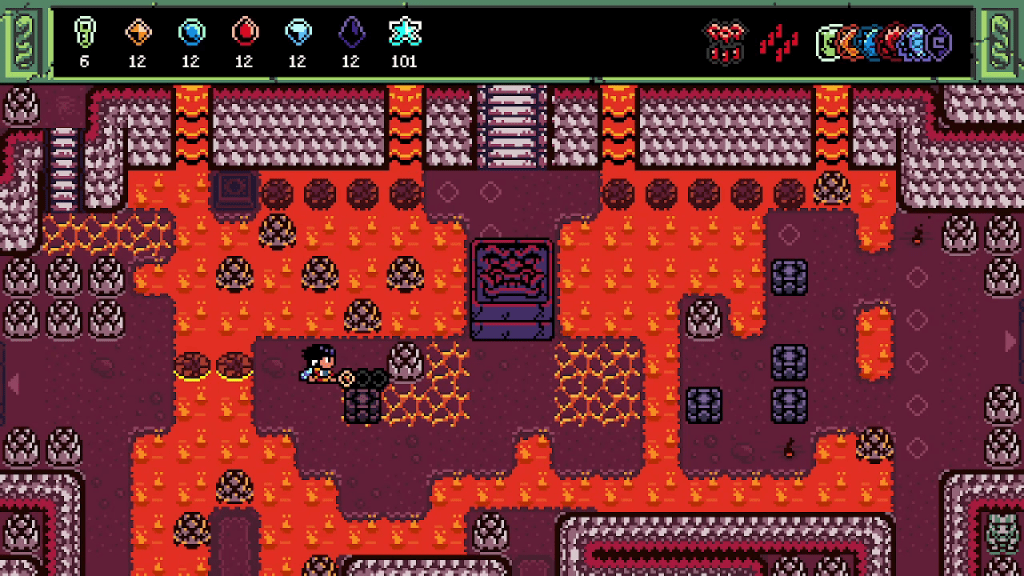
The only other thing that I want to mention before I close out is how Isles of Sea and Sky is yet another game that doesn’t rely solely on in-game power-ups for its Metroidvania progression. Some of the “power-ups” you’re going to find are simply figuring out how certain mechanics interact with one another. You can then use that knowledge anywhere in the game world where it’s applicable.
This particular style of progression, one built around obtaining information instead of tools, is something I’ve grown to love more and more as I play an increasing number of games that feature it. It’s a uniquely satisfying way to make the player feel smart when they finally make the connection, and start applying what they learned without any prompting or tutorials from the game itself.
I already stated it at the top of the review, but it bears repeating: I really enjoyed playing Isles of Sea and Sky. It’s a game I had on my wishlist for most of the year, and, honestly, I regret not buying it sooner. It’s so smartly designed, and I found it incredibly compelling to play. I know a game entirely about pushing blocks will be a hard sell for some folks, but trust me on this one. Isles of Sea and Sky is an absolute gem.
Did you enjoy what you read? Consider supporting my work by buying me a coffee over on Ko-fi.


So glad the game’s good – Backed it on Kickstarter but haven’t played it yet. Definitely should play it soon tho!
Love games where you can choose to skip certain puzzles and return later – just makes the game so much better to play.
LikeLiked by 1 person
Oh absolutely. If you already have a game key then the only thing stopping you is finding the time to play it. I hope that you enjoy it as much as I did. 🙂
For sure – I’ve been increasingly finding that I have a far higher opinion on puzzle games specifically when they give me a pass when I get stuck on stuff. It’s a really easy way to prevent folks from getting overly frustrated. Plus, it’s not like people won’t come back to try the puzzles later with a fresh set of eyes later.
LikeLiked by 1 person