Back in 2015, I played what I believed to be my first Roguelike: Rogue Legacy. There was a ton of positive buzz for the game, but I was fairly resistant to starting it. The reason for this was simple: I didn’t want to play a game where I’d lose all of my progress when I died. To this point, that was pretty well all I knew about Roguelikes, and it was more than enough to keep me from playing any of them. I didn’t want to have hours of my life poured down the drain because of a handful of mistakes.
However, Rogue Legacy was able to lure me in with a slightly different twist on the classic Roguelike formula. During each playthrough, players would collect golden coins from the enemies that they defeated, which could be spent on permanent upgrades after they died. In this way, each death in Rogue Legacy acted as a springboard for another adventure, instead of a crushing loss.
Fast forward a decade, and I’m sure it’s obvious how well my playthrough of Rogue Legacy went. A little over 20% of the games I played last year had some Roguelike component, Hades 2 was my game of the year, and 2 Roguelikes were featured in my Best of 2025 listicle. I don’t think it’d be an exaggeration to say that I have a high affinity for this genre of video games.
Though, with that being the case, I think it’d also be fair to say that my expectations of the genre have warped over the past decade. You can’t put the genie back in the bottle as it were, so I’m looking at more recent games like The King is Watching, or Mewgenics from a completely different lens than I did something like Rogue Legacy.
In fact, it’s actually The King is Watching that even got me thinking about how my expectations, specifically as they relate to Roguelikes, have changed. I noted in my Month in Review for February that I was fairly lukewarm on the title, despite really enjoying the demo. I chalked this up to a lack of variety from run-to-run, which kept things feeling a little too samey for my tastes.
Though, I’m fairly certain that if I’d played The King is Watching something like 5 years ago, I’d have felt a lot more positively about it. I can say that with some degree of certainty because I hadn’t quite hit my stride with the genre yet, and was a lot more impressed by games with fewer available options. For example, in my 2019 review of Slay the Spire, which I originally wrote for the now defunct Viewport Gaming, I stated the following:
Experimentation is encouraged as you’ll find exciting new ways to utilize familiar cards alongside cards you’ve never used before.
Meanwhile, in an article that I wrote in 2024, I had the following to say about Slay the Spire:
I noted that while [Deckbuilders] should play like Balatro – they should have a degree of randomness that asks the player to think on their feet, and make interesting decisions – that’s not really been my experience. Instead, many [Deckbuilders] are built in a way where I’ve been able to reliably construct very homogeneous decks, which utilize the same core strategy every single time I play the game.
Nowhere is this homogeneous deck problem more apparent than with Slay the Spire, specifically the Defect. This class has a ton of unique cards with loads of mechanical depth. However, every single time I play them, I invariably do so the exact same way.
That’s a fairly radical shift in opinion that came about because I’ve played dozens of other Roguelikes in the intervening years. I’ve also more than decupled my playtime in Slay the Spire, which has given me a very different perspective on it compared to when I originally penned my 2019 review of the game.
Heck, I’d bet that if I played Rogue Legacy for the first time now, I’d probably pan it. The game was truly revolutionary when it was released, but it has been completely obliterated by the passage of time. I even said as much when I reviewed Rogue Legacy 2 in 2022, which felt leagues behind the likes of Dead Cells, or Hades.
Though, that does raise the question of what exactly has changed? If you asked me back in 2020 what my favourite Roguelike was then I would’ve happily replied Slay the Spire. Fast forward to the present day, and it’s not even my favourite Deckbuilder with Roguelike elements let alone my favourite Roguelike. Obviously something about my tastes in these games has shifted.
After a little consideration, I think I know what it is: I enjoy chaos more than I used to. I don’t think it’d be an unfair statement to say that Slay the Spire (and its recently released sequel) have incredibly tight balance. A lot of that is owed to how stable, and reliable certain strategies within the game are. For example, there’s no shortage of videos all over Youtube showing players how to generate an infinite combo in Slay the Spire 2, which is considered a prerequisite for piercing through the game’s higher difficulty rungs. In fact, some contingents of the playerbase consider infinites the only viable way to play the game at the highest difficulty.

I’ll concede that there is a certain joy to mastering a game such that you can reliably win despite the game’s random elements, but that’s not exactly why I play Roguelikes anymore. Instead, I’m a lot more interested in being handed a bunch of disparate parts, and figuring out how best to slot them together. In essence, I’ve become a lot more enamoured with solving puzzles than I have with solving the game.
For an example of exactly what I mean, we have to talk about Mewgenics.
In a recent run I completed, I had a Hunter class kitty with the ability Marked. As the name implies, Marked will inflict the marked status onto a single target. This causes all attacks against said target to become a critical hit that’ll also bypass armour. Effectively, Marked forces a single target to receive double damage from all sources.
In a vacuum, Marked is already an amazing skill. It effectively doubles your damage output, and gives your Hunter the ability to deal even more absurd damage than what they’re typically known for.
However, the ability gets even more busted when combined with other skills from other classes. For example, the Thief class’ Sever Artery skill, which applies 5 bleed whenever it critical hits a target. If it’s upgraded, this bonus is increased further by applying All Stats Up to the cat who dealt the critical hit. For context, that’s basically a 10-25% boost to all of your cat’s stats.
But, you can push this even further with something like the Druid’s Form of the Squirrel. This trades in the Druid’s basic attack for the ability to birth Squirrel minions, which fight on your behalf. Instead of attacking once per turn, the Druid is now effectively attacking once for each Squirrel minion they’ve summoned. The result is a frankly explosive amount of damage when used alongside the marked status.
If you’re curious what this all looks like, I actually recorded a video of that particular run to share with some friends:
It’s also worth noting that you’re normally not meant to kill The Coven this quickly. Instead, you’re supposed to put out the candles, to weaken the summoning ritual for the actual boss: Tormentor. I just…didn’t need to worry about that because Tormentor never spawns if you interrupt the ritual by killing The Coven prematurely.
And that’s just 1 example that I happened to have a video of for reference. There are a ton of other times where I’ve taken far less useful sounding abilities, but I ended up wringing a ton of value out of them by combining them across several classes. One of my favourites involved placing spiked bramble tiles all over the map before I’d taunt enemies, which caused them to mindlessly walk through the bramble to their death. It was very silly, but very effective. Plus, I doubt it’d have worked if I didn’t have that exact combination of abilities.
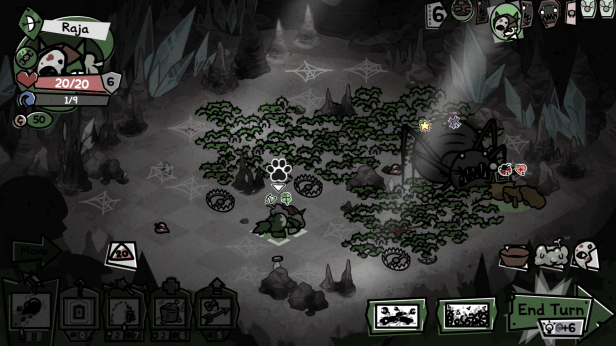
What makes this so darn compelling is that I’m not likely to replicate either of these strategies again. There are so many different abilities, and so few times when you’re able to draft new ones. This makes replicating strategies that you’ve leveraged in previous runs a nearly impossible task. Instead, Mewgenics asks the player to take all of the chaos – new abilities, passives, items – and meld it into something great.
Heck, that’s exactly what I was on about in that second quote where I was praising Balatro for the very same thing.
Though, I should clarify that none of this is meant to be a dunk on a particular game. Instead, it’s an acknowledgement that I have my own biases when it comes to evaluating, and expressing my opinions on games. I think that’s a fairly normal phenomenon, and I would always encourage folks to get a second opinion since my perspective isn’t infallible.
And who knows exactly what the future will hold. My opinions on Roguelikes have shifted fairly radically over the past decade, but there’s no guarantee they won’t continue to shift as I’m exposed to yet more games. Frankly, I wouldn’t have it any other way.
Also, I feel obligated to mention that my opinions on The King is Watching have meaningfully improved after I spent some more time playing it following the most recent update to the game. However, I’d prefer to cover the particulars in a dedicated article, instead of it being a non sequitur here.
Anyway, if you made it to the end, thank you for reading. This isn’t exactly what I planned to write when I sat down, but here we are.
If you feel like sharing, let me know if you’ve had a similar experience to my own. Either having your preferences radically change over time, or altering your expectations such that a game wasn’t able to impress you as much as it might have had you played it earlier in life. I’m curious to hear from other folks about this. I’m fairly certain I’m not alone, but it’s always good to hear from others.
Did you enjoy what you read? Consider supporting my work by buying me a coffee over on Ko-fi.
 Frostilyte Writes