In the past, I haven’t found myself in a position where I’ve felt compelled to call into question the intent behind a piece of fiction. Typically, this happens for one of 2 reasons. Either the text is explicit enough about its underlying themes that there’s no room to question them, or I don’t care enough about the text to actually interrogate it.
That second reason is especially common for me when it comes to video games because I don’t always need to interrogate what I’ve played to derive meaning from it. Sometimes, it’s enough if the game’s mechanics are satisfying to interact with. For example, I’ve played Dark Souls cover-to-cover 5 times now, and I still couldn’t tell you what that game is actually about. Say what you will, but I just enjoy spending time in Dark Souls for its own sake.
Having said that, I don’t always move through games with horse blinders on. In fact, I’m a lot more inclined to think about games beyond their mechanics now that I’m reading more. I don’t know if the 2 things are correlated, but it has left me in a state where I’m a lot more curious about what games that I’m playing are trying to say, if anything.
Enter Cairn.
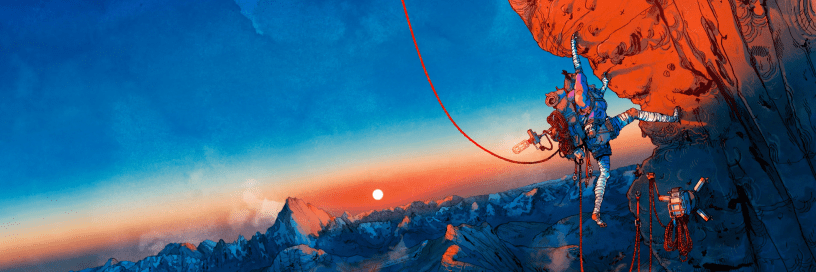
It’s a game about rock climbing where the player is able to place each of protagonist Aava’s limbs independently upon the surface that she is climbing. This is a stark contrast to how the overwhelming majority of games handle climbing. In Cairn there are no scripted climbing sequences. Instead, the game derives both its mechanical depth, and challenge from asking players to figure out exactly how they’re going to scale each of the game’s cliff faces.
Having said that, Cairn isn’t just a game about the mechanical complexity of climbing. It’s also about what it takes to climb an insurmountable mountain. I don’t mean that in a physical sense. Rather, Cairn is about the cost of mindlessly pursuing a goal, and how that singular focus can affect us, and those who surround us.
Or, that’s what I thought. I’m not as certain anymore, which is why I’ve rewritten this stupid article multiple times over the past few weeks. As such, I’d like to walk you (yes, you) through a few narrative beats that helped to inform my perspective on Cairn’s overarching narrative. Then we’ll touch on why I’ve been calling that into question, and why this game has been living rent-free in my brain for the past 6 weeks.
Sounds good? Ok.
For my first example, I’d like to start with my favourite: Roberto. He’s a fellow climber who chronicled his solo ascent of the mountain ahead of Aava’s own journey. Roberto was searching the tumultuous cliffs for the Edelweiss flower – a flower that is said to have supernatural medicinal properties. We learn that Roberto hoped to use the rare flower to cure his wife, Gabriel, who is dying of an unspecified terminal illness. Hence why he braved the ascent alone.
Throughout the journey, Roberto left a handful of notes, which you can discover during your own ascent, where he fondly reminisces about the time that he, and Gabriel shared together. He even goes as far as saying that she would’ve loved to be up on Kami, the mountain where the whole game takes place, alongside him. The view is breathtaking, and Roberto seems genuinely disheartened that he wasn’t able to share this final journey with her.
However, as the player continues up Kami, they’ll find notes from later in Roberto’s journey where his hope has given way to grief. After weeks of searching for, and failing to find the Edelweiss, Roberto concludes that Gabriel has likely passed away. The grief he feels is palpable, as is the regret that he wasn’t there to stand alongside her in those final days. If only he hadn’t been so focused on finding a cure, Roberto could have cherished those final fleeting moments instead of abandoning Gabriel during her final hours when she needed him most.
And it isn’t just Roberto who makes this mistake. There are several other stories scattered throughout Kami of people who’ve responded to the call of the mountain only for it to adversely affect those around them. There’s another example you’ll find early on in your ascent of a man who walked out on his family, and died while climbing Kami. His son, who was a boy at the time, continues to call him every year hoping that he’s still out there. During the call that Aava overhears, we learn that the boy, who is now an adult, has a family of his own, and wishes he understood why his father chose the mountain over family.
Or there’s Aava’s own journey up the mountain, which we’re given 0 explanation for. In the opening hours of Cairn, Aava hints at their being a grand reason for her journey up Kami, but she never lets the player in on the secret. As such, you’re strung along hoping that with each ridge climbed, eventually you’ll figure out what about climbing Kami is so important to Aava.
However, continuing to climb Kami is only met with more silence, and resistance from Aava. During 1-sided calls with her partner Naomi, it is revealed that not even she knows why Aava decided to climb Kami. In fact, Naomi seems pretty broken up about it, and is worried for Aava’s well-being. Despite this, Aava scoffs disapprovingly, and states something along the lines of, “she just doesn’t get it.”
Aava’s indignation only continues to grow worse when she runs into another climber named Marco who is also doing a solo climb of Kami. However, there is a key difference between Marco, and Aava: Marco can actually articulate why he is climbing the mountain. He finds joy in the escape of climbing. It gives him time to process his thoughts. He has no intention of reaching the summit of Kami. Instead, he wants to enjoy his time on the wall, and return to his life with a clear head once he’s had his fill.
However, when Marco asks Aava about why she climbs, she’s only able to give him what sounds like a scripted answer. It’s the kind of thing she’d say in an interview – something that sounds good, but where she’s ultimately said nothing at all. A big bowl of word salad. Marco immediately calls her out on this, and she merely dismisses his criticism before walking away.
This all comes to a head toward the summit of the mountain when the pair meet Marco’s grandfather, Damas, who has been living on the mountain for over a decade. The final stretch up to the summit is so dangerous that Damas hasn’t figured out how best to tackle it. Instead, he’s set up a camp where he could study the mountain, and offer refuge to other climbers who’ve made the ascent up Kami.
Unfortunately, Damas shares a grim truth with the pair: no one has made it farther than his camp. Every climber who has attempted to continue to the peak of Kami perishes shortly thereafter. Damas even has a shrine dedicated to all of the fallen climbers, which Aava (and by extension the player) are forced to walk through before they’re finally asked if they’d like to continue their ascent.
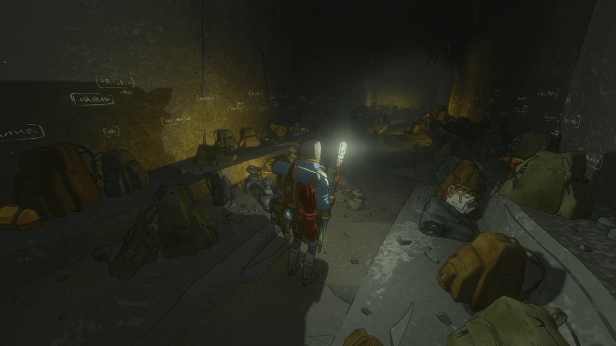
It’s at this point that Aava finally breaks. During an attempted call to Naomi, Aava has a complete emotional breakdown, and admits that she doesn’t know why she’s been climbing Kami.
I’ll be the first to admit that I also broke a little during Aava’s admission during this cutscene. I’d already kind of realized it, but finally hearing it out loud – that Aava didn’t have a reason for climbing this God forsaken mountain – was the straw that broke the camel’s back. Cairn is a very challenging game, and hearing that all of this bullshit was for nothing stung. There was no greater revelation. Aava was just trying to run away from her problems.
It was at this moment, after suffering through hours of gruelling gameplay, that I decided I had enough. If Aava didn’t have a good reason for climbing the mountain, then neither did I. Continuing to play had made me complicit in enabling her terrible behaviour, and I wasn’t going to continue letting this farce carry on. When Marco asked if I’d join him on his journey down Kami, I accepted.
What followed was a series of vignettes that outlined the journey the pair took down Kami, as well as a final cutscene where it’s noted how the 2 stayed in touch afterwards. This all seemed to reaffirm my choice – that I had made the right decision in abandoning Kami. Aava was able to return home, repair her relationship with Naomi, and she’d even managed to make a (potential) lifelong friend from the whole affair.
That’s where my journey with Cairn would’ve ended, but I decided a few weeks later to play through the game a second time. I wanted to re-familiarize myself with some of the different stories that players encounter during their climb, specifically for this article, but I also wanted to explore some of the areas that I’d missed during my original ascent.
As it would turn out, with an entire mountain’s worth of experience under my belt already, I found my second playthrough a lot easier than the first. So much so that when I was asked if I’d like to do the final climb up Kami, I decided to take it. I was still convinced that everything about Cairn was a direct condemnation of choosing to climb the summit, but I wanted to experience the other ending just to be sure.
What followed was a cutscene where Damas heavily criticizes Aava for continuing to climb up the mountain. This even went as far as having her shoot down one of the corpses that was hanging over the gorge that loomed below the wall she was about to attempt climbing. All to really drive home that you’re not meant to ascend to the peak.
The game doesn’t even stop with that cutscene either. Aava repeatedly calls into question her decision to climb to the summit of Kami throughout the final leg of the journey. For context, these voice lines do not play at any other point in the game. It’s only while attempting the final leg of the journey that Aava finally calls into question her actions, and seems to feel regret for taking them.
Furthermore, after all of the build-up, you’d think that the final stretch of Cairn would be absolutely gruelling. In actuality, it contains some of the easiest walls to climb throughout the entire game. It’s almost condescending in nature with the final few walls being as easy as the first few that are completed during Cairn’s tutorial. It’s one final desperate plea, via the game’s mechanics, for the player to understand what Cairn is actually about: the “mountain” isn’t worth it.
Then you reach the summit. Aava screams out in frustration, and the credits roll.
And that’s when it happened. The credits concluded, and I read something that called into question everything that I’d taken away from 2 separate playthroughs of Cairn:
Thank You For Making It to the Top.
And You – What is Your Summit?
Huh?!
You’re kidding.
Wasn’t this whole game a big fat condemnation of climbing the mountain? Isn’t that why all the side stories are of people who regret choosing the mountain over their loved ones? Or otherwise died in pursuit of a dream they never got to see come to fruition? Isn’t that why the player is chastised by Damas for choosing to go to the summit? Isn’t that why Aava feels regret for the first time only while she’s doing the final ascent?
What do you mean, “what is your summit”? My brother in Christ, the answer should be nothing. Nothing in your life should be so all consuming that it affects you in a way that is both harmful to you, and everyone around you. And if it is, then you need to seek help.
Though, perhaps I am reading too much into those 14 words. Maybe it’s just meant as a bit of fanfare, and a mountain pun to thank the player for their time, and support. Maybe those words are purely vestigial instead of an assertion from the developers that climbing to the top of Kami was indeed the intended experience.
Honestly, I don’t know, and I lack the confidence to stand by my own interpretation of Cairn. I still believe my experience and reading of the events carry weight, but those final handful of words have really put me into a brainrot death spiral over the past few weeks. What if I interpreted everything wrong? What if I walked away from Cairn with the completely wrong message? What if it was meant to be a celebration of human spirit, and how we can overcome insurmountable odds?
Though, were that the case, then I suppose it failed. At least once. With me.
Plus, art is subjective, as is experiencing it, so perhaps it’s not a bad thing that I had an entirely different experience. Hell, the experience I had was incredibly meaningful to me. It was a keen reminder that I too need to remember to ask for help from my loved ones, and think about how my actions will affect them instead of assuming that I operate in isolation. No man is an island after all.
Did you enjoy what you read? Consider supporting my work by buying me a coffee over on Ko-fi.


I apologize in advance for my rambling, but I think this game is so interesting (I won’t play it because I know the gameplay just isn’t for me) and the story is so compelling?? Loved reading your interpretation. I think the game asking you “What is your summit?” might be a more introspective ask – like, what goal or pursuit have you had in your life that you look back on and realize you made it at a great cost? Aava can make it to the top, but where does that really get her? With the stories of everyone on the mountain, I’d probably end up walking away with a similar interpretation as you did. I think it’s also worth thinking about the title of the game (Cairn) and what that means? Those rock piles. There’s different definitions, but they all kinda speak to a message of human intent. Maybe the mountain itself is the cairn? I have to keep thinking it through lol.
LikeLiked by 1 person
No need to apologize. This is exactly the kind of post that invites rambling, so I’m here for it.
Hmm…you might be onto something with that line of thinking. Maybe it could even go a step further and ask the player if they had a similar reaction to Aava once they achieved their summit (angry screaming into the void because they felt nothing but pent up rage).
Also, imma be the devil on your shoulder and say you should give Cairn a go. It was definitely a mountain worth climbing, which I can say with some degree of confidence now that I’ve gone through the game twice lol
Also, low-key very validating that you enjoyed reading the post. My lack of proper post secondary always makes me think I’m totally out of my depth when tackling something like this. I’m a little more assured that I hit what I was aiming for now though.
LikeLiked by 1 person
I always feel bad when I send a novel of a reply lmao.
Yeah, I think there’s a lot to be said about the journey vs. the destination, or sometimes you get so focused on a path you think will lead you somewhere that you lose track of things along the way. I think there’s also hints of some kind of older civilization that lived on the mountain..? I think their story would also lend some insight into the message the game is trying to get across.
I think when I initially saw the gameplay, it gave me some flashbacks to QWOP and having to control that dudes legs separately and wanting to die.
Nah, you did a great job, and sometimes analysis is more of pattern recognition across different fiction anyway – the more you read/watch/play things, the more you’ll be able to pick up on. I guess it’s sort of a branch of the media literacy tree.. ish.
LikeLiked by 1 person
Well…I can’t help that, but I can reiterate that this is absolutely the kind of post that invites that kind of rambling (and I’m more than welcome to it).
Yeah that’s a whole other thing that I didn’t even mention in the article. Hell – there was an entire section I cut about one of the NPCs you encounter who is defiling a graveyard within the mountain digging up crystals because he wants to be rich. Dude is so blinded by how rich he is going to be that I don’t even think he’s considered how he’ll transport all his precious crystals down the mountain. Though, I’m not entirely sure he’d ever stop digging because of how obsessed he has become.
In the end, I figured that fewer examples were needed to illustrate my point, and it kept things from getting away from me. I can only keep so many balls in the air after all haha.
But yes – the Troglodytes used to live on the mountain and you can uncover at least 2 different multi-part stories with readings that support how we can often lose sight of what’s important during our pursuit of a goal.
RE: QWOP – it ain’t quite that painful, but it does feel quite awkward in the beginning. There was like…a complete night and day difference between my 2 playthroughs just down to how much I learned while playing the first. I do think that Cairn doesn’t want to be as intentionally frustrating as QWOP is, but it certainly has its moments. Mir can testify to the few times where I was losing my marbles while playing, and I got 2 different angry messages from my Brother-in-Law after he started playing on my recommendation lmao
RE: the last bit – It probably sounds silly, but I never would’ve thought that reading more would have any kind of tangible benefit outside of the enjoyment that comes from reading. That’s a nice little bonus…at least I think it is.
I suppose that’s why so many critics and artists are always saying that it’s so important to get out there and experience a broad range of…experiences. You never know exactly when, or what will help to expand your line of thinking.
…It’s a shame I hadn’t figured this out 20 years ago, but at least I figured it out at 33.
LikeLiked by 1 person
Resuming rambling in that case.
Totally understand that, I know sometimes I need to be choosy about what references to include, or things to talk about, unless I want to turn my post into a 27 part series. The crystal guy is wild though? Guess he ended up digging his own grave? There’s probably some kind of colonialism-type commentary going on as well, but I’d have to.. dig more into it. It’s just really impressive to me how dense of a story it is, given that it’s a relatively short game.
Bahaha, that’s basically what I was afraid of, that I’d feel more like throwing myself off the mountain out of frustration. Also RIP, I hope your brother-in-law ended up enjoying as much as you did!
Honestly feel like a lot of people don’t realize this, and it’s kinda why the humanities in general are so underappreciated? The way reading can improve your critical thinking skills alone could benefit a lot more people nowadays, imo. Also has the added benefit of greatly improving your writing skills, even if you’re not actively writing. Not to sound like a snob, but I think a lot of people never figure it out at all, so I think you’re doing great at 33 lmao.
I say all this to say – Dark Souls story-focused playthrough when?
LikeLiked by 1 person
God…I wish I’d thought of that…Digging his own grave. *Chef’s kiss*
And, hard maybe on the colonialism stuff. That’s not an area I have much of any exposure to, so I’d have a really hard time saying one way or another. Evidently, I’ve need of more books that’ll help me to branch out into thinking about, and identifying that.
No shot, there were a few times where I’d hit the next save point, and then run for the nearest cliff at full speed before jumping. It feels a little morbid to say, but there was definitely some stress relief from just…throwing one’s self off the mountain. It’s even funnier because the game keeps track of your entire journey so you can see every single spot where you got frustrated and offed yourself after the fact.
I think so…he’s still making his way up Kami. Fingers crossed.
For sure. That and it is hard to translate education within the humanities into a job that you can support yourself with, which is primarily how people view school. You go to school, put in the work, get a job, and then work the rest of your life in a factory so some chud who has been fed from a silver spoon their whole life can drink the sweat from your brow. Gotta love some good ol’ capitalism.
Maybe next year? I just recently rolled credits on another DS playthrough when I needed a screenshot for my post about vertical villages. Got all the way down to Blighttown (going through the back) and had so much fun that I decided to finish the playthrough. Though I did walk out of Blighttown, and took the front entrance through the sewers for the authentic experience. Fucking love that place even though 99% of people want it to die in a coal fire.
LikeLiked by 1 person
Reading your post about Cairn, I get a similar feeling from videos I’ve seen about people who have died on Everest, or while cave diving – people in the prime of life, or with a wife or husband and kids and good lives, getting lost and dying in insanely high altitudes or the darkest parts of the Earth for the sake of exploration when a lot of people would kill to have everything they’d left behind. I get the impulse to explore and excel and all that, but you have to have your priorities straight in life. Depending on how you play it, sounds like Aava is the type who has them crooked despite anything else you can say about her fitness and drive.
That’s a great message for a game like this to deliver, so that ending line probably would also throw me off. I don’t know if that ending could be read as a little ironic somehow, whether that was the intent, asking you if what you’re aiming for is truly worth it. Otherwise that’s a weird disconnect.
LikeLiked by 1 person
That’s kind of the conclusion that a few folks I’ve talked to about Cairn came to as well – that it’s more ironic in nature. It’s more asking the player to reflect on their life, and consider if they’ve done something similar to Aava. I think I like that as a reading better than a more literal one because…so much of this game feels antithetical to the idea of pushing through all the suffering in the name of achieving your goal(s).
It all kind of reminds me of a poem I ended up reading, but not using as part of this post. The poem in question No Man is an Island by John Donne. It’s a quick read, but stands as a reminder that what we do and how we do it can have a profound impact on others. Doubly so for those closest to us. As such, the poem feels like a reminder that we need to occasionally look outside our own box, and consider the impact of our actions on those around us.
Perhaps, Aava wouldn’t have bothered climbing Kami if she’d read the poem before beginning her ascent.
LikeLiked by 1 person