And so we begin year 10.
I feel like I’m meant to say something…I don’t know…profound(?) here, but I don’t really know what to say. It’s just wild to think that I’ve been doing this for 9 years, and it’ll be a decade provided I can persist for another 363 days.
Though, I’ll be the first to admit that how my blog looks now is very different from those first few years. Namely, the quality of the writing has improved dramatically since then, as has the frequency at which I write. I still wish I could write and edit a little bit faster, but I think that might just be the conditioning of 20+ years under Capitalism speaking. “If you’re not totally exhausted mentally, and physically then you could be giving more,” kind of energy, ya know?
Anyway, thank you for any support that you’ve offered – views, sharing articles, (positive/negative) comments – over the past 9 years, and here’s to year 10! Hopefully it’s a good one. I suppose we’ll see when August 30th, 2027 rolls around.
Navigation
Slay the Spire 2
God. I feel like August was just a month of me being a complete crackhead. Case in point, I had less than 40 hours played in Slay the Spire 2 on August 1st, and I now have almost 130 hours.
Though, I must address the elephant in the room: wasn’t I kind of lukewarm on the sequel when I played it earlier this year?
Yes.
And in all honesty, I still think Act 1 sucks. Every single run, irrespective of which character you choose to play as, starts nearly identically. That means the first several fights of every run are very repetitive to the point of being kind of monotonous to actually complete.
That said, I have shifted my drafting style a little bit, so I’m not stuck in repetition limbo for as long while playing. Part of that shift came as a response to the higher Ascension levels wherein players need to draft cards that solve problems. For example, if you’re in the Overgrowth, 1 of the 2 available biomes for Act 1, then you need to draft powerful attacking cards immediately. It doesn’t matter how badly those cards function in the late game – you do not survive Overgrowth unless you can reliably unload 30 damage in a single turn. As such, you draft cards that help you to hit harder, so you can reliably survive into Act 2 where your deck actually starts to take shape.
As a direct result of this pivot in how I play, my decks tend to take a unique shape (in some capacity) by about the mid-point of Act 1. I won’t say that they’re remarkably different from run-to-run, but I do at least feel like I’m playing something non-standard by that point. In a sense, the chest in Act 1 is the “true” starting point of the run.
That shift in mindset also scored me my first A10 clear. It was cool, but A10 is not a comfortable difficulty for me to play the game at. I think I much prefer A7, which falls before everything receives a health, and damage buff.
Though, I suppose I haven’t actually addressed what kept me playing for almost 100 hours: card reworks. So many of the cards have had their effects tweaked, or outright reworked in the face of player feedback from Early Access. This is even more true if you’re playing on the public beta branch, which I eventually swapped over to myself. This meant that there were a ton of things to see, try, and experiment with, which was a lot of fun.
Also, I gotta give it up for the Regent who was the class that I had the most fun playing during this latest stint of StS2. I had a fairly poor first impression of him, but I’ve come to really enjoy the controlled chaos that is emblematic of some of his cards. There’s a lot of goofy ways to play him effectively, so you’re not constantly stuck relying on Forge which I found to be the least interesting way to play the Regent.
Of particular note, was a run where I set up Genesis+, and then would spend several turns building up a mountain of 20+ Stars using cards like Hidden Cache before I’d unload everything into a high health target using Stardust. It was very silly to watch Stardust hit something for 15 to 17 damage anywhere from 10 to 20 consecutive times. Pretty well every boss fight ended the moment I drew Stardust after I finished setting up.
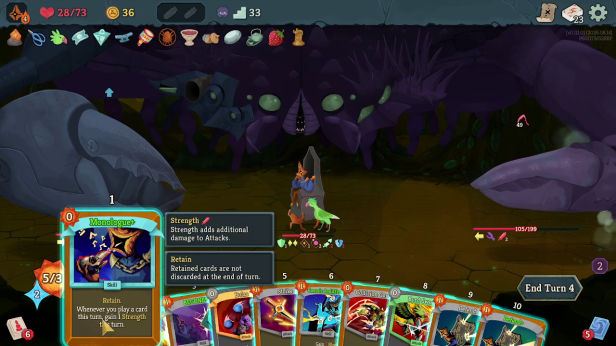
The other really funny run I had involved leveraging 2 copies of Monologue. This card gives the Regent 1 additional Strength every time you play a card that turn. So I’d end up stacking 2 of them, and would gain 2 Strength every time I played a card.
However, I also had an upgraded copy of Foregone Conclusion, so I could force 3 cards into my hand on the following turn. I kept using this to grab at least 1 copy of Monologue, alongside a 0 cost attack, and a card that’d allow me to draw additional cards. Then I’d play something like 9 cards consecutively, and absolutely obliterate everything. Again, very funny deck, and I had a lot of fun piloting it across the run.
All said, I now think the Regent is a very funny guy, and I look forward to playing more of him when I decide to dive back into the spire.
For now, I have at least a dozen other games that I’d like to play before December, so it is time to put Slay the Spire 2 back on ice.
Fields of Mistria
The other big ticket item for August was Fields of Mistria. Similar to Slay the Spire 2, I’ve been playing it like a complete crackhead. Though, I had to let my wife finish Mistria before I was allowed to start playing it in earnest, so I’ve only managed to make it to the end of the first year.
That said, that first year turned me into an absolute slug. I have not been this enthralled by a Farming game since Stardew Valley. I’m aware that’s a lofty comparison to make, but I genuinely feel like Fields of Mistria is that good. Every single time I sit down to play, I end up burning several hours playing it. It’s simply impossible to play 2, or 3 days without thinking to yourself, “well…I could do 1 more.” Then you look up at the clock, and realize you should’ve been in bed an hour ago.
So, what’s the big deal? What makes Mistria click, for me, in a way that other Farming games can’t manage?
For starters, I really like how the auxiliary systems are integrated into the primary gameplay loop. What I mean is that cooking, crafting, and smithing are integrated in a way that naturally encourages the player to engage with them. Each of these professions has a skill tree, and the skills therein are broadly useful. For example, there are skills within the crafting skill tree that double the amount of wood that you find while chopping down trees. This is very helpful, especially for several of Mistria’s later quests, which is all I needed as an incentive to stop ignoring crafting like I normally would in these games.
Heck, I think a better example of all of this at play is with cooking. I NEVER cook in these games. Yet, cooking was the first profession that I hit max level with in Mistria. There were so many skills that naturally increased my yield on a crop of veggies, and cooking made befriending the townsfolk a lot easier. As such, I spent a significant amount of time in the kitchen, instead of ignoring it like I normally would.
Speaking of befriending the townsfolk, that’s the other area where Mistria meaningfully separates itself from its contemporaries: the dialogue. There is so much writing in this game. I don’t know that anyone really expects a game like this to have a lot of writing because we’ve all grown used to how Harvest Moon did it back in the day. You talk to someone, and they repeat their 1 or 2 lines of dialogue. Maybe it changes to something different in the following season, or after you befriend them. Otherwise, you’re stuck talking to a cardboard cut-out who repeats the same handful of lines.
By contrast, Mistria is absolutely overflowing with dialogue. The characters will reference things that I’ve done, talk about themselves, talk about characters they’re close to, reference in-game events, mention where they’re going while they’re walking to their destination, and they have context-sensitive dialogue for scenarios like when they’re visiting the beach. I am aghast. How?! How are your NPCs still saying completely new lines of dialogue in year 2?
Honestly, the verbosity of the characters in Mistria has got my wheels spinning on a standalone post. I don’t know what that’ll look like, but I can say with certainty that the writing in Mistria is well worth adding it to your wishlist.
As such, Mistria is an easy recommendation. It has all of the trappings of your favourite Farming game, but meaningfully improves on every facet of what makes these games so compelling to play. If you hadn’t already heard of it, give it a look. Honestly, Fields of Mistria deserves to blow up in the same way that Stardew did back in 2016.
Review Round-Up
ShantyTown
Just the one game for August: ShantyTown.
I felt compelled to highlight ShantyTown after I finished it because it’s kind of perfect for what it is. You make dioramas of cramped urban spaces, and every facet of the game feeds into that. There’s even some light puzzle elements that help to give the experience a little more structure than your typical creative Sandbox game.
All said, it’s an easy recommendation, and you can read my full review for the particulars of why.
Indie Spotlight
Valheim
I went back and forth on whether, or not I wanted to mention Valheim here. It’s most assuredly indie in the sense that a very small team has worked on it, but it also made more money than God when it originally launched in 2021. On that basis, it doesn’t really need a shout-out because everyone, and their dog has already heard of it.
That said, Mir is really excited about the 1.0 release, and I’m eager to jump back into Valheim alongside her. It looks like it should be really fun to play through a fresh co-op savefile as we revisit the newly implemented early-game features, and eventually work our way through the Ashlands and Deep North. We’re…2 of the only people who actually liked Mistlands, so I’m fairly confident that we’ll have a good time playing through the remainder of the game.
Though, I think we might disable corpse running this time. I think there was an update for that at some point.
Either way, September 9th for Valheim on all platforms.
Isle of Reveries
Our next game to keep an eye on in September is the very first game that I covered in Demo Dive: Isle of Reveries.
You can read the Dive here, but the gist is that Reveries is aiming to deliver an experience akin to older Zelda titles. You explore dungeons, find key items, and solve a boatload of puzzles. All with some beautiful pixel art to back up the proceedings.
I was really impressed by the demo when I played it in 2024, and I’m keen to play the full release when it launches on September 4th. As with Valheim, Isle of Reverie will be available on all platforms, and it has a demo on Steam.
20 More, Somehow Even Smaller, Mazes
FLEB is back with 20 additional small mazes.
I feel like this is a case of “what you see is what you get,” and I’m uncertain that I need to elaborate further. Though, I will say that I’m keen to play through 20 Smaller Mazes given I rather enjoyed the original 20 Small Mazes.
September 17th for 20 More, Somehow Even Smaller, Mazes, and it’ll only be available on PC.
With that, I think we’re good for the recap of August, and the look at upcoming titles in September. Here’s hoping I can get through a few more things this month, though I’m a little dubious knowing how much of a time commitment playing Valheim with my wife will be.
Regardless, thank you for reading, and I’ll see you in the next one.
Did you enjoy what you read? Consider supporting my work by buying me a coffee over on Ko-fi.

