
For the next bit of advanced Next Fest coverage, I’d like to cover a game that I was notified about back in September: Alethra. It is the first commercial release by Youtuber Nebulix (ala NebulixDev) who has released a handful of Devlogs covering the process of what it’s been like to make the game.
The basic premise is thus: what if Balatro, but Yahtzee?
Okay, so that’s a gross oversimplification, but it’ll give you the gist of what Alethra is going for. You play Yahtzee, and have to pass a certain threshold of points, with rarer hands being worth more points, each round in order to proceed to the next round. In between rounds, you visit a shop where you can buy passive abilities, purchase new types of dice, or upgrade dice from your collection with new face values. So far, so Balatro.
Were this all that Alethra had to offer, I wouldn’t have felt compelled to cover it further. Which brings me to the question that I’ve been burning to answer since I started writing this article: what makes Alethra different? What is the X factor that helps it to stand apart from the avalanche of other games that have applied Balatro’s gameplay loop to every manner of different board game over the past 3 years?
The answer is simple: Alethra is also an Extraction game.
Now, for those of you who aren’t familiar, Extraction Shooters have become a bit of a white whale in gaming lately. The craze started with the likes of Escape from Tarkov, and The Division’s Dark Zone, but has gone on to become a (relatively) popular new genre. The basic idea of these games is that the player has the ability to leave the game at any time. In doing so, they’ll extract (hence the name) all of the equipment that they’ve looted, and then they can use their ill-gotten gains in future gameplay scenarios.
Think of it kind of like a raid from an MMO. You play the game, collect some loot, and try to escape with whatever you’ve collected.
The biggest difference separating Extraction games from other such titles is that they also feature permadeath. As such, there’s a constant pressure that hangs over the player when they’re making decisions about how to proceed forward. Does it make sense to keep pushing for more loot, or should you bail early, and secure what you’ve already come across? It makes for a fairly compelling question, and leads to some very high stakes (and ultra sweaty) gameplay. Hence, why Extraction games have exploded in popularity among a very hardcore contingent of gamers.
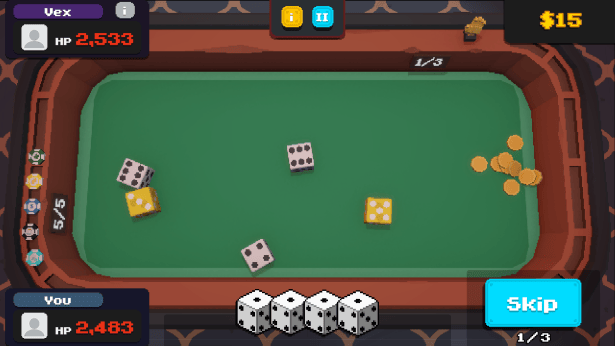
So, how exactly does extraction work in a single-player Roguelike where you’re playing Yahtzee?
Simply put, after each round, while you’re visiting the shop, the game asks you a question: do you want to continue? If yes then you’ll proceed to the next round where you will face off against an even tougher opponent. Alternatively, you could leave, add your customized dice to your collection, and then make use of them in a future run.
That might sound like it’s always a good idea to bail early, but rarer types of dice only become available in later rounds of Alethra. So the question is really about gauging how much risk you’re willing to tolerate while in pursuit of an ever increasing pay-out with the consequences for failure being that you lose everything.
That is so fucking cool.
I couldn’t even tell you how many Roguelikes I’ve played where I view death as a completely meaningless setback. Hades, Slay the Spire, Into the Breach, Monster Train, Wildfrost, Gungeon, Necrodancer, One Step From Eden, Rabbit & Steel, Star Renegades, Shardpunk, Ship of Fools, and Ziggurat. What do all of these games have in common? They’re all Roguelikes where it doesn’t matter if you die. Sure, you lose your run, but you can just try again. As such, there’s no incentive to not swing for the fences every single time.
The same can’t be said in Alethra thanks to this 1 simple change of allowing players to carry forward their customized dice into future runs. I actually had to think about whether it made sense to continue forward after I completed each round because my carefully curated collection of dice was always on the line if I screwed up. To that end, winning in Alethra’s higher rounds felt quite thrilling in a way that seldom other Roguelikes manage.
It really can not be overstated how different Alethra feels to play thanks to the addition of extraction mechanics. It seems like such a minor addition at a surface level, but it completely changes the way that players need to think about, and engage with the game. The result is an incredibly refreshing Roguelike that manages to stand apart from the sea of mechanically similar games that exist in our post-Balatro world.
As you might’ve surmised, you can play the demo for yourself here, or by looking it up on Steam. It comes highly recommended, especially if you, like myself, have found yourself in a bit of a rut with other Roguelikes lately. Who would’ve thought that all I needed was a little extra tension to help reinvigorate the gambling addicted goblin in my brain.
Also, don’t forget to wishlist Alethra if you enjoyed the demo.
Did you enjoy what you read? Consider supporting my work by buying me a coffee over on Ko-fi.

