
Question: do you enjoy creative limitations? I ask because I’m increasingly finding that I enjoy games more when they impose some kind of limitation. More specifically, I enjoy the challenge of trying to solve problems with an unconventional solution. Is there a square-shaped hole that’ll accept a circle? How far can I push things without having the game buckle?
This fascination with prodding at a game’s systems is likely a big contributor to my fascination with Roguelikes over the past decade, but that’s not where I wanted to focus today. Instead, I want to talk about Pokémon. More specifically, I want to talk about older Pokémon games, and bad learnsets.
If you’ve spent any amount of time engaging with Pokémon on the internet then you’ve likely come across someone complaining about how bad older Pokémon learnsets are. For those unaware, learnset refers to the whole list of available attacks that a Pokémon can learn. This includes what it’s offered while leveling up, as well as moves that can be taught via 1-time use items or through breeding. Generally speaking, there are fewer strong attacks in the older games, and fewer of the total available Pokémon can learn those aforementioned attacks. As such, many fans have taken to complaining about how much worse learnsets are in older games, especially when compared against modern games.
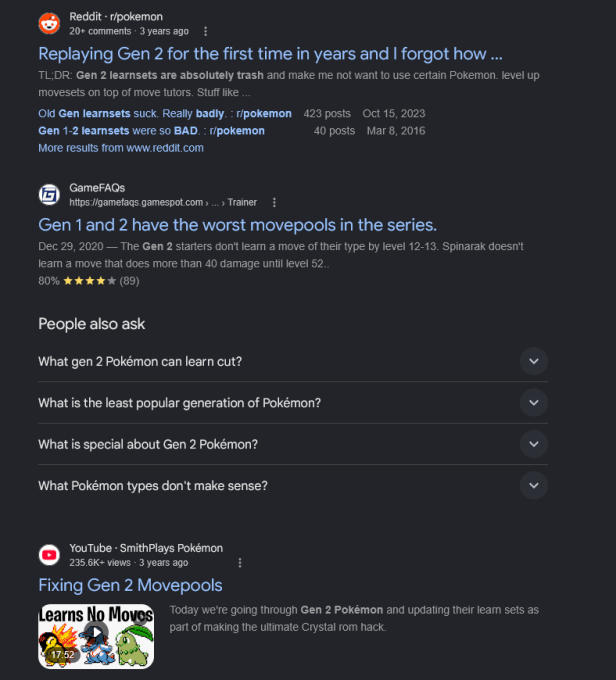
There was definitely a time when I would’ve agreed with this sentiment myself. It is much easier in modern games to assemble an eclectic squad of 6 critters that each carry 3 or 4 different elemental attacking types. This ensures that you’re always ready to answer any potential combination of types appearing on the enemy team, and gives you plenty of room to score Super Effective hits for increased damage.
However, I no longer find that kind of team building as fun. There are so many potential solutions to every problem that it never really feels like the player is being challenged to solve anything. Instead, they can simply assemble a squad with all of their favourites, and call it a day. In the overwhelming majority of cases, this will provide players with everything that they need to finish the game without any pushback.
By contrast, older games provide far fewer options thanks to how restricted many Pokémon learnsets are. This means that when a Pokémon learns a strong attack, it becomes a defining characteristic of said Pokémon. Likewise, if a Pokémon has a wide variety of elemental attacks at its disposal, that too becomes a defining characteristic. As such, there’s a bigger emphasis on choosing your party members specially for what they bring to the table.
Or you can just over-level your starter Pokémon, which is all we ever did back in the 90s, and early aughts.
Regardless, I’ve been replaying older Pokemon games with some of my free gaming time, and have found that they’re quite compelling thanks to those aforementioned learnset limitations. For example, in my most recent playthrough of Pokémon Silver, I decided to use Yanma on my team. Why Yanma? Because this was the first, and only time I’ve ever seen one. On that basis, I decided it made sense to try it since I wouldn’t get another opportunity anytime soon.
Though, if you’re familiar with Yanma then you likely already know how infamously terrible it was within its debut generation. It learns very few strong attacks, and gets almost no attacks that take advantage of its typing. Despite this, I had a lot of fun trying to figure out how to make Yanma work. It even managed to contribute (several times) throughout the Elite Four boss rush that capstones the game.
If you’re curious, this is what I came up with:
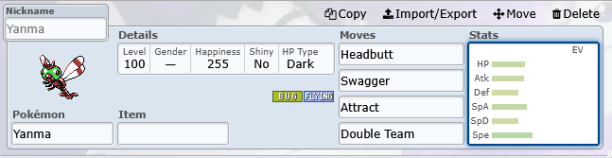
Yes – I’m aware that this is a frustratingly luck dependent strategy. There are an uncountable number of times that this completely backfired on me, specifically because the enemy Pokémon never bothered to attack themselves in Confusion. Regardless, it was still hilarious when it worked. Yanma was quite good at stalling for kills with just Attract, and Headbutt’s 30% flinch chance.
Regardless, using Yanma got me wondering if there were other “bad” Pokémon that I’d have just as much fun mucking around with. What kinds of moves, and strategies would I need to employ to enjoy the same sort of success that I did with Yanma?
Hence, I’ve decided to play through Pokémon Silver again, but with a twist: I’ll only be using so-called “bad” Pokémon. My hope is that this will force some more creative problem solving than what I’d normally employ while playing a Pokémon game. It’ll also give me something to write about because I want to record my thoughts along the way. I think that might be more fun than simply doing a big retrospective at the end, which is what I normally do after finishing a playthrough of Fire Emblem.
It’s also important to mention that I didn’t come up with this idea in a vacuum: I originally got the idea from a Youtuber named ji_mothy. He’s done a few different E-Tier challenge runs where he plays through (older) Pokémon games using decided underpowered teams. It was a combination of his videos, and the fun I had using Yanma that gave me this idea, so I’ve linked his videos here, and highly recommend checking them out. Mothy’s dry sense of humor, and matter-of-fact delivery make the series quite entertaining.
- Can the WORST team beat Pokémon Crystal?
- I tried to beat Pokémon Sapphire with the WORST team
- Can the WORST team beat Pokémon LeafGreen?
Pre-Challenge Research
Before we even begin this challenge, we need to answer 1 very important question: what is a “bad” Pokémon? There are a lot of factors that you could look at while answering this question, and answers may vary wildly depending on who you ask. As such, I decided to defer to the court of public opinion.
Taking a page right out of Mothy’s playbook, I turned to the Smogon forums: a site for the sweatiest Pokémon players on the internet. They’re all but responsible for codifying the fan formats of competitive Pokémon, and have long served as a message board for fans to discuss strategies for all facets of Pokémon.
Unfortunately, the first tier list that I happened upon didn’t appear to be finished. It was missing 46 of the ~110 eligible Pokémon. All of the very best, and a few notably terrible options had been highlighted, but that didn’t really provide me with the information that I needed. A lot of the grey area Pokémon weren’t accounted for, and those were the ones that I wanted an outside perspective on. Basically, I didn’t want to over, or underestimate a potential candidate that I might be able to use during the run.
Plus, the list of bad Pokémon was almost entirely populated with Baby Pokémon. I get the thought process here, but most of those Baby Pokémon are simply weaker versions of their fully evolved counterparts. I don’t think anyone would say that Jynx, Magmar, or Electabuzz are bad Pokémon, so using their unevolved forms would feel like a bit of a cop-out. By that same logic I could also make use of Totodile, or Abra provided I didn’t evolve them, which goes against the spirit of what I’m trying to do.
However, all was not lost, as I noticed that this thread was marked as the fifth iteration of the GSC in-game tier list. So I decided to go farther back to see if I could find the fourth iteration, and hoped that it would be more complete than the fifth. Thankfully, the fourth iteration was easy to locate, and it did have every single potential encounter evaluated.
Using the fourth GSC in-game tier list as a guide line, here’s what I came up with for potential encounters across the run:
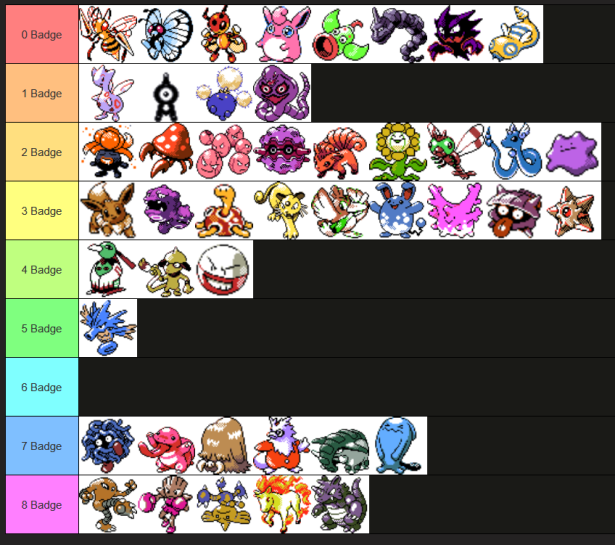
I know that I’m using the tier list format here, but I have them organized by when I can acquire each Pokémon. Basically, I wanted an at-a-glance visual guide so that I’d know what was available, and when I could add it to my team. If you’re curious about the specific breakdown, and logic behind each inclusion on the list then you can check the linked Smogon thread for details.
On that basis, I’ve also removed all of the Gold version exclusives that were listed because I can’t actually catch those in Silver version.
And if you’re wondering why I’m not playing Crystal, it’s because I have original hardware for Silver version. Ergo, we’re playing on Silver despite the obvious advantages that come with Crystal’s much wider distribution of specific Pokémon species.
Anyway, taking a quick look over the selection of available encounters, there are quite a few that immediately stand-out to me. Chief among them is Wigglytuff. I’m honestly not sure why it was rated so lowly, but I guess I’ll take it. It’s capable of learning all 3 elemental punches, which is a huge boon.
I’d also argue that Wigglytuff is a huge beneficiary of Badge Boost. This raises each of your Pokémon’s stats by a flat 12.5% with the exception of HP. As such, Pokémon with high HP stats get a lot more defensive value out of the increases than Pokémon who have a low HP stat.
As far as other early game stand-outs, I’m curious about Ledian, Arbok, and Fortress.
Ledian is an often maligned Pokémon, but it learns a handful of rare supportive moves like Reflect, and Lightscreen. These moves halve incoming damage for specific elemental attacking types, which can be very useful in a run where you’re intentionally using weaker Pokémon. Plus, Ledian also gets both Ice Punch and Thunder Punch, which gives the team some much needed coverage.
On the flip side, Arbok has decidedly OK stats, access to the paralysis inducing Glare, and makes use of some TMs that I otherwise wouldn’t have a home for. Namely, I think it might be able to leverage Dig, and Sludge Bomb to great effect throughout the mid-game. Plus, Poison is a great type to have defensively across Silver since there aren’t a ton of Ground, or Psychic attacking mons to worry about.
Finally, Fortress offers a ton of defensive value thanks to its Steel, and Bug typing. I’m not entirely sure what I’ll do with it offensively, but I play in Set mode, so having a Steel Pokémon to pivot with in battle is always helpful.
The only other Pokémon that immediately jumped out at me was Jumpluff, which I’m debating against using. It’s a Pokémon that I’ve run numerous times before in both Silver, and the Gen 4 remakes. As such, I already kind of know what I’m getting with it, which feels antithetical to the intent behind this challenge. I want to challenge myself to “solve” Pokémon I’ve never used before, so running Jumpluff with Headbutt, Leech Seed, and Stun/Sleep Power feels a little like cheating. I suppose we’ll see if I change my tune after I get into the weeds with the challenge, but I’m thinking I might exclude it for now.
Either way, that’s where I’m at as I prepare to start my Low-Tier challenge run of Silver. Next time, we’ll cover how the first (maybe second?) gym went, and how the opening few hours felt without any of the game’s obviously overpowered starter Pokémon. Yes – even Chikorita is overpowered when compared to low-level dregs of the opening handful of routes.
I hope you’ll join me throughout the journey as I think it’ll be an interesting one.
Did you enjoy what you read? Consider supporting my work by buying me a coffee over on Ko-fi.


I like this idea. Can’t wait to read how it goes!
LikeLiked by 1 person
great idea for a playthrough, I hope Yanma toughens it out!
I often use non-ideal pokemon in my playthroughs because I like using my favorites and they usually are not very good (looking at you, all poison types).
LikeLiked by 1 person